

Why wait twelve months for a concrete-and-steel treatment plant when your production capacity needs to double by next quarter? High upfront capital expenditures and rigid infrastructure often trap industrial operations in systems that are either oversized for current needs or obsolete within a few years. You likely recognize the inefficiency of waiting on site-built civil works while water quality requirements or flow demands shift beneath your feet. This guide demonstrates how modular (packaged) water treatment systems solve these bottlenecks by providing pre-engineered, skid-mounted, or containerized solutions that deploy in weeks. You'll learn how to select the right modules to reduce immediate costs and future-proof your facility against evolving regulatory standards.
We provide a technical roadmap for evaluating high-performance components, such as FilmTec reverse osmosis membranes and Goulds vertical multi-stage pumps, within a modular framework. We'll analyze the total cost of ownership and explain how to scale capacity using mobile ultrafiltration units or containerized RO plants. This article outlines the exact steps to transition from static infrastructure to a flexible, asset-based water strategy that prioritizes rapid deployment, technical integrity, and logistical competence.
Key Takeaways
- Transition from static civil works to agile assets by comparing the lead times and labor costs of traditional plants versus modular units.
- Evaluate high-performance hardware, including Goulds Water Technology Pumps and Hydranautics RO membranes, to ensure long-term system reliability.
- Determine the optimal configuration for your site by analyzing the differences between indoor skid-mounted units and ruggedized containerized plants.
- Use specific metrics like TDS levels and peak GPM demand to engineer modular (packaged) water treatment systems that meet your exact contaminant profile.
- Implement scalable treatment modules to future-proof your industrial operations against shifting water chemistry and capacity requirements.
The Shift to Modular: Why Packaged Water Treatment is the 2026 Standard
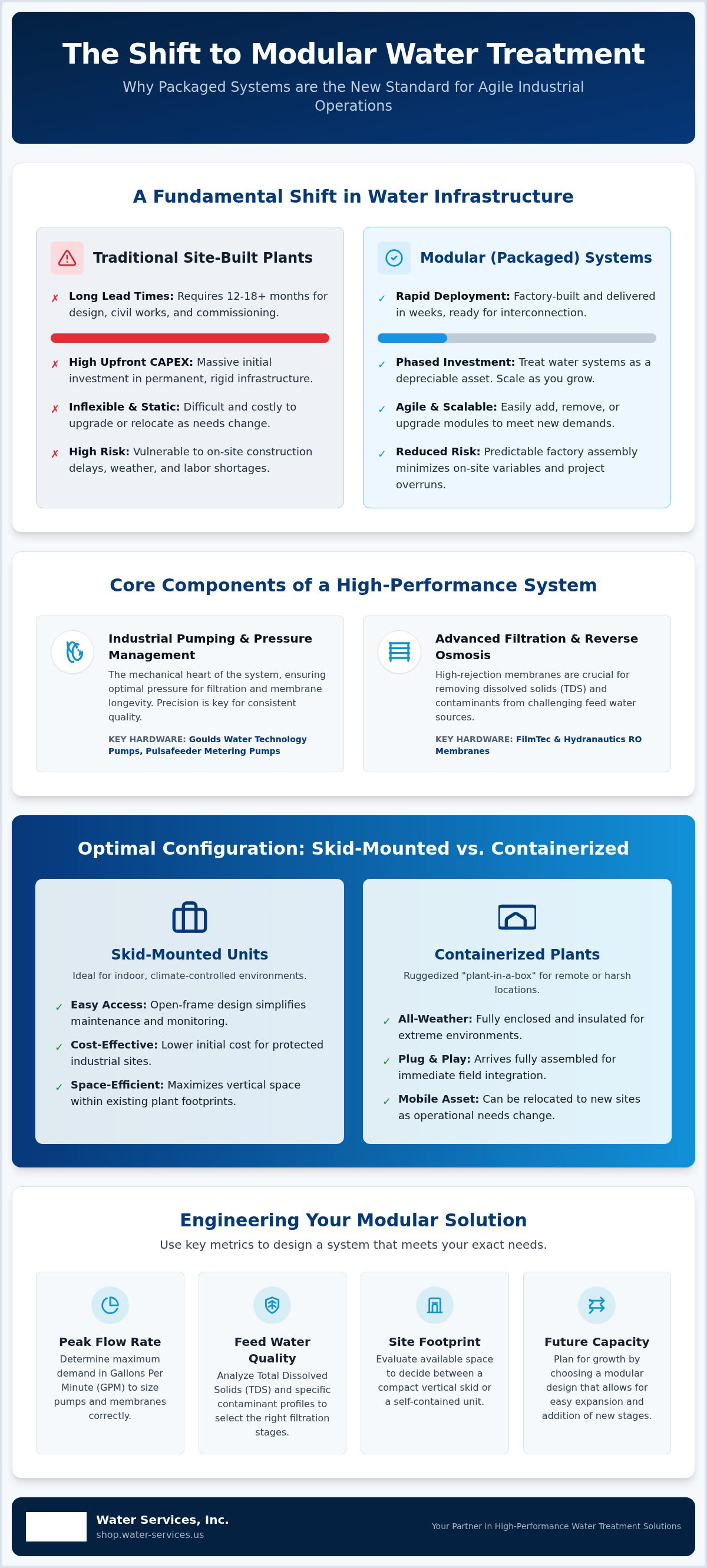
Industrial water management is undergoing a fundamental shift. Static, site-built infrastructure is no longer the default for high-growth operations. Instead, modular (packaged) water treatment systems have become the standard for 2026. These units are pre-engineered, factory-tested, and delivered as complete assemblies. They treat water equipment as a mobile, depreciable asset rather than a permanent civil engineering expense. By integrating established water treatment processes into a compact footprint, these systems offer a level of agility that traditional concrete-and-steel plants cannot match.
The primary differentiator lies in lead times and labor efficiency. Conventional infrastructure projects often exceed 18 months from design to commissioning. They require extensive on-site coordination between multiple contractors. In contrast, modular skids are fabricated in controlled environments and arrive ready for interconnection. This approach cuts delivery schedules significantly. It also minimizes the need for specialized on-site labor, which reduces the risk of installation errors and project overruns.
Reducing Infrastructure Risk and Upfront Costs
Pre-fabricated units significantly lower the risk profile of new projects. Since the assembly occurs in a factory, your site isn't vulnerable to weather-related construction delays or local labor shortages. This predictable delivery schedule is essential for meeting production deadlines. Financially, modularity allows for phased investment. You don't need to pay for a high-capacity plant on day one if your current demand is low. You can scale by adding modular water treatment components as your capacity requirements grow. This capital efficiency is vital for space-constrained industrial sites where every square foot of floor space must be maximized for production.
Scalability: Future-Proofing Your Water Assets
Rigid systems are difficult to upgrade when environmental regulations change or raw water quality shifts. Modularity solves this by allowing for the rapid addition of new filtration stages. You can integrate a UV disinfection module or an extra reverse osmosis rack into an existing skid without a total system overhaul. This flexibility is a key driver for the 2026 move toward containerized modules. In remote mining and oil operations, the ability to relocate or expand treatment capacity is a strategic advantage. These systems are built to endure harsh environments while maintaining technical integrity. They ensure your operation remains compliant and functional regardless of shifting site conditions or stricter discharge permits.
Core Components of a High-Performance Modular System
High-performance modular (packaged) water treatment systems rely on the technical integrity of individual hardware components. Unlike massive municipal projects, industrial modules for remote mining or oil sites require ruggedized parts that function reliably in isolation. Integrating premium brands ensures that the system maintains specified flow rates and rejection percentages under demanding conditions. Research into modular water treatment solutions highlights that component reliability directly impacts long-term operational uptime and sustainability. Every module must be a "plug-and-play" asset designed for immediate field integration.
Industrial Pumping and Pressure Management
The pump serves as the mechanical heart of any treatment skid. It provides the pressure necessary to drive water through filtration media and membranes. For high-pressure reverse osmosis applications, Goulds Water Technology Pumps are the industrial standard due to their durability and hydraulic efficiency. Selection depends on the specific duty point. Vertical multi-stage centrifugal pumps handle high-volume feed water. Pulsafeeder metering pumps provide the precision required for chemical dosing and antiscalant injection. Maintaining exact pressure is critical for membrane longevity and consistent permeate quality.
Advanced Filtration and Reverse Osmosis
Modular RO units must process varying feed water qualities, from brackish wells to high-TDS industrial process water. This requires high-rejection membranes. FilmTec membranes offer high flux and excellent chemical resistance. Hydranautics membranes provide specialized options for low-energy operations or high-fouling environments. Pre-treatment is equally vital. Multimedia filter tanks and Pentair filter housings protect the RO racks from sediment and colloidal solids. For a deeper dive into sizing these units, consult our Commercial Reverse Osmosis Water Filtration System Guide.
Safety and automation are non-negotiable in managed modular systems. Viqua UV water purification modules offer a chemical-free method to neutralize pathogens without altering water chemistry. These are often paired with Walchem controllers to automate the treatment train. These controllers monitor Signet flow sensors and Ashcroft pressure gauges in real-time. They adjust chemical dosing or trigger backwash cycles based on precise technical metrics. This level of automation reduces the need for constant on-site supervision. You can find these specialized water treatment components available for individual replacement or full system integration.
Format Comparison: Skid-Mounted vs. Containerized Modular Units
Selecting the correct hardware format is a critical engineering decision that impacts both deployment speed and long-term durability. Modular (packaged) water treatment systems are engineered in two primary configurations: open-frame skids and enclosed containers. While the internal technology may be identical, the physical housing dictates the facility requirements and environmental resilience. Choosing between them requires a clear understanding of your site's infrastructure and logistical constraints.
When to Choose Skid-Mounted Solutions
Skid-mounted units are the standard for indoor installations where a climate-controlled building already exists. These systems utilize an open-frame design, which provides unrestricted access for maintenance and component replacement. They're ideal for integrating with existing industrial water filtration systems during facility upgrades or capacity expansions. The primary advantage is lower equipment cost, as the manufacturer doesn't need to provide a structural enclosure. However, you must have a dedicated shelter. Dust, humidity, and temperature fluctuations in unprotected environments can degrade sensitive Walchem controllers and Signet sensors over time.
The Advantages of Containerized RO and Treatment
Containerized plants function as a complete, self-contained water treatment facility. These units arrive with internal lighting, HVAC systems, and all electrical and plumbing interconnections pre-installed. They offer maximum protection against extreme weather, making them the preferred solution for mining and military deployments in remote or harsh climates. Using containerized modular (packaged) water treatment systems allows you to treat water as a mobile asset. If project requirements change, the entire plant can be disconnected and relocated with minimal logistical friction. This "plug-and-play" capability eliminates the need for expensive civil works and permanent foundations.
For scenarios requiring immediate response or temporary capacity, mobile ultrafiltration systems provide a rapid solution. These are often trailer-mounted or designed for extreme portability. They're particularly effective during emergency response or when a permanent system is offline for major repairs. Site conditions ultimately dictate the format. Evaluate the available footprint and security needs. Containerized units offer a secure, lockable environment that protects high-value components like FilmTec membranes from theft or environmental damage. If floor space is limited inside an existing factory, a skid-mounted system provides the highest density of treatment per square foot.
Selection Criteria: Engineering Your Modular Solution
Engineering effective modular (packaged) water treatment systems requires a systematic evaluation of site-specific data. You can't rely on a one-size-fits-all approach when dealing with variable raw water chemistry or fluctuating production demands. A successful implementation begins with a rigorous technical assessment to ensure each module operates within its designed hydraulic and chemical limits. This process transforms water treatment from a reactive maintenance burden into a predictable industrial asset.
Follow these five steps to define your system requirements:
- Step 1: Define raw water quality. Conduct a comprehensive lab analysis to determine Total Dissolved Solids (TDS), bacterial count, and sediment load. This data dictates the necessary micron ratings for pre-filtration.
- Step 2: Determine flow requirements. Identify your average daily consumption and peak demand periods in gallons per minute (GPM).
- Step 3: Identify compliance targets. Establish whether the output must meet potable water standards or specific industrial discharge limits.
- Step 4: Select treatment modules. Match your contaminant profile to specific technologies, such as Viqua UV modules for disinfection or FilmTec RO racks for desalination.
- Step 5: Plan process control. Determine the level of automation required, including sensor integration and remote monitoring capabilities.
Flow Rate and Sizing Considerations
System sizing is the most common point of failure in modular deployments. You must distinguish between total daily demand and peak flow velocity. If your process requires 50,000 gallons per day but pulls that volume in a four-hour window, an under-sized system will fail. Utilizing a water flow meter GPM reading from your existing lines provides the baseline data needed for accurate scaling. Under-sizing pre-treatment skids often leads to premature membrane fouling and increased maintenance costs. Ensure your multimedia filter tanks and pump sets can handle peak demand cycles without sacrificing contact time or filtration efficiency.
Chemical Dosing and Monitoring
Precision chemistry is essential for protecting high-value components like reverse osmosis membranes. Integrating Pulsafeeder metering pumps allows for the exact injection of antiscalants and biocides based on real-time flow data. Monitoring system health requires durable instrumentation. Ashcroft pressure gauges should be installed at every stage to track pressure differentials, which signal when filters need replacement. For detailed guidance on selecting the right reagents for your modules, consult our Water Treatment Chemicals Distributor Guide. To begin configuring your system, you can explore our full range of modular water treatment components today.
Top Modular Solutions from Water Services, Inc.
Water Services, Inc. has provided high-performance water assets to the mining, military, and industrial sectors since 1994. Our experience in global deployments across Africa and South America informs the engineering of every system we offer. We provide a curated selection of modular (packaged) water treatment systems that prioritize technical integrity and logistical competence. Unlike vendors who only offer proprietary bundles, we provide transparent access to both full plants and individual high-performance components. This ensures your facility maintains long-term reliability through standardized hardware and expert technical support.
Featured: Containerized RO Modules
Our containerized reverse osmosis plants are the standard for remote brackish water desalination. These units are specifically engineered for mining and oil/gas sites where local water sources contain high levels of dissolved solids. By utilizing high-rejection FilmTec membranes, these modules deliver maximum permeate purity for both process and potable use. Each plant is a self-contained environment, protected from harsh external conditions and ready for immediate interconnection. We don't just supply the hardware. We provide the technical support and maintenance services necessary to keep your RO racks operating at peak hydraulic efficiency.
Featured: Mobile Filtration and UV Units
For operations requiring rapid turbidity and pathogen removal, our mobile ultrafiltration systems offer a flexible solution. These modules are built for emergency response or temporary capacity increases. They integrate Viqua UV water purification systems to provide chemical-free disinfection without the logistical burden of reagent storage. This makes them ideal for remote sites where chemical supply chains are unreliable. Each unit is designed for rapid deployment, allowing you to establish a safe water supply in weeks rather than months. You can browse the full collection of modular systems to evaluate specific flow rates and filtration configurations.
We also specialize in custom-engineered skids that combine premium components for specific duty points. These systems frequently feature Goulds vertical multi-stage pumps for high-pressure feed and Walchem controllers for automated process management. By treating every skid as a scalable asset, we help you avoid the high upfront costs of traditional infrastructure. Our team ensures that every component, from the Ashcroft pressure gauges to the Pulsafeeder metering pumps, is selected for its durability in demanding commercial environments. This technical focus ensures your modular (packaged) water treatment systems remain reliable throughout their entire lifecycle.
Future-Proofing Industrial Water Infrastructure
The transition from static infrastructure to agile, asset-based water management is a necessity for 2026. You've seen how modular (packaged) water treatment systems eliminate the risks of long lead times and high upfront construction costs. Selecting pre-engineered units built with industry-leading Goulds pumps, Viqua UV sterilizers, and FilmTec membranes ensures technical integrity in demanding environments. Whether you deploy a ruggedized containerized plant for remote mining or a skid-mounted unit for facility upgrades, the focus remains on scalability and lower total cost of ownership.
Since 1994, Water Services, Inc. has provided global shipping and technical support for complex deployments in South America, Africa, and beyond. We understand the rigors of oil, gas, and military operations where equipment failure isn't an option. Our logistical competence and expertise in high-performance hardware make us a dependable partner for your long-term water strategy. Take the first step toward a more flexible and reliable treatment train today.
Shop Modular (Packaged) Water Treatment Systems
Frequently Asked Questions
What is the lead time for a modular water treatment system compared to traditional builds?
Modular systems typically deploy in weeks; traditional civil projects often require 12 to 18 months for completion. Because we pre-integrate components like Goulds pumps and FilmTec membranes in a controlled factory environment, site labor is restricted to final interconnections. This streamlined schedule eliminates the weather delays and contractor coordination issues that frequently inflate the timelines of site-built infrastructure.
Can modular water treatment systems be customized for specific industrial contaminants?
Yes, modular (packaged) water treatment systems are customized based on a site-specific contaminant profile. We engineer the treatment train using targeted technologies, such as specialized Hydranautics RO membranes for brackish water or multimedia filter tanks for high turbidity. Each module's configuration depends on a laboratory analysis of your raw water to ensure compliance with specific industrial discharge or potable standards.
Are packaged water treatment plants suitable for permanent municipal use?
Packaged plants are suitable for permanent municipal use and offer a reliable alternative to traditional concrete plants. These systems meet stringent regulatory requirements for drinking water by utilizing high-performance Viqua UV sterilizers and Pentair filter housings. They are especially effective for municipalities needing to expand capacity quickly or for those operating in regions where traditional construction is logistically difficult.
What maintenance is required for containerized reverse osmosis systems?
Maintenance involves monitoring pressure differentials across membranes using Ashcroft gauges and managing chemical dosing via Pulsafeeder metering pumps. Operators must perform routine membrane cleaning and replace replacement sediment or carbon filters according to the manufacturer's technical specifications. Walchem controllers simplify this process by providing real-time data, though periodic manual inspection of mechanical components is necessary to maintain industrial reliability.
How do I scale my water treatment capacity with a modular setup?
You can scale capacity by adding parallel treatment modules or additional reverse osmosis racks as your demand increases. This phased approach allows operations to grow without a massive upfront capital investment. Because each unit is pre-engineered for compatibility, integrating a new mobile ultrafiltration system or RO module into your existing hydraulic loop is a straightforward technical process that minimizes downtime.
Can these systems be operated in extreme climates like deserts or arctic regions?
These systems are engineered for extreme climates, including arctic and desert environments. Containerized units feature integrated HVAC systems and heavy-duty insulation to protect sensitive Walchem controllers and membranes from temperature extremes. Water Services, Inc. has extensive experience deploying modular (packaged) water treatment systems in remote mining and military sectors across South America and the Middle East.
What are the power requirements for a standard modular RO skid?
Standard industrial RO skids typically require 460V, 3-phase electrical service to power high-pressure Goulds Water Technology Pumps. The exact amperage depends on the GPM flow rate and the osmotic pressure required for the specific feed water chemistry. For off-grid deployments, these modules are designed for easy integration with localized power generation systems, including diesel generators or industrial microgrids.
Is technical support available for on-site installation and commissioning?
Technical support is available for every stage of on-site installation and system commissioning. Our team provides engineering consulting, operator training, and long-term maintenance contracts to ensure system integrity. Since 1994, we have supported global installations in Africa and South America. We ensure that each module is correctly calibrated and meets its specified performance metrics before the project is finalized.
0 comentarios