

By 2026, the global market for zero liquid discharge systems for mining is estimated to reach $8.4 billion as operators race to meet the stringent requirements of EU Directive 2026/805. You're likely feeling the pressure of rising freshwater transport costs and the technical headache of scaling RO membranes in high-altitude or remote sites. It's a difficult balance to maintain production while eliminating tailings discharge and managing complex waste streams. We understand that the stability of your operation depends on equipment reliability and strict adherence to environmental standards.
This engineering guide provides the technical roadmap to master every stage of ZLD, allowing you to achieve up to 98% water recovery and full regulatory compliance. You'll learn how to optimize the pre-concentration phase to reduce thermal loads by 70% and protect expensive hardware from fouling. We'll examine modular implementation strategies, the role of high-performance FilmTec membranes, and the precision pumping configurations required to maintain industrial-grade efficiency in the harshest environments.
Key Takeaways
- Achieve 98% water recovery by transitioning to a closed-loop engineering process that converts liquid waste into high-purity process water and solid dry cake.
- Understand the technical stages of zero liquid discharge systems for mining, focusing on robust pre-treatment and membrane concentration to meet 2026 environmental standards.
- Evaluate the logistical benefits of modular, containerized reverse osmosis plants for remote or high-altitude sites where traditional infrastructure is cost-prohibitive.
- Identify critical maintenance protocols, including precision chemical dosing and high-head centrifugal pump selection, to prevent membrane scaling and ensure system longevity.
- Leverage custom engineering and specialized component sourcing to balance high water recovery targets with sustainable operational expenditures.
What is Zero Liquid Discharge (ZLD) in Mining?
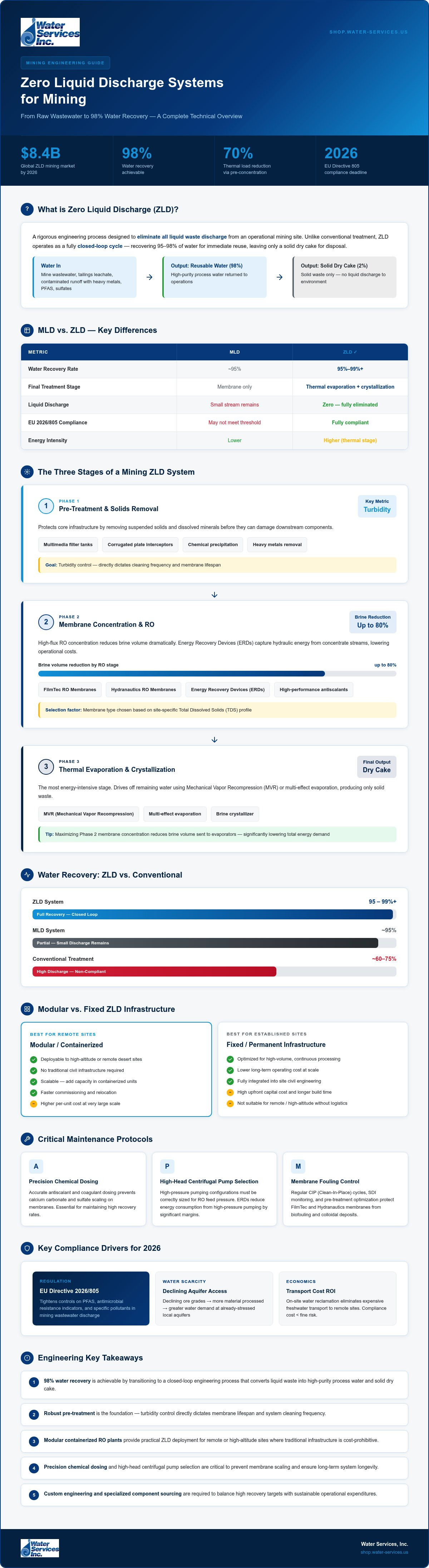
What is Zero Liquid Discharge (ZLD) in a mining context? It's a rigorous engineering process designed to eliminate all liquid waste discharge from an operational site. Unlike conventional treatment methods, zero liquid discharge systems for mining target a fully closed-loop cycle. This process recovers 95% to 98% of water for immediate reuse, leaving only a solid dry cake for disposal or further processing. By August 2026, global water scarcity and new environmental mandates have shifted ZLD from a corporate social responsibility initiative to a mandatory operational standard.
The economic logic for ZLD has also changed. Transporting fresh water to high-altitude or remote desert sites involves massive logistical costs. On-site reclamation provides a predictable ROI by reducing these intake expenses. It also mitigates the severe legal and financial risks associated with tailings dam seepage. For many operators, the cost of compliance is now lower than the potential fines for groundwater contamination under new 2026 standards.
The Drivers: Water Scarcity and Environmental Compliance
Declining ore grades are forcing mines to process larger volumes of material. This trend increases water consumption per ton of finished product at a time when local aquifers are under stress. Simultaneously, EU Directive 2026/805 has tightened controls on specific pollutants, including PFAS and antimicrobial resistance indicators. These regulations demand absolute containment of wastewater. Modern ZLD designs also incorporate resource recovery, allowing operators to extract valuable minerals or industrial salts from concentrated brine streams before final crystallization.
ZLD vs. Minimal Liquid Discharge (MLD)
The distinction between MLD and ZLD is defined by the recovery threshold. MLD systems typically target a 95% recovery rate using membrane-based processes. ZLD pushes this further, often exceeding 99% by incorporating thermal evaporation. The final stages of ZLD are energy-intensive, so the decision to move from MLD to a full ZLD setup requires a detailed cost-benefit analysis. Utilizing advanced mining wastewater treatment solutions helps bridge this gap. By maximizing membrane concentration with high-performance RO hardware, mines can reduce the volume of brine sent to evaporators, significantly lowering the system's total energy demand.
The Three Stages of a Mining ZLD System
A successful implementation of zero liquid discharge systems for mining requires precise synchronization between three distinct engineering phases. Treating ZLD as a "black box" thermal solution often leads to premature system failure due to scaling and membrane fouling. It's a mistake to focus only on the final evaporation step. Each stage serves a specific function in reducing liquid volume while managing the chemical complexity of mining wastewater.
Phase 1: Pre-Treatment and Solids Removal
Protecting the core infrastructure begins with removing suspended solids and dissolved minerals. Multimedia filter tanks and corrugated plate interceptors are deployed to reduce the physical load on downstream components. Chemical precipitation is then used to target heavy metals and hardness, preventing calcium carbonate and sulfate from precipitating on expensive membranes. Turbidity control is the most important metric in ZLD pre-treatment because it directly dictates the cleaning frequency and lifespan of the primary concentration hardware.
Phase 2: Membrane Concentration and RO
This stage utilizes commercial reverse osmosis water filtration systems to achieve high-flux concentration, reducing the brine volume by up to 80%. Engineers must select between FilmTec and Hydranautics RO membranes based on the specific Total Dissolved Solids (TDS) profile of the mine water. Modern systems incorporate Energy Recovery Devices (ERDs) to capture hydraulic energy from the concentrate stream, which significantly lowers the operational cost of high-pressure pumping. Maintaining a steady supply of high-performance antiscalants is essential to sustain these recovery rates.
Phase 3: Thermal Evaporation and Crystallization
The final stage involves Mechanical Vapor Recompression (MVR) or multi-effect evaporation to drive off the remaining water. This is often the most energy-intensive part of zero liquid discharge systems for mining, making the efficiency of the previous RO stages critical. The process results in a "dry cake" of solid minerals that can be disposed of in a lined landfill or, in some cases, sold for industrial reuse. Because these brine streams are highly corrosive, all heat exchangers and internal components must utilize specialized metallurgy, such as titanium or high-nickel alloys, to withstand the extreme chemical environment.
Modular vs. Fixed ZLD Infrastructure for Remote Mines
In 2026, the deployment of zero liquid discharge systems for mining has shifted toward modularity to address the logistical constraints of remote operations. Traditional fixed-base plants require extensive civil engineering and multi-year construction timelines. For high-altitude sites in the Andes or remote projects in the Middle East, these delays are often unacceptable. Modular infrastructure allows for a "train-based" expansion strategy. Instead of overbuilding a fixed facility for a peak capacity that might not be reached for years, operators add containerized treatment units as production scales. This approach aligns capital expenditure with actual output, reducing the risk of stranded assets if ore grades fluctuate.
Comparing CAPEX and OPEX between these two models reveals a clear trend. Fixed plants offer the lowest long-term operational cost per cubic meter, but they demand massive upfront investment. Mobile and modular solutions carry higher OPEX due to rental fees or specialized maintenance, yet they drastically lower initial CAPEX and site preparation costs. For many 2026 mining projects, the ability to mobilize equipment quickly outweighs the marginal increase in per-unit treatment costs.
Containerized and Mobile Treatment Units
Speed of deployment is the primary advantage of containerized reverse osmosis plants. These units are pre-assembled and factory-tested, arriving on-site ready for plug-and-play integration with existing tailings infrastructure. This reduces commissioning time from years to months. The flexibility of mobile water treatment plant rental is particularly valuable for exploratory mining sites or temporary operations where permanent construction isn't justified. These units can be demobilized or relocated as the mining footprint shifts, providing a level of agility that fixed infrastructure cannot match.
Brownfield Retrofitting: Integrating ZLD into Existing Mines
Adding zero liquid discharge systems for mining to established water circuits presents unique spatial and hydraulic challenges. Established mines often lack the flat acreage required for large evaporation ponds or massive treatment buildings. Modular concentration stages are ideal for these brownfield sites because they feature space-saving designs that fit into tight underground or mountainous footprints. By integrating these units into existing circuits, operators can relieve pressure on aging tailings dams and meet new 2026 discharge standards without a total plant overhaul. This phased integration allows for continuous production while the water balance is gradually brought into full ZLD compliance.
Optimizing ZLD Performance: Components and Maintenance
High-uptime zero liquid discharge systems for mining rely on the technical integrity of individual hardware components. Precision in flow control and chemical dosing prevents the catastrophic scaling that often plagues mining water circuits. Maintaining these systems requires a shift from reactive repairs to a strictly scheduled preventative maintenance program. This ensures that expensive downstream equipment, such as thermal crystallizers, remains protected from fouling and corrosion.
Pumping and Flow Control
Goulds Water Technology Pumps are the industry standard for mining durability, providing the high-head pressure necessary for the reverse osmosis stages of a ZLD circuit. These pumps must be paired with Walchem controllers and Signet flow sensors to enable automated process logic. This integration allows the system to adjust flow rates in real time based on fluctuating feed water quality. Managing abrasive slurry and corrosive brine requires specialized pump impellers and metallurgy to prevent premature mechanical failure and maintain hydraulic efficiency.
Chemical Management and Antiscalants
The critical role of water treatment chemicals in extending membrane life cannot be overstated. Precise dosing with Pulsafeeder metering pumps avoids chemical waste and ensures the brine remains stable during concentration. Engineers must select antiscalants specifically formulated for high-silica or high-sulfate mining water common in copper and gold operations. Without accurate dosing, mineral precipitation will quickly compromise membrane flux, leading to increased energy consumption and frequent clean-in-place (CIP) cycles.
Filtration and Membrane Replacement
Monitoring pressure drops across Pentair or Harmsco filter housings is the primary method for detecting sediment breakthrough. If these pre-filters fail, suspended solids will cause irreversible physical damage to the RO membranes. Operators need to know when to clean versus when to replace FilmTec RO membranes to maintain the system's water recovery targets. Maintaining commercial water purification systems through regular UV sterilizer inspections and carbon filter swaps prevents organic growth and downstream evaporator fouling. Sourcing high-performance components is the first step toward system reliability. You can browse our catalog of industrial water treatment hardware to find the specific pumps and membranes required for your ZLD project.
Implementing ZLD with Water Services, Inc.
Water Services, Inc. provides the technical engineering and containerized hardware necessary to deploy high-performance zero liquid discharge systems for mining. Since 1994, our firm has delivered industrial water solutions to remote and high-altitude sites globally. We understand that a successful ZLD implementation requires more than just equipment; it demands a deep understanding of site-specific water chemistry and the logistical hurdles of international mining environments. Our approach combines custom engineering with the distribution of authorized components from Goulds Water Technology, FilmTec, and Hydranautics.
Beyond permanent installations, we offer rental and leasing options for mobile water treatment hardware. This flexibility allows operators to pilot ZLD technologies or manage temporary wastewater surges without committing to significant upfront capital. Whether you require a replacement set of RO membranes or a fully commissioned containerized RO plant, our supply chain ensures that critical consumables and hardware are available to prevent operational downtime.
From Engineering Design to Global Installation
Consultation begins with a detailed analysis of your mine's water balance and chemical profile. We design systems to handle high-silica and high-sulfate streams, ensuring the pre-treatment and concentration stages are synchronized for maximum recovery. Our logistical expertise covers the secure shipping of modular plants to mining hubs in Africa, South America, and the Middle East. To ensure operational transparency, we integrate electric power controls that allow for remote system monitoring and real-time data acquisition from any location.
Ensuring Long-Term Operational Compliance
Maintaining zero liquid discharge systems for mining requires ongoing technical support and a reliable supply of consumables. Water Services, Inc. provides maintenance contracts and on-site training to ensure your site personnel can manage complex filtration and dosing cycles effectively. We also supply the necessary personal protective equipment (PPE) required for safe chemical handling and system maintenance. Our 24/7 technical support acts as a safeguard for your critical water infrastructure, providing immediate assistance to resolve hydraulic or chemical issues before they impact production. This comprehensive support model ensures your operation remains in full compliance with 2026 environmental standards while maximizing water reuse efficiency.
Securing Operational Continuity in the 2026 Mining Landscape
Achieving 98% water recovery and meeting stringent 2026 environmental standards requires a synchronized engineering approach. Success depends on optimizing the pre-concentration phase to reduce thermal loads and utilizing modular, containerized hardware for rapid deployment at remote sites. By prioritizing precision pumping and high-performance membranes, operators can mitigate the risks of scaling and membrane fouling while significantly reducing freshwater intake costs and eliminating tailings discharge.
Water Services, Inc. brings global installation expertise dating back to 1994, specializing in containerized mining solutions that withstand harsh industrial environments. As an authorized distributor for Goulds Water Technology and FilmTec membranes, we provide the technical support and high-performance components necessary to maintain reliable zero liquid discharge systems for mining. Our team understands the logistical complexities of international projects in South America, Africa, and the Middle East, alongside the critical importance of maintaining system uptime through scheduled maintenance and precision chemical dosing.
Contact our engineering team for a custom ZLD system design to ensure your operation remains compliant and efficient. We're ready to help you optimize your water balance and secure your project's future.
Frequently Asked Questions
What is the typical water recovery rate for a mining ZLD system?
Modern zero liquid discharge systems for mining typically achieve a liquid waste recovery rate between 95% and 98%. This high efficiency is reached by combining membrane-based pre-concentration with thermal evaporation. Recovered water is returned to the process circuit as high-purity permeate, while the remaining waste is converted into a solid dry cake. These rates allow mining operations to significantly reduce freshwater intake costs and meet strict 2026 environmental compliance standards.
How much does a zero liquid discharge system cost to operate?
Operating costs for ZLD systems are primarily driven by energy consumption and chemical consumables. Thermal stages like crystallizers are energy-intensive, though modern RO pre-concentration can reduce this load by 70%. Ongoing expenses include replacement FilmTec membranes, sediment filters, and specialized antiscalants. Maintenance labor and the cost of managing the final solid waste also contribute to the total expenditure. Some mining operations report a payback period of three to five years through freshwater savings.
Can ZLD systems recover valuable minerals from mining wastewater?
Yes, ZLD systems provide a significant opportunity for resource recovery from wastewater streams. As the system concentrates brine, valuable materials such as lithium, magnesium, or caustic soda can be extracted before final crystallization. This transformation of a waste stream into a revenue source improves the overall ROI of the installation. By 2026, many operators view ZLD not just as a compliance measure but as a strategic method for securing critical raw materials.
What is the difference between ZLD and MLD in a mining context?
The primary difference lies in the recovery threshold and the final waste state. Minimal Liquid Discharge (MLD) typically targets a 95% recovery rate using high-efficiency reverse osmosis, leaving a small volume of concentrated brine. In contrast, zero liquid discharge systems for mining incorporate a thermal evaporation stage to achieve up to 99% recovery. This extra step eliminates all liquid discharge, resulting in a solid dry cake that is easier to manage at remote sites.
How do RO membranes handle the high TDS levels in mining brine?
RO membranes handle high TDS levels through a combination of high-pressure pumping and specialized chemical management. High-performance FilmTec or Hydranautics membranes are selected for their durability in high-flux environments. Precision dosing of antiscalants using Pulsafeeder metering pumps is critical to prevent mineral precipitation on the membrane surface. Without this chemical control, the high mineral content in mining brine would cause rapid scaling, leading to frequent downtime and expensive membrane replacement cycles.
What maintenance is required for a ZLD evaporator?
Evaporator maintenance focuses on managing scaling and preventing corrosion in the heat exchangers. Regular mechanical cleaning or chemical descaling is necessary to maintain thermal efficiency. Because mining brine is often highly corrosive, internal components must be inspected for wear, especially if specialized metallurgy like titanium was used. Operators also monitor the Mechanical Vapor Recompression (MVR) units and ensure that the solid dry cake discharge mechanisms remain clear of obstructions to prevent system imbalances.
Are modular ZLD systems as effective as fixed plants?
Modular ZLD systems are as technically effective as fixed plants while offering superior logistical flexibility. These containerized reverse osmosis plants are factory-tested and pre-assembled, ensuring they meet the same performance metrics as site-built infrastructure. The modular approach allows for a train-based expansion, where additional units are added as production increases. This scalability is particularly beneficial for remote or high-altitude mines where traditional civil engineering and construction timelines are often cost-prohibitive or physically impossible.
How does ZLD help with mining environmental compliance?
ZLD ensures compliance by eliminating the discharge of pollutants into local aquifers and surface waters. New regulations, such as EU Directive 2026/805, establish strict limits on PFAS, microplastics, and heavy metals. By converting wastewater into high-purity process water and solid solids, zero liquid discharge systems for mining mitigate the risk of tailings dam seepage. This absolute containment helps mining companies avoid severe environmental fines and meet the global sustainability standards required by international regulatory bodies.
0 comments