

Industrial water treatment is an engineering calculation, not just a hardware acquisition. If your facility ignores the relationship between flow rate and UV Transmittance (UVT), you risk pathogen breakthrough regardless of your equipment's price tag. Selecting the right uv water sterilizers & ultraviolet disinfection systems requires a precise understanding of your water's optical clarity and the required log reduction for your specific process. You likely need to eliminate the high maintenance costs and safety risks of chemical disinfection while ensuring 24/7 reliability for your drinking or process water.
We recognize that sizing units for variable water quality remains a significant technical hurdle for plant managers. This 2026 industrial buying guide will help you master the technical requirements for high-performance UV disinfection. You'll learn how to evaluate Viqua and Trojan systems against the updated NSF/ANSI 55-2026 standards to achieve total regulatory compliance. We'll examine the critical metrics of UV dose, the impact of pre-treatment on quartz sleeve longevity, and the logistics of maintaining a chemical-free disinfection barrier in demanding industrial environments.
Key Takeaways
- Understand the biocidal mechanism of 254nm UVC light for the complete inactivation of bacteria, viruses, and protozoa in industrial process water.
- Learn how to calculate the optimal UV dose by matching your peak flow rate with specific UV Transmittance levels for uv water sterilizers & ultraviolet disinfection systems.
- Evaluate the operational differences between Viqua and Trojan UV systems to select the hardware best suited for your facility's scale and reliability requirements.
- Optimize system uptime by implementing standard 9,000-hour lamp replacement cycles and proactive quartz sleeve maintenance protocols.
- Achieve 2026 regulatory compliance and reduce your facility's chemical footprint through precise engineering calculations and modular system design.
What are UV Water Sterilizers and How Do They Work?
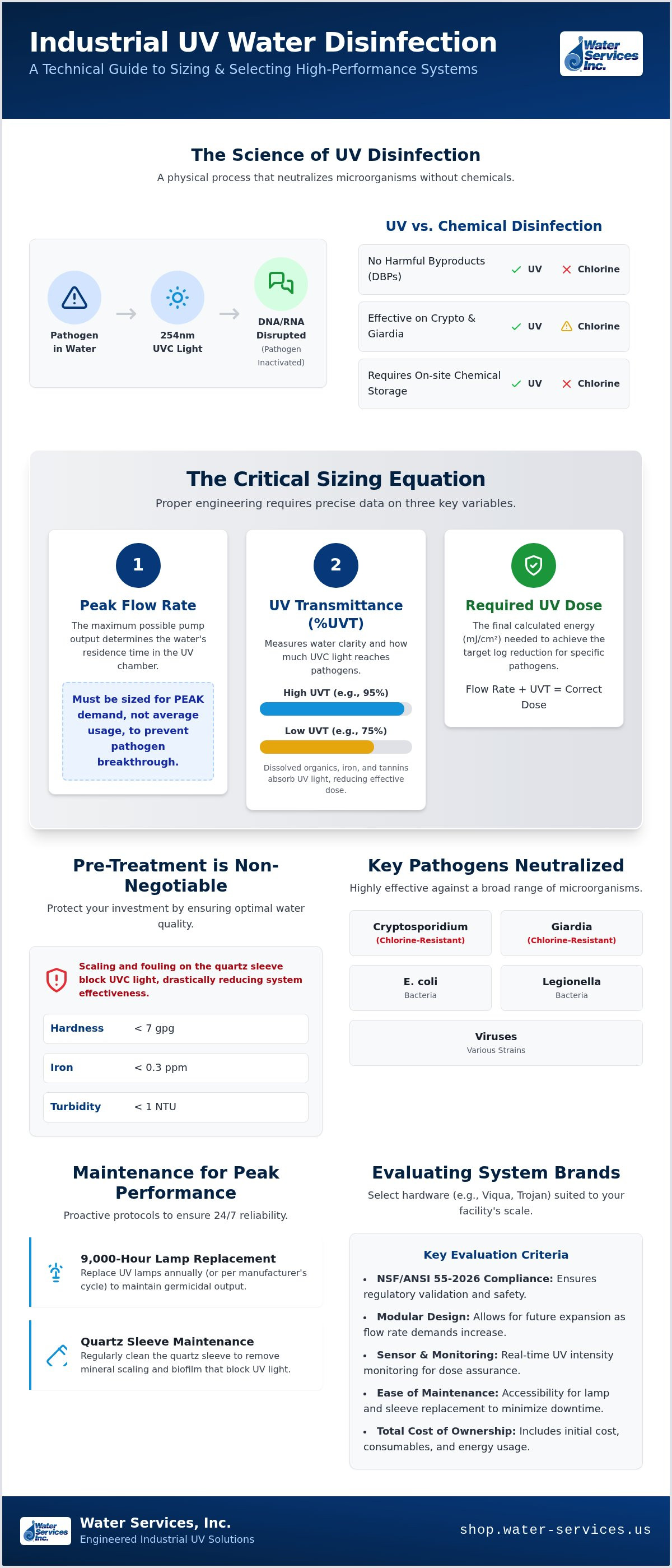
Industrial uv water sterilizers & ultraviolet disinfection systems utilize high-intensity germicidal lamps to emit ultraviolet light at a peak wavelength of 254 nanometers. This specific UVC band is optimal for nucleic acid absorption. When microorganisms pass through the UV chamber, the energy penetrates the cell membrane and disrupts the molecular bonds of their DNA and RNA. This process creates thymine dimers that prevent the organism from replicating. Since a pathogen that cannot reproduce is considered biologically dead, the water becomes safe for process or potable use. Understanding how UV disinfection works is essential for engineers designing reliable treatment trains. UV disinfection is a physical process that renders pathogens sterile without altering water chemistry.
Unlike chlorination, UV treatment produces no harmful disinfection byproducts (DBPs) like trihalomethanes (THMs) or haloacetic acids (HAAs). This is a critical advantage for facilities seeking to reduce their chemical footprint and eliminate the safety risks associated with storing and handling bulk oxidizers. UV systems provide a compact, automated solution that operates with minimal pressure drop across the reactor. They don't require contact tanks or long dwell times, making them ideal for high-flow industrial applications where space is at a premium.
Pathogens Controlled by Ultraviolet Disinfection
Conventional chemical treatments often struggle with specific chlorine-resistant microorganisms. UV systems are highly effective against Cryptosporidium and Giardia, which possess thick outer shells that resist oxidation. These systems also provide rapid inactivation of E. coli, Legionella, and various viral strains that can compromise industrial cooling towers or food processing lines. Integrating these units into commercial water purification systems ensures a robust microbiological barrier that meets strict 2026 health standards. The reliability of this technology makes it a primary choice for pharmaceutical and beverage industries where water purity is non-negotiable.
The Role of UV in Multi-Stage Treatment
For optimal efficacy, UV units must be positioned correctly within the treatment train. We recommend installing UV reactors after industrial water filtration systems to ensure low turbidity. Suspended solids can cause "shadowing," where particles physically block UV light from reaching pathogens. UV also works in synergy with FilmTec and Hydranautics reverse osmosis membranes by protecting the permeate from downstream contamination. This integration with broader water treatment strategies provides a comprehensive safety net for remote mining sites and military installations where water quality is variable and reliability is paramount.
Critical Selection Metrics: Flow Rate, UVT, and Dosage
Engineering a reliable disinfection barrier requires precise data on three variables: peak flow rate, water clarity, and required biological inactivation. Peak flow rate, measured in Gallons Per Minute (GPM), determines the residence time of water within the UV reactor. If flow exceeds the system's rated capacity, the exposure time drops, and the UV dose becomes insufficient to neutralize pathogens. Professionals must size uv water sterilizers & ultraviolet disinfection systems based on the maximum possible pump output rather than average daily usage to prevent bypass during high-demand periods.
Pretreatment is non-negotiable for system longevity. High levels of hardness (above 7 gpg), iron (above 0.3 ppm), and turbidity (above 1 NTU) cause mineral scaling and solarization of the quartz sleeve. These deposits physically block UVC energy from entering the water column. You can evaluate our inventory of water treatment components to ensure your feed water meets these technical specifications before it reaches the UV chamber.
Understanding UV Transmittance (UVT)
UV Transmittance (UVT) measures the percentage of 254nm light that remains after passing through a 1 cm water sample. Dissolved organic matter, tannins, and minerals absorb this energy before it reaches target microorganisms. A drop from 95% UVT to 75% UVT often requires doubling the number of lamps or significantly reducing the flow rate to maintain the same biocidal efficacy. For remote industrial sites, handheld UVT monitors are essential tools for real-time adjustments when source water quality fluctuates due to seasonal changes or environmental events. This level of precision in monitoring water clarity is equally vital for maintaining sensitive aquatic ecosystems; learn more about the tropical freshwater species that thrive in stable, high-clarity environments.
Dosage Standards for Industrial Compliance
The UV dose is the product of UV intensity and exposure time, expressed in millijoules per square centimeter (mJ/cm²). For industrial applications, the NSF/ANSI Standard 55 Class A is the mandatory benchmark, requiring a minimum dose of 40 mJ/cm². This level is engineered to inactivate pathogenic bacteria, viruses, and cysts in microbiologically unsafe water. While lower dosages might suffice for basic water conditioning, industrial process water and potable supplies for remote camps require the Class A threshold to ensure 2026 regulatory compliance. Systems should be calibrated to provide this dose at the end of the lamp's rated life and at the lowest expected UVT level.
Comparing UV Brands: Viqua vs. Trojan UV Systems
Selecting the appropriate hardware for uv water sterilizers & ultraviolet disinfection systems requires a clear distinction between light commercial and heavy industrial application tiers. Viqua and Trojan, both part of the Trojan Technologies family, serve different operational scales. Viqua systems are the industry standard for localized process water and high-end backup. Trojan specializes in municipal-grade and heavy industrial solutions where flow rates and reliability requirements are extreme. A key engineering decision involves choosing between monitored systems, which use sensors to verify dosage, and unmonitored systems that rely on fixed lamp output. Both brands offer global availability and technical engineering support, but their hardware configurations target specific facility sizes.
Viqua UV Features for Commercial Use
Trojan UV for Large-Scale Industrial Applications
Trojan systems handle high-volume process water disinfection for large manufacturing plants and mining operations. These units feature robust sensor technology that provides real-time dosage monitoring, adjusting lamp intensity to compensate for changes in UVT. Modular configurations enable water treatment plants to scale horizontally. This ensures that the system can meet increased demand without requiring a complete overhaul of the existing infrastructure. Trojan's focus on heavy industrial engineering makes it suitable for the most demanding 24/7 disinfection environments.
Selecting the Right Brand Tier
Choosing the correct tier is vital for long-term operational efficiency. We recommend Viqua for supporting a commercial reverse osmosis water filtration system where space and ease of maintenance are priorities. Conversely, Trojan is the preferred choice for complex mining wastewater treatment solutions that require high-log reduction of pathogens at scale. You can browse our full selection of uv water sterilizers & ultraviolet disinfection systems to compare specific model specifications for your 2026 facility upgrades.
Maintenance Logistics: Lamps, Sleeves, and Sensors
Operational reliability for uv water sterilizers & ultraviolet disinfection systems depends on a strict preventative maintenance schedule. The standard lamp replacement interval is 9,000 hours, or approximately one year of continuous operation. While a lamp may still emit visible light after this period, its UVC output at the 254nm wavelength degrades significantly. Operating beyond this limit risks falling below the required biocidal dose. Facilities must track these intervals using integrated controllers to ensure the system maintains its rated log reduction performance.
Quartz sleeves require periodic inspection and cleaning to remove mineral scaling and bio-fouling. Even a thin layer of calcium or iron deposit acts as a physical barrier to UV radiation, a phenomenon known as solarization. For systems equipped with UV sensors, annual calibration is essential. These sensors provide a real-time measurement of UV intensity reaching the water column; if they drift, the system may provide a false sense of security or trigger unnecessary alarms. Proactive maintenance ensures the total cost of ownership remains predictable by avoiding emergency component failures.
Managing Consumables in Remote Sites
Facilities in mining or military sectors must maintain a local inventory of critical spares to prevent extended downtime. This inventory should include at least two replacement lamps, two quartz sleeves, and a set of O-rings for every reactor. Maintenance personnel must use appropriate PPE, including UV-rated face shields and gloves, to prevent skin and eye exposure during testing. Since industrial UV lamps contain small amounts of mercury, they require disposal according to hazardous waste regulations. We support global logistics from our Provo, Utah headquarters to ensure these critical parts reach remote installations quickly.
Automated Maintenance Features
Modern industrial units incorporate automated safeguards to ensure continuous compliance. Solenoid shut-off valves are critical; they automatically stop the flow of water if the sensor detects a lamp failure or a drop in UV intensity below the safety threshold. High-fouling applications benefit from mechanical wiper systems that physically clean the quartz sleeve without interrupting the process. These systems often integrate directly with feed pumps and Walchem controllers to provide a unified treatment interface. This automation reduces the manual labor requirements and minimizes the risk of human error in disinfection monitoring.
Ensure your facility maintains 24/7 disinfection reliability by ordering critical UV replacement lamps and sleeves for your Viqua or Trojan systems.
Engineering Industrial UV Solutions with Water Services, Inc.
Water Services, Inc. functions as a specialized technical partner for complex industrial water treatment projects globally. We provide the expert engineering support required to size and integrate uv water sterilizers & ultraviolet disinfection systems across the mining, military, and heavy manufacturing sectors. Our engineering team conducts thorough reviews of water chemistry reports to prevent mineral scaling and ensure the longevity of the disinfection barrier. Operating from our central headquarters in Provo, Utah, we manage international logistics to support remote installations that require 24/7 disinfection reliability. Our approach prioritizes technical integrity and logistical competence, ensuring that each system is calibrated for the specific flow rates and UVT levels of the local source water.
Custom Modular System Design
Our engineering team specializes in the design and fabrication of containerized water treatment plants that incorporate Trojan and Viqua hardware. These modular units provide a scalable solution for international projects that must adhere to stringent 2026 regulatory standards. These containerized solutions often include integrated Walchem controllers and Signet flow sensors for real-time monitoring of system performance. Technical consulting for complex wastewater challenges focuses on the synergy between UV reactors and existing filtration stages. By integrating high-intensity UVC systems into mobile treatment platforms, we ensure that remote sites can achieve drinking water safety and process water purity without the need for extensive permanent infrastructure. This modularity allows for rapid site deployment and simplified relocation as project needs evolve.
Procurement and Fast Shipping
Maintaining a reliable disinfection barrier requires immediate access to critical hardware and consumables. We maintain a comprehensive inventory of replacement lamps, quartz sleeves, and sensors to support our global client base. Our procurement system is designed for high-volume commercial accounts, offering a streamlined path from technical specification to site delivery. We prioritize fast shipping on all maintenance components to prevent operational downtime in critical environments. By acting as a curated authority for established third-party manufacturers, we ensure that our customers receive only the most durable and reliable hardware for their specific industrial applications.
Secure your disinfection system today by exploring the Water Services UV Collection.
Securing Your 2026 Disinfection Infrastructure
Mastering the technical requirements for industrial water treatment ensures that your facility remains compliant with the updated NSF/ANSI 55-2026 standards. Success depends on matching the specific UV dose to your peak flow rates and real-world UV Transmittance metrics. As an authorized Trojan and Viqua dealer, Water Services, Inc. provides the engineered solutions and specialized expertise necessary to deploy uv water sterilizers & ultraviolet disinfection systems in the most demanding environments. We prioritize technical integrity, focusing on the durability and performance of your equipment.
Our Provo-based technical support team understands the unique logistical challenges of supporting remote mining and military sites across the globe. We maintain a deep inventory of critical lamps, sleeves, and ballasts to ensure your system operates without interruption. You can achieve 24/7 disinfection reliability while reducing your chemical footprint through precise system selection and proactive maintenance protocols. We're ready to assist with the engineering calculations required for your next project.
Shop UV Water Sterilizers & Disinfection Systems to secure your facility's water purity and operational uptime today.
Frequently Asked Questions
How often do I need to replace the UV lamp in an industrial system?
Industrial UV lamps typically require replacement every 9,000 hours of continuous operation. This ensures the UVC output remains at the intensity required for your specific log reduction target. Even if the lamp still produces a visible blue glow, the germicidal effectiveness at the 254nm wavelength declines after 12 months. We maintain a deep inventory of Viqua and Trojan replacement lamps at our Provo headquarters to support fast shipping for remote site maintenance.
Can UV disinfection remove chemicals or heavy metals from water?
UV disinfection does not remove chemicals, minerals, or heavy metals from water. It is a physical process designed strictly for microbiological inactivation. To address chemical contaminants or high TDS, you must integrate uv water sterilizers & ultraviolet disinfection systems with other technologies. We recommend using Hydranautics or FilmTec reverse osmosis membranes in a multi-stage treatment train to remove dissolved solids and chemical pollutants before or after the UV stage.
What happens if the UV transmittance (UVT) of my water drops suddenly?
A sudden drop in UVT means the water has become less clear to UVC light, which significantly reduces disinfection efficacy. This often occurs due to seasonal changes or upstream filtration failures. When UVT falls, the required dose may not reach the pathogens in the water column. Our engineering team utilizes Walchem controllers and Signet sensors to monitor these fluctuations in real-time, allowing the system to trigger solenoid shut-off valves if the dose becomes insufficient.
Is a UV sensor necessary for commercial water treatment compliance?
A UV sensor is essential for any facility requiring NSF/ANSI Standard 55 Class A compliance. These sensors provide continuous monitoring of the UVC intensity that actually penetrates the water. Without a sensor, you cannot verify if the system is providing the necessary 40 mJ/cm² dose, especially if the quartz sleeve becomes fouled. Most industrial and military projects mandate monitored systems to ensure 24/7 reliability and to meet strict 2026 health and safety regulations.
Do UV sterilizers require a specific water pressure to operate?
UV reactors are designed to operate within standard industrial pressure ranges, typically up to 125 psi. The systems themselves don't require high pressure to function, but they do cause a minor pressure drop, usually between 3 and 5 psi, as water flows through the chamber. It's important to use Ashcroft pressure gauges to monitor the influent and effluent pressure. This helps identify when pre-filters are clogged or if the flow rate is exceeding the reactor's design capacity.
What is the difference between a UV sterilizer and a UV purifier?
In the industrial sector, these terms are often used interchangeably, but they can signal different performance tiers. A UV sterilizer generally refers to a system capable of achieving a 4-log reduction of pathogens, meeting Class A standards. A UV purifier might refer to a broader range of uv water sterilizers & ultraviolet disinfection systems, including Class B units for supplemental treatment. Always check the specific mJ/cm² dosage rating rather than relying on the product category alone.
Can I use UV disinfection for wastewater effluent?
UV disinfection is a standard solution for wastewater effluent, particularly for reducing the chemical footprint of a treatment plant. Trojan UV systems are frequently used in these high-volume applications to meet discharge permits. Success depends on high-quality pre-treatment, as wastewater often has lower UVT and higher turbidity than potable water. Utilizing multimedia filter tanks or ultrafiltration before the UV stage prevents suspended solids from shielding pathogens from the germicidal light.
How do I size a UV system for a remote mining site with variable flow?
Sizing for remote mining sites requires calculating the system capacity based on the maximum peak flow rate of your Goulds Water Technology pumps. You should never size based on average daily demand, as this leads to untreated water bypass during peak usage. We engineer modular solutions that can scale with your site's needs. By using Signet flow sensors and Walchem controllers, we can design a system that adjusts lamp intensity or activates additional reactors based on real-time demand.
0 comments