

Selecting a water flow meter gpm rating based solely on pipe size is a technical oversight that often leads to premature equipment failure. In demanding industrial environments, a mismatched meter doesn't just provide poor data; it causes pump cavitation, creates unnecessary pressure drops, and risks non-compliance with the updated ISO 4064:2024 standards. You've likely dealt with the frustration of meter corrosion in harsh chemical lines or the confusion of choosing between turbine, magmeter, and ultrasonic technologies for your reverse osmosis systems.
It's clear that precision in flow measurement is the vital sign of any stable industrial water system. This guide provides the technical framework you need to master GPM nuances, ensuring your equipment longevity and operational efficiency. We'll analyze how to identify the correct meter technology for your specific GPM range and how to ensure your discharge monitoring meets the 2026 PFAS quarterly requirements. You'll gain a clear path to integrating high-performance Signet flow sensors and Walchem controllers into your existing pumping infrastructure to achieve total system reliability.
Key Takeaways
- Define the technical relationship between flow velocity and pipe diameter to establish precise volumetric measurement standards across your facility.
- Compare turbine and ultrasonic technologies to select the correct water flow meter gpm configuration for high-purity, abrasive, or corrosive fluid environments.
- Evaluate turndown ratios and fluid chemistry compatibility to ensure meter performance remains consistent during variable industrial flow cycles.
- Apply specialized inline installation protocols to mitigate the impact of turbulence and air bubbles on sensor reading integrity.
- Integrate real-time flow data into Walchem controllers or Signet sensors using 4-20mA, Pulse, or Modbus protocols for advanced process automation.
What is a Water Flow Meter (GPM) and Why is it Critical?
Gallons per minute is the volumetric flow rate standard for North American industrial sectors. It measures the volume of liquid passing a fixed point in exactly sixty seconds. This metric is fundamental to Flow measurement principles; it allows engineers to calculate system capacity, chemical dosing requirements, and total throughput. Without an accurate water flow meter gpm reading, managing the mass balance of a complex hydraulic circuit becomes impossible.
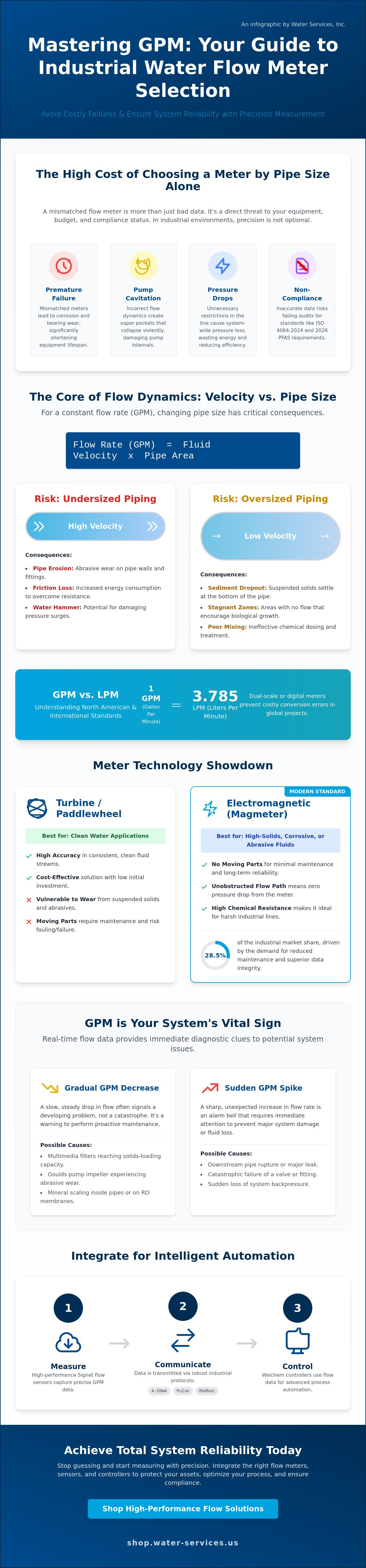
The relationship between fluid velocity and pipe diameter is the core of flow dynamics. A flow rate is the product of the fluid's velocity and the cross-sectional area of the conduit. If you maintain a constant GPM while reducing pipe diameter, the velocity must increase. High velocity leads to friction loss, heat generation, and potential pipe erosion. Conversely, oversized piping for a low GPM leads to sediment dropout and stagnant zones that encourage biological growth.
In industrial water treatment systems, GPM acts as the primary safeguard for high-value assets. For example, FilmTec or Hydranautics RO membranes require specific cross-flow velocities to prevent mineral scaling. If the GPM drops below the manufacturer's minimum specification, the concentration of salts at the membrane surface increases. This leads to irreversible fouling and premature membrane replacement, which significantly raises the total cost of ownership.
GPM vs. LPM: Understanding Flow Units
Engineers working on global projects must frequently convert between GPM and Liters Per Minute (LPM). While the US mining and chemical sectors standardize on GPM, international reverse osmosis plants often utilize metric units. For precise technical documentation, one GPM is defined as 3.785 liters per minute. Using a water flow meter gpm display with dual-scale capability or digital switching helps avoid calculation errors during multi-national system commissioning.
The Role of Flow Measurement in System Health
Fluctuations in GPM provide immediate diagnostic data for maintenance teams. A gradual decrease in flow often signals that multimedia filter tanks are reaching their solids-loading capacity or that a Goulds pump impeller is experiencing abrasive wear. Sudden spikes in GPM can indicate pipe ruptures or valve failures downstream. By utilizing Signet flow sensors and Walchem controllers, operators can implement real-time process control. This automation ensures the system maintains optimal hydraulic balance, preventing the pipe erosion and water hammer associated with unregulated flow surges.
Industrial Flow Meter Technologies: From Turbines to Ultrasonic
Industrial flow monitoring has evolved significantly. Mechanical dials are largely replaced by digital pulse outputs for 2026 operations. These digital signals allow for seamless integration with precision instrumentation and controls. Modern sensors provide the granular data required for complex chemical dosing. Specifically, Signet flow sensors are the standard for high-accuracy chemical injection due to their chemical resistance and reliable digital communication. Selecting a water flow meter gpm configuration requires a deep understanding of the fluid's physical properties and the sensor's mechanical limits.
While mechanical meters remain cost-effective for simple applications, non-intrusive technologies are gaining market share. According to 2026 market data, electromagnetic meters now account for 28.5% of the market share. This shift is driven by the need for reduced maintenance in high-solids environments. Modern industrial facilities prioritize "no moving parts" designs to minimize the risk of mechanical failure and to ensure long-term data integrity.
Turbine and Paddlewheel Meters
Turbine meters utilize a multi-bladed rotor suspended in the flow stream. As fluid moves, it turns the rotor at a speed proportional to the GPM. These are excellent for clean water applications due to their high accuracy and low initial cost. However, they face significant challenges in mining wastewater treatment solutions. Suspended solids and abrasive particulates lead to bearing wear and rotor fouling. If your process fluid contains debris, a mechanical rotor will eventually seize, resulting in inaccurate data or total system downtime.
Magnetic and Ultrasonic Flow Measurement
Magnetic flow meters, or magmeters, operate based on Faraday’s Law of Induction. They generate a magnetic field and measure the voltage produced as a conductive fluid passes through it. Because they have no moving parts, they're ideal for slurries and corrosive chemicals. For non-conductive or high-purity fluids, ultrasonic technology is the preferred choice. These meters use either "Transit-time" (measuring the time difference between signals sent upstream and downstream) or "Doppler" (measuring frequency shifts from particles in the fluid).
These non-intrusive Water flow measurement methods eliminate pressure drop and the risk of mechanical failure. In 2026, the industry's focus on the total cost of ownership makes these advanced technologies more attractive despite higher upfront costs. They ensure a reliable water flow meter gpm reading in environments where mechanical sensors would fail within months. This reliability is essential for maintaining regulatory compliance in industrial discharge monitoring and protecting downstream RO membranes.
Selection Criteria: Matching Meters to Your GPM Requirements
Selecting a water flow meter gpm configuration requires more than matching the existing pipe diameter. To ensure 2026-level precision, you must evaluate the turndown ratio. This ratio represents the range between the maximum and minimum flow rates a meter can accurately measure. For systems with variable frequency drives (VFDs), a high turndown ratio is essential to maintain data integrity during low-flow periods. If your meter's turndown ratio is too narrow, you'll lose visibility when the system throttles down, leading to chemical dosing errors or pump dry-run risks.
Installation geometry is equally critical for accuracy. Most industrial meters require a specific length of straight pipe to eliminate turbulence and ensure laminar flow. The industry standard is the 10x/5x rule: ten pipe diameters of straight run upstream and five diameters downstream. Failure to provide this "settling" space results in erratic readings and erratic process control. For detailed specifications on hydraulic conditions, professionals should consult the U.S. Bureau of Reclamation Water Measurement Manual, which outlines foundational requirements for various sensor types.
Your meter selection must also align with your pump's performance curve. For instance, when configuring a system around a 3 HP industrial pump, the meter must handle the maximum GPM at the pump's "run-out" point without creating excessive backpressure. A meter that is too small for the pump's output will increase the Total Dynamic Head (TDH), forcing the motor to work harder and reducing the overall efficiency of your water treatment plant.
Material Compatibility: PVC, Stainless Steel, and Bronze
Material selection depends entirely on fluid chemistry and temperature. PVC meters are cost-effective for ambient temperature water and many corrosive antiscalants, but they fail under high-temperature or high-pressure steam condensate conditions. For high-purity RO permeate or aggressive mining chemicals, 316L Stainless Steel is the standard due to its superior corrosion resistance. Bronze or brass components are durable for standard municipal-grade water movement but shouldn't be used in deionized water systems where metal leaching could contaminate the process.
Flow Range and Accuracy Specs
It's vital to distinguish between "Full Scale" and "Reading" accuracy. Full scale accuracy calculates error based on the meter's maximum capacity; this means the margin of error remains the same even at low flows. Reading accuracy is more precise because it calculates error based on the actual flow at that moment. To maximize the life of your water flow meter gpm sensor, size the unit so your average operating flow sits between 50% and 70% of the meter's maximum capacity. This prevents the "Oversizing Trap," where a meter is too large to register low-flow movements accurately.
Installation and Maintenance: Ensuring 2026-Level Accuracy
Achieving a reliable water flow meter gpm reading requires more than just a physical connection. Even the most advanced 2026 sensor technology will fail if the installation environment introduces hydraulic or electrical interference. Precision in the field starts with understanding that flow meters don't measure fluid; they measure the effects of fluid movement. Any deviation from laminar flow or any electrical "noise" in the line will distort the digital output, leading to inaccurate chemical dosing or false system alarms.
Signal integrity is particularly vulnerable in magnetic flow meter installations. Because magmeters measure millivolt-level signals, they're highly sensitive to stray electrical currents. Proper grounding is mandatory. When installing these sensors in plastic piping systems, you must use grounding rings to provide a stable electrical reference point. Without this, EMI from nearby high-performance pumps or VFDs will cause the GPM reading to fluctuate wildly. For seamless data transmission, these signals should be routed through shielded cables to specialized electric power controls that can filter out industrial interference.
Positioning and Piping Requirements
A "Full Pipe" condition is the most critical requirement for accurate measurement. If the conduit is only partially filled, the sensor will calculate the GPM based on the total pipe diameter rather than the actual fluid volume; this results in significant over-reporting. To prevent this, install meters in low points or vertical "up-flow" sections of the piping. While horizontal runs are common, vertical installations ensure that air bubbles—which can trick ultrasonic sensors or cause paddlewheel "skipping"—rise to the top of the system and away from the sensor head. If your facility has limited space and cannot meet the standard straight-run requirements, you must utilize flow straighteners to artificially recreate laminar flow before the fluid reaches the water flow meter gpm sensor.
Calibration and Troubleshooting
Field verification remains the only way to guarantee 2026-level accuracy. The "Bucket Test" is a fundamental diagnostic tool: measure the time it takes to fill a container of a known volume and compare that manual calculation against the digital meter's display. If you find a discrepancy, check for scaling or mineral buildup on the sensor electrodes or rotors. In high-scaling environments where antiscalants are used, regular cleaning with a mild acid solution is necessary to maintain sensitivity. If the reading remains erratic, investigate "Signal Noise" by temporarily deactivating nearby motors to see if the flow reading stabilizes.
Maintain your system's technical integrity by choosing high-performance components. Browse our selection of Signet flow sensors and Walchem controllers to ensure your facility operates with absolute precision.
Integrating Precision GPM Data into Process Automation
Operational efficiency in 2026 relies on the successful translation of fluid dynamics into actionable digital intelligence. A water flow meter gpm sensor serves as the primary data source for the automation layer of an industrial water plant. While standard 4-20mA loops provide a reliable analog signal for basic monitoring, digital protocols like Modbus RTU or TCP/IP offer superior data density. These digital interfaces allow engineers to integrate multiple sensors into a single PLC, providing real-time visibility into system throughput and totalization. This connectivity facilitates the autonomous adjustments necessary to maintain peak efficiency in reverse osmosis and mobile ultrafiltration systems, allowing the plant to respond dynamically to variable demand cycles.
Flow-Proportional Dosing
Flow-proportional dosing eliminates the chemical waste associated with manual feed settings. By connecting a Signet flow sensor to a Walchem controller, the system transmits a direct pulse signal to Pulsafeeder metering pumps. This configuration ensures that chemical injection rates modulate in direct response to the water flow meter gpm reading at any given second. This automation is essential for maintaining precise ppm levels of antiscalants, which protects Hydranautics and FilmTec membranes from irreversible mineral scaling. Such precision is a standard requirement for mission-critical applications at remote mining sites and military installations where resource conservation and consistent effluent quality are operational priorities.
Remote Monitoring and SCADA Integration
Modern SCADA integration transforms raw flow data into a diagnostic tool for predictive maintenance and environmental compliance. By monitoring GPM trends, operators can identify pump performance degradation or filter clogging before a catastrophic failure occurs. Additionally, totalized flow data is now a mandatory component for quarterly PFAS monitoring and environmental discharge reporting under 2026 EPA guidelines. Our engineering support team, based at our Provo, Utah headquarters, specializes in the technical configuration of these automated networks for global distribution. We ensure that your facility benefits from both domestic industrial reliability and worldwide technical reach through curated hardware selection and protocol optimization.
Contact Water Services, Inc. for custom flow monitoring solutions to enhance your facility's process automation and technical integrity.
Securing System Precision through Advanced Flow Monitoring
Maintaining 2026-level efficiency requires a strategic shift from basic monitoring to integrated process control. You now understand how critical the turndown ratio is for variable flow and why the 10x/5x straight-pipe rule is non-negotiable for data integrity. Selecting a high-performance water flow meter gpm configuration ensures your RO membranes and pumping assets remain protected against hydraulic instability and chemical dosing errors. Precision measurement is the only way to guarantee regulatory compliance and long-term equipment longevity.
Reliability is the foundation of successful industrial water management. As an authorized Signet and Ashcroft distributor, we supply the specialized hardware required for the most demanding commercial environments. We provide global engineering support for complex mining and military projects, ensuring your specific technical requirements are met with exact solutions. Our industrial components are in-stock and ready for same-day shipping to minimize your system downtime and maintain logistical competence.
Browse Professional Flow Sensors and Meters to secure your facility's operational future. We're ready to assist with your technical hardware needs.
Frequently Asked Questions
What is the difference between GPM and flow velocity?
GPM is a volumetric measurement while flow velocity is a linear measurement of speed. GPM represents the total volume of fluid passing a fixed point in one minute. Flow velocity measures the speed of that fluid in feet per second. In a closed system, GPM remains constant even if the pipe diameter changes, but velocity increases as the pipe size decreases.
How much straight pipe is required before and after a flow meter?
The standard industrial installation requires ten pipe diameters of straight run upstream and five diameters downstream. This 10x/5x rule is essential to eliminate turbulence and ensure laminar flow before the fluid reaches the sensor. While some advanced ultrasonic technologies permit shorter runs, following this baseline prevents erratic readings and maintains high data integrity in 2026 operations.
Can a water flow meter GPM be used for chemicals or oils?
Yes, provided the meter construction materials are chemically compatible with the process fluid. A water flow meter gpm configured with 316L stainless steel or PVDF can handle aggressive chemicals and various oils. It's important to note that magnetic meters require conductive fluids; therefore, non-conductive oils require turbine or ultrasonic sensors to provide accurate volumetric data.
Why is my digital flow meter reading zero when there is flow?
A zero reading during active flow usually indicates a signal processing failure or a mechanical blockage. Common industrial causes include a seized paddlewheel rotor, a disconnected 4-20mA loop, or air pockets trapped in the sensor housing. For magnetic meters, ensure the pipe is completely full and the fluid meets the minimum conductivity threshold required for the sensor to generate a voltage signal.
How often should an industrial GPM meter be recalibrated?
Most industrial facilities perform annual calibration to meet ISO 4064:2024 accuracy standards. In high-fouling environments or applications involving regulated discharge, semi-annual verification is often necessary. Regular field checks using a master meter can identify signal drift caused by mineral scaling on electrodes or mechanical wear on internal rotors before it affects process control.
What is a "K-factor" in flow measurement?
The K-factor is a specific calibration value representing the number of pulses a sensor generates per unit of volume. For a water flow meter gpm sensor, the K-factor is expressed as pulses per gallon. You must program this exact value into your Walchem controller or PLC to ensure the raw digital signal is correctly converted into a usable volumetric flow rate.
Do I need a strainer before my GPM flow meter?
You must install a strainer before any mechanical meter, including turbine or paddlewheel types. Suspended solids and debris can damage rotors or cause them to seize, which leads to immediate data loss and potential system downtime. While magmeters and ultrasonic sensors are less sensitive to solids, upstream filtration is still recommended to protect high-value downstream assets like FilmTec RO membranes.
What happens if I install a flow meter backwards?
Installing a flow meter backwards will result in incorrect data or a total signal failure. Most industrial sensors are unidirectional and feature a permanent arrow on the body to indicate the required flow direction. Mechanical meters may spin in reverse without providing accurate pulse data; digital meters like magmeters will typically display a negative flow value or trigger a system error code.
0 comments