

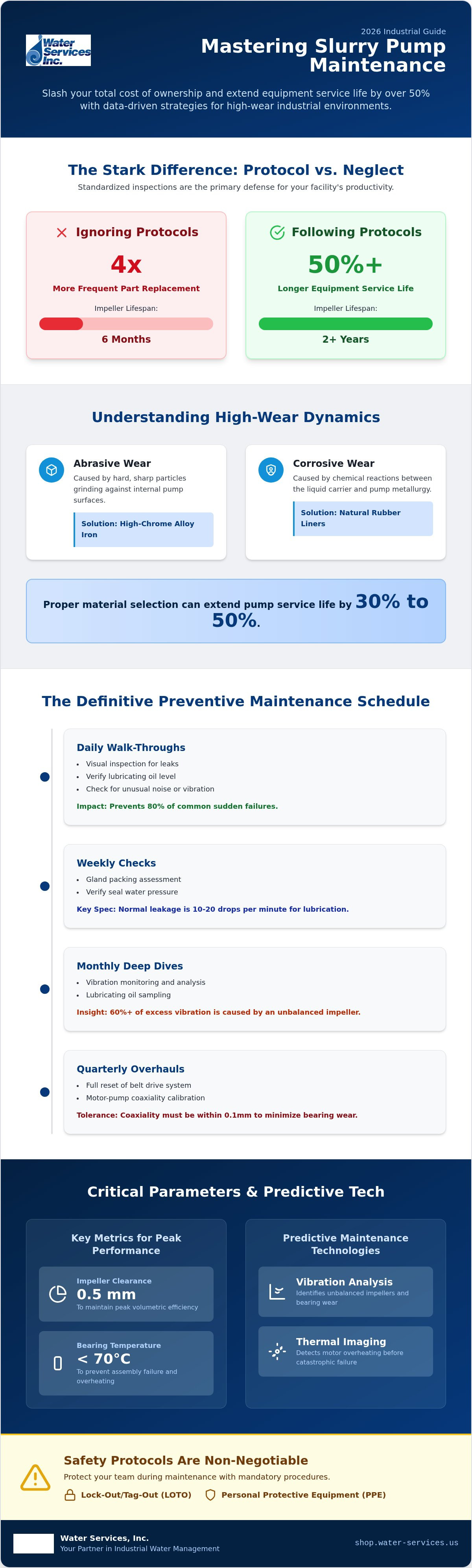
Did you know that industrial teams ignoring standardized inspection protocols end up replacing critical flow parts four times more often than those following a rigorous schedule? While some sites replace impellers every six months, organizations that prioritize technical precision often extend that interval to two full years. We understand that frequent impeller erosion and unexpected bearing failures in remote mining sites aren't just technical inconveniences. They're expensive, high-stakes disruptions to your entire industrial water treatment infrastructure.
It's frustrating to manage persistent mechanical seal leakage when you're trying to maintain steady operations in high-wear environments. This 2026 industrial guide will help you master the specific slurry pump maintenance best practices required to slash your total cost of ownership and extend equipment service life by more than 50%. You'll learn the technical protocols used by seasoned experts to ensure system reliability and prevent the downtime that eats into your margins.
We'll provide a detailed breakdown of essential maintenance steps, from maintaining precise 0.5mm impeller clearances to monitoring bearing temperatures below the critical 70°C threshold. This guide offers standardized checklists and data-driven strategies to transform your pump maintenance from a reactive chore into a primary defense for your facility's productivity.
Key Takeaways
- Learn how to match metallurgy, such as high-chrome alloys or natural rubber, to specific slurry concentrations to mitigate abrasive and corrosive wear.
- Establish a rigorous preventive schedule using our slurry pump maintenance best practices checklist; this includes daily walk-throughs and weekly gland packing assessments.
- Master technical adjustments for impeller clearance to maintain peak volumetric efficiency and recognize the specific indicators for component replacement.
- Integrate predictive technologies like vibration analysis and thermal imaging to identify bearing assembly failures and motor overheating before they cause downtime.
- Optimize your total cost of ownership by synchronizing pump maintenance with your global water infrastructure and securing high-quality replacement parts.
Understanding the High-Wear Dynamics of Slurry Pumping
A Slurry pump functions in environments that would destroy standard water pumps within hours. The combination of solid concentration and particle size creates a high-wear environment where friction and impact are constant. In 2026, industry data confirms that custom-engineered pumps can handle solid concentrations up to 80%, but this capability requires precise material selection. Understanding these dynamics is the first step in establishing effective slurry pump maintenance best practices.
Abrasive wear occurs when hard, sharp particles grind against internal surfaces. High-chrome alloy iron is the standard solution for these conditions. Corrosive wear happens when the liquid carrier reacts chemically with the pump metallurgy. Natural rubber liners often provide better resistance to smaller, rounder particles and corrosive agents. Research shows that proper material selection can extend the service life of a pump by 30% to 50%.
Many operators fall for the "Brute Force" fallacy. They over-specify motor horsepower, assuming more power equals better reliability. In reality, oversized motors often force the pump to operate far from its Best Efficiency Point. This causes internal turbulence, which accelerates wear on the impeller and casing. The economic impact of downtime in sectors like mining or oil is severe; a single unexpected failure can halt production for days and lead to massive revenue losses. Following slurry pump maintenance best practices starts with matching the pump performance curve to the actual system requirements.
The Role of Goulds Water Technology in Slurry Management
Goulds Water Technology pumps are engineered for the most demanding industrial wastewater applications. These systems allow for precise metallurgy matching, ensuring the impeller and liners are compatible with the specific abrasive or corrosive profile of the slurry. In 2026, Goulds centrifugal pumps utilize advanced hydraulic geometries to maintain high efficiency even when processing high-density slurries. Utilizing genuine replacement parts ensures the tight tolerances required for long-term durability and system stability.
Safety Protocols and PPE for Maintenance Teams
Maintenance teams face significant risks during pump teardowns, especially when handling mining wastewater. Chemical residues from tailings can cause severe skin and respiratory irritation. All personnel must use appropriate Personal Protective Equipment (PPE), including chemical-resistant gloves, face shields, and protective suits.
Lock-out/Tag-out (LOTO) procedures are mandatory before any maintenance begins. High-voltage motors must be physically disconnected and tagged to prevent accidental startup. Because slurry pumps are often located in remote or confined spaces, teams must also account for ventilation and emergency extraction protocols during major overhauls. For repairs requiring heat-intensive work in volatile environments, utilizing safety enclosures from PetroHab LLC ensures that maintenance remains compliant with the highest industrial safety standards, making these protocols non-negotiable components of any professional program.
The Definitive Slurry Pump Preventive Maintenance Checklist
Standardizing your inspection schedule is the foundation of slurry pump maintenance best practices. Reliability in high-wear environments doesn't happen by accident. It requires a tiered approach that catches minor issues before they escalate into catastrophic failures. Simple daily checks, such as verifying the lubricating oil level and checking for slurry leakage, can prevent 80% of common sudden failures in mining and industrial settings.
Daily walk-throughs focus on identifying immediate mechanical distress. Weekly checks shift the focus to gland packing and seal water pressure. For packing gland seals, a leakage rate of 10-20 drops per minute is considered normal to maintain lubrication of the sealing surface. Monthly deep dives must include vibration monitoring and oil sampling. Data shows that over 60% of excessive vibration issues are caused by an unbalanced impeller due to partial wear. Quarterly overhauls require a full reset of the belt drive system and motor-pump coaxiality. Coaxiality must be calibrated to within a 0.1mm tolerance to minimize additional bearing wear.
Step-by-Step Daily Inspection Routine
Visual inspections are your first line of defense. Check the stuffing box or mechanical seal for excessive slurry spray or pooling. Monitor Ashcroft pressure gauges for any unexpected discharge fluctuations. Sudden pressure drops often indicate an internal blockage or severe impeller erosion. Listen for cavitation, which sounds like marbles rattling in a can. This noise signals that the pump is operating outside its designed hydraulic parameters, which will quickly destroy internal components.
Lubrication and Oil Management Standards
Effective predictive maintenance relies heavily on oil integrity. Bearing operating temperatures should stay below 70°C. If temperatures spike, check for over-greasing or water contamination. In 2026, industrial standards require high-viscosity lubricants that maintain film strength under heavy radial loads. Pump bearings typically require more frequent greasing than motor bearings due to the higher vibration levels inherent in slurry transport. Always verify the motor's rotation direction after any electrical maintenance to prevent the impeller from unscrewing and damaging the casing.
If you notice gauge inaccuracy or seal degradation during your walk-through, sourcing high-quality Goulds replacement parts immediately prevents extended downtime and protects your equipment's service life.
Optimizing Impeller Clearance and Mechanical Seal Integrity
Maintaining the hydraulic performance of a slurry pump requires precise management of internal clearances. As abrasive particles pass through the pump, they naturally erode the impeller and suction liner. This erosion increases the gap between components, which allows slurry to recirculate within the casing. This internal recirculation directly reduces volumetric efficiency and increases energy consumption. If seal integrity fails, the resulting leak can introduce unfiltered solids into downstream industrial water filtration systems, potentially fouling membranes or clogging media tanks.
Adhering to slurry pump maintenance best practices involves periodic adjustment of the impeller to compensate for this wear. While minor adjustments can restore performance, you must recognize terminal erosion. When the impeller vanes show deep pitting or the shroud thickness is reduced by more than 50%, the component has reached its end of life. Replacing worn parts before they fail protects the pump casing from expensive washout damage. This proactive replacement strategy is essential for maintaining the total cost of ownership in high-duty mining environments.
Precision Impeller Adjustment Techniques
Field technicians must use accurate feeler gauges or dial indicators to measure the gap between the impeller and the front liner. For most industrial applications, the optimal clearance range is between 0.5mm and 1mm. Precision matters because even a minor deviation has significant consequences; a 1mm gap increase can drop efficiency by up to 5%. In high-solids applications, maintaining this tight tolerance prevents larger particles from becoming trapped, which would otherwise cause localized gouging and accelerated wear on the suction side.
Troubleshooting Mechanical Seal Leakage
Choosing between a mechanical seal and gland packing depends on your site's specific slurry characteristics and water availability. Mechanical seals offer superior leak prevention but are highly sensitive to dry running conditions. If the seal face loses lubrication for even a few seconds, the resulting heat will crack the faces or melt the elastomers. A consistent, clean seal water flush system is essential to keep abrasive particles away from the seal faces. Common causes of O-ring and bellows failure include chemical incompatibility with the slurry carrier or excessive shaft deflection caused by bearing wear. Regular inspection of the flush water pressure ensures that the seal remains protected from the abrasive environment it serves.
Predictive Maintenance: Using Data to Prevent Catastrophe
Transitioning from schedule-based inspections to condition-based monitoring is the next evolution of slurry pump maintenance best practices. While preventive checklists ensure basic upkeep, predictive data identifies specific component failures before they occur. This approach utilizes vibration analysis, thermal imaging, and real-time flow metrics to create a transparent view of the pump's internal health. By leveraging these data points, industrial operators can move away from "run-to-fail" cycles that jeopardize site-wide productivity.
Vibration analysis remains the most effective tool for detecting mechanical distress. As previously noted, over 60% of excessive vibration stems from unbalanced impellers. However, spectral analysis allows technicians to differentiate between this imbalance and other issues like bent shafts or structural looseness. Thermal imaging complements this by identifying hot spots in bearing housings or motor windings. Maintaining bearing temperatures below the 70°C threshold is critical; any spike above this baseline indicates a loss of lubricant film strength or impending bearing seizure.
Interpreting Vibration and Temperature Signatures
Establishing baseline vibration levels for new Goulds pumps is essential for future comparisons. During commissioning, record the velocity and acceleration signatures at the inboard and outboard bearing positions. Misalignment typically manifests as high axial vibration, while mechanical looseness produces a wide spectrum of harmonic peaks. By monitoring these signatures, teams can schedule targeted repairs during planned shutdowns rather than reacting to emergency failures in remote mining or military environments.
Flow Monitoring for Performance Tracking
Integrating flow sensors provides a direct measurement of hydraulic efficiency. By tracking Gallons Per Minute (GPM) against the original pump curve, operators can detect internal bypass caused by impeller wear. A steady drop in flow at a constant RPM is a terminal indicator of wear-ring or impeller erosion. This data allows for "just-in-time" maintenance, where parts are replaced exactly when efficiency drops below a predetermined threshold. This prevents the energy waste associated with operating a worn pump and ensures downstream water treatment systems receive consistent flow rates.
Remote monitoring via IoT solutions is now standard for off-grid sites where manual daily checks are logistically difficult. These systems transmit vibration and temperature data to centralized dashboards, allowing technical experts in Provo, Utah, or other global hubs to provide diagnostic support. If your data indicates a trend toward failure, you can order replacement components and sensors directly to maintain system uptime.
Integrating Pump Health into Global Water Infrastructure
Slurry pumps are often the first stage in a complex industrial treatment chain. Their reliability directly impacts the performance of sensitive downstream systems, such as commercial reverse osmosis water filtration plants. In mining wastewater applications, a slurry pump failure can cause a surge of solids that overwhelms primary filters and fouls RO membranes. Integrating slurry pump maintenance best practices into your broader infrastructure management ensures that the entire water treatment train remains stable and compliant with environmental regulations.
Strategic Sparing and Global Logistics
For remote mining sites or military installations, logistical delays are the primary drivers of downtime. Effective maintenance requires a strategic approach to spare parts inventory. High-turnover consumables, including impellers, liners, and mechanical seals, must be stocked on-site to facilitate immediate repairs. Water Services, Inc. leverages its Provo, Utah headquarters to provide specialized technical support and expedited shipping for Goulds replacement parts worldwide. This global reach reduces lead times and ensures that critical hardware is available before a scheduled maintenance window begins.
When a primary pump suffers catastrophic internal damage, site managers must decide between an extensive on-site rebuild or a temporary system substitution. In scenarios where downtime costs exceed the expense of a temporary unit, utilizing a mobile water treatment plant rental allows operations to continue while the core pumping hardware is restored. This flexibility is a hallmark of sophisticated industrial water management, allowing for deep repairs without sacrificing daily production targets.
System Commissioning and Long-Term Maintenance
Professional commissioning is the final step in ensuring long-term reliability for containerized or modular systems. Technical experts verify the hydraulic alignment, motor coaxiality, and sensor calibration to ensure the pump operates at its Best Efficiency Point from day one. Structuring long-term maintenance contracts provides 24/7 industrial uptime by providing regular site audits and specialized technical support for on-site commissioning. These contracts formalize slurry pump maintenance best practices, turning them into a standardized operational requirement rather than a variable task.
To maintain your system's integrity, browse our complete selection of industrial pumps and parts for immediate global distribution.
Maximizing Operational Reliability in High-Wear Environments
Implementing rigorous slurry pump maintenance best practices transforms equipment from a consumable expense into a durable asset. By adhering to standardized clearance adjustments and monitoring critical thermal thresholds below 70°C, you can extend component service life by more than 50%. These technical protocols are essential for maintaining the stability of your broader wastewater treatment infrastructure and preventing the high costs of unplanned downtime in remote mining sites.
Water Services, Inc. supports your operations with specialized expertise in mining and industrial wastewater solutions. As an Authorized Goulds Water Technology Distributor, we provide global technical support and maintenance services to ensure your systems operate at their Best Efficiency Point. Whether you require on-site commissioning or a reliable supply of high-chrome replacement parts, our Provo, Utah headquarters is equipped to support your international logistics needs.
Shop Goulds Water Technology Pumps and Replacement Parts to secure your facility's long-term productivity and ensure consistent hydraulic performance across your entire treatment train.
Frequently Asked Questions
How often should slurry pump impeller clearance be adjusted?
Impeller clearance should be adjusted every three to six months in typical mining applications. This frequency depends on the abrasive nature of the media and the solids concentration. Regular adjustment is a core component of slurry pump maintenance best practices to maintain volumetric efficiency. It prevents high recirculation rates that accelerate internal wear on the casing and suction liners, ultimately protecting the pump's hydraulic performance.
What is the most common cause of slurry pump failure in mining?
Premature wear of the wet-end components due to mismatched metallurgy is the leading cause of failure. When the pump material isn't compatible with the particle size or chemical acidity of the slurry, erosion occurs rapidly. This leads to unbalanced impellers and excessive vibration. Following standardized slurry pump maintenance best practices helps identify this wear early, preventing the catastrophic failure of bearing assemblies and motor drives.
Can I use standard gland packing for highly abrasive slurry?
Standard packing is generally unsuitable for high-solids applications without a clean water flush system. Abrasive particles will embed in the packing material and score the shaft sleeve, leading to rapid leakage. For these environments, specialized PTFE-impregnated or aramid fiber packing is required. These materials provide better resistance to heat and friction, though mechanical seals remain the preferred option for zero-leakage requirements.
What are the signs that my slurry pump bearings are failing?
Increased noise levels and a rise in housing temperature are the primary indicators of bearing distress. If the bearing housing feels excessively hot to the touch or emits a high-pitched grinding sound, the internal rolling elements are likely damaged. You should also check for discolored or metal-flecked lubricant during oil sampling. These physical signs often precede a total seizure, which can cause significant damage to the pump shaft.
How does slurry temperature affect pump maintenance intervals?
High slurry temperatures accelerate the degradation of elastomers and lubricants. Natural rubber liners and O-rings have specific thermal limits; exceeding them causes the material to soften and lose abrasion resistance. Additionally, elevated temperatures reduce the viscosity of bearing oil, requiring more frequent greasing or oil changes. Maintenance teams must shorten inspection intervals when processing slurries that consistently exceed 60°C to prevent premature seal failure.
Why is pump alignment critical for belt-driven slurry systems?
Proper alignment ensures that radial loads are distributed evenly across the pump and motor bearings. Misaligned sheaves cause uneven belt wear and introduce parasitic vibrations that fatigue the shaft and bearing housing. In belt-driven systems, even a minor parallel or angular offset increases energy consumption and generates excessive heat. Precise laser alignment is necessary to achieve the durability required for continuous-duty industrial pumping applications.
Is it better to repair or replace a worn slurry pump liner?
Replacement is almost always the more cost-effective choice for internal liners. Because these parts are engineered with specific metallurgical properties, such as high-chrome iron, localized repairs rarely restore the original abrasion resistance. A patched liner often creates turbulent flow areas that accelerate wear in adjacent sections. Replacing the liner ensures the pump maintains its original hydraulic geometry and protects the expensive outer casing from washout.
What PPE is required for working on industrial wastewater pumps?
Maintenance personnel must use chemical-resistant gloves, face shields, and waterproof aprons to protect against hazardous slurry spray. Because mining wastewater often contains acidic tailings or processing chemicals, respiratory protection may also be necessary in confined spaces. Standard industrial safety gear, including steel-toed boots and hard hats, is mandatory. All PPE should be inspected for punctures or chemical degradation before beginning any teardown or inspection.
0 comments