

What if a containerized reverse osmosis plant reaches the port on schedule but can’t be installed because the site isn’t ready? Shipping and installing a containerized water system involves more than arranging transport. Load requirements, lifting access, utility connections, customs documentation, and commissioning all need attention before the unit arrives.
It’s easy to focus on freight and overlook details that can add costs or delay water production. A successful deployment starts during design, with logistics and site preparation planned alongside the treatment system.
This 2026 guide explains how to coordinate the move from shipment to operational water production. It covers international customs, transport and offloading, site compatibility, foundations, utilities, and final commissioning, plus a practical site-readiness checklist to help identify potential issues early. For global industrial projects, custom engineering and technical planning can help align a containerized system with the destination site and its treatment requirements.
Key Takeaways
- Plan component bracing and modular design before shipment to limit transit risks and reduce on-site engineering work.
- Coordinate each transport mode and account for the container’s weight distribution and center of gravity.
- Check foundation suitability and confirm that grid or generator capacity can meet the system’s peak reverse osmosis demand.
- Set an offloading and placement sequence, then connect power, raw water, permeate, and waste lines before commissioning.
- Plan for ongoing operation, including remote monitoring where appropriate and schedules for chemical and filter replacement.
Pre-Shipment Strategy: Engineering for Global Deployment
Successful shipping and installing a containerized water system starts with considering transport conditions during the design review. Sea and land transit can expose equipment to vibration, shock, and repeated handling. Secure pumps, piping, control panels, and other internal assemblies for movement. Protect reverse osmosis membranes according to their manufacturer’s handling and storage instructions. A factory test confirms system function under test conditions, but it doesn’t replace transport bracing or a post-transit inspection.
Treat Factory Acceptance Testing (FAT) as a project acceptance checkpoint. Before dispatch, document agreed operating parameters, inspect electrical and mechanical connections, verify controls and alarms, and record test results and unresolved items. This creates a baseline for the installation team to check whether anything shifted or was damaged in transit.
Modular design can reduce field work by grouping treatment stages and connections into defined assemblies. Before shipment, confirm interfaces, connection points, lifting provisions, and the division of work between the factory and destination site. These details help limit on-site modifications and clarify what must be ready before arrival. A review of portable water purification techniques can also help teams compare the treatment processes a mobile system may combine.
Customizing for Remote Site Realities
Climate and utilities affect equipment selection. Desert installations may need protection from heat and dust. Arctic sites need a plan for freeze exposure, including vulnerable pipework and idle periods. Specify insulation and environmental protection based on expected site conditions rather than relying on a standard enclosure. For variable-power sites, match Goulds Water Technology Pumps to the system’s hydraulic duty, then confirm compatibility with the planned generator, controls, and power quality. Remote monitoring may help teams observe system status where site access is limited, but check communications and power requirements during design.
Compliance and Certification Standards
Check the container’s external dimensions and handling interfaces against the applicable ISO 668 container series, carrier requirements, and transport route before finalizing the design. Requirements vary by destination, so confirm local environmental rules for concentrate or wastewater discharge with the relevant authority. Prepare a document pack with technical manuals, equipment and packing details, and current safety data sheets for any shipped chemicals. Confirm customs documentation with the importer or broker before dispatch. Define operator labels and personal protective equipment (PPE) based on the site’s hazard assessment and local requirements. Don’t assume one safety setup applies at every destination.
Navigating the Logistics: Shipping Containerized Systems
Shipping and installing a containerized water system requires a transport plan built around the equipment, not just the container. Sea freight, rail, and heavy-haul trucking each involve different handling, clearance, and route constraints. Confirm packed dimensions, gross weight, lifting points, and tie-down locations before booking. Pay particular attention to load distribution: heavy RO pressure vessels, pumps, and tanks can concentrate weight and shift the center of gravity. Secure assemblies as engineered, and document whether tanks and pipework will ship drained. Any remaining liquid adds weight and may move during transit.
Arrange cargo insurance against the project’s declared value, and review the policy’s limits, exclusions, and handover points across carriers. Location tracking can show where the shipment is; optional IoT sensors may also record tilt or humidity. Agree in advance on who receives alerts and what readings trigger an inspection. Confirm sensor capability, power, and network coverage for the route rather than assuming they will be available.
The Last Mile to a Remote Site
Port delivery is only one milestone. For the final route, assess road grade, turning radius, overhead clearance, bridge limits, and soil bearing conditions. Pay particular attention to unpaved access roads after rain. Match the offload method to site access and the container’s engineered lifting points. A crane may suit a prepared pad with clear overhead access, while a tilt-bed needs a stable approach and suitable ground for unloading. Confirm equipment, operators, and access permissions with local logistics partners early. For remote projects in Africa or the Middle East, local route knowledge can help identify constraints before dispatch.
Customs and Regulatory Clearance
There isn’t one universal Harmonized System (HS) code for every containerized water plant. Classification can depend on the system’s configuration and destination rules. Give the importer or customs broker an accurate equipment description, packing list, country-of-origin details, and technical documentation so they can confirm the applicable code and entry requirements. For rental units, clarify whether temporary import procedures or permanent import treatment applies, including any conditions for re-export, before shipment.
Ask the destination authority or broker whether pressure vessels, electrical controls, or other components require specific inspections or documentation. Prepare manuals, equipment records, and inspection certificates where applicable, and keep them accessible to the receiving team. Requirements vary by country, so confirm them for the actual destination and route. Early coordination between the system engineer, freight forwarder, and local importer can prevent a container from clearing the port but stalling before it reaches the site.
Site Preparation: The Foundation for Successful Installation
A container landing on ground that looks level isn’t necessarily ready for operation. The foundation must support the system’s installed and operating loads, including equipment and any water held in tanks or pipework. Confirm these loads and their distribution with the system design team and a qualified civil engineer before choosing a concrete pad or compacted gravel. A concrete pad may suit a permanent installation with defined anchor points. Compacted gravel may be considered where ground conditions and the engineered support plan allow. Check bearing capacity, drainage, settlement risk, and lifting-equipment access before selecting either option.
Plan utilities from the equipment drawings, not estimates. Confirm the required voltage, phase, frequency, connected load, and starting demand for pumps and other major equipment. Size a generator or verify the grid connection against the system’s peak operating requirements, including protection and any power-quality constraints specified by the equipment designer. Arrange raw-water piping to meet the system’s required flow and pressure, and route permeate and reject streams to approved destinations. Discharge requirements depend on local rules and the site’s permit conditions.
Utility Interface Standards
Agree on pipe material, diameter, flange or threaded connection type, pressure rating, and connection locations before delivery. A mismatch can turn a planned hookup into field modifications. For controls, define signal types, communication protocols, alarms, and control responsibilities before integrating with site SCADA. Confirm compatibility with the selected electric power controls. Zero liquid discharge (ZLD) also requires process design for the site’s water balance and concentrate management. Don’t assume it can be achieved through a simple drain connection.
Site Readiness Checklist
Use the approved equipment drawings and site requirements to verify readiness. The suggested 1% grade is not a universal installation tolerance. Obtain the allowable foundation levelness from the system design team, then have the completed pad surveyed against that specification.
- Foundation: Confirm bearing capacity, drainage, anchor locations, and levelness against project documents.
- Access: Check container door swing, operator working space, lifting access, and room to remove filters and service equipment.
- Power and controls: Verify supply or generator capacity, protective devices, grounding, and SCADA interface requirements.
- Water lines: Identify and label raw-water, permeate, and reject connections. Confirm their routes and termination points.
- Chemical handling: Prepare storage and secondary containment where required by the chemicals’ safety data sheets and applicable site rules.
- Safety: Mark operator access and keep emergency routes and maintenance areas clear.
Completing these checks before shipping and installing a containerized water system helps expose civil, electrical, and piping gaps while they can still be addressed without delaying offloading.
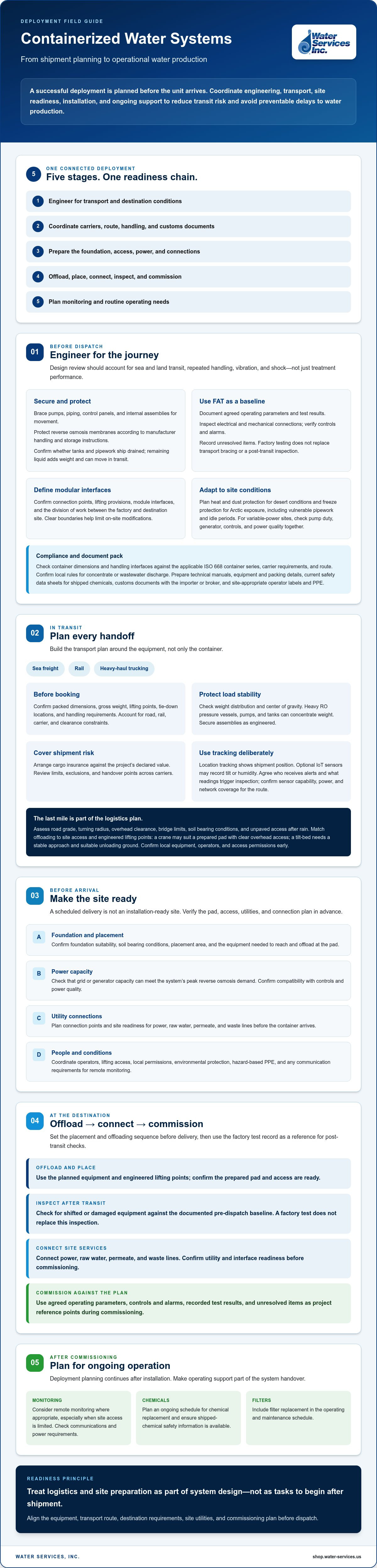
The Installation Workflow: From Offloading to Commissioning
After offloading the container, follow the approved installation drawings and commissioning procedure. A controlled sequence helps catch alignment, connection, and startup issues before the reverse osmosis system reaches operating pressure.
- Place and level the container. Use the designated lifting points and verify position and level against the project drawings before securing the unit. Confirm doors and maintenance panels can open fully.
- Connect external utilities. Connect power, raw-water supply, permeate, and reject or waste lines to the specified interfaces. Check line identification, flow direction, supports, and connection ratings before introducing water or energizing equipment.
- Inspect and prepare the system. Check that components are secure and valves are in the correct startup position. Prime and vent centrifugal pumps as directed by the manufacturer. Running a pump without adequate liquid can damage equipment.
- Load and stabilize membranes. Follow the membrane manufacturer’s handling, storage, loading, flushing, and startup instructions. Keep membranes protected from drying or contamination, and bring the system into operation under the specified conditions.
- Test and verify performance. A project may specify a 48-hour performance test. Treat that duration as an acceptance-plan requirement, not a universal standard. Record operating conditions and verify product-water quality against the project’s agreed criteria before handover.
Mechanical and Electrical Integration
Before startup, verify protective grounding and surge protection against the electrical design and applicable site requirements. Check centrifugal pump rotation using the manufacturer’s approved procedure before running under full load. For RO equipment, inspect and leak-test high-pressure manifolds using the system’s specified test method and limits. Don’t tighten or adjust pressurized components while the system is operating.
Calibrate flow meters and pressure sensors according to their manufacturers’ procedures and the accuracy requirements documented for the project. Record calibration status, instrument identifiers, and readings. Don’t assume one accuracy standard applies to every instrument or installation.
Commissioning, Training, and Baseline Records
Commissioning should include operator instruction on normal startup and shutdown, alarms, safe isolation, and routine checks. Tailor the training to the treatment process and site operating conditions. For the performance baseline, record feed-water conditions, flow rates, pressures, recovery settings, and product-water results alongside the date and test conditions. These records give the operations team a reference for identifying changes during future maintenance.
For projects specifying Goulds centrifugal pumps, review the relevant Goulds Water Technology pump options and confirm the selected equipment matches the system design. A documented commissioning sequence makes shipping and installing a containerized water system a verifiable handover, not just a completed hookup.
Operational Success: Support and Maintenance Post-Installation
Commissioning marks the start of operations, not the end of planning. For off-grid sites, remote monitoring can help operators track system status and identify changes in flow, pressure, or alarms without relying on constant on-site observation. Confirm communications coverage, power requirements, alert routing, and response responsibilities before the system enters service. Monitoring supports operations, but it doesn’t replace scheduled inspections or trained site staff.
Consumable planning matters just as much. Set replacement intervals for filters and membranes using manufacturer guidance, operating records, and actual feed-water conditions. Track antiscalant and other chemical use against expected demand, and set reorder points that account for procurement and transport to the site. Avoid basing stock decisions only on calendar estimates: changes in source-water quality or operating conditions can affect consumption and component life.
Consumable Logistics for Remote Sites
Maintain an inventory of critical items such as RO membranes, antiscalants, and replacement filters. Record part identifiers, storage requirements, quantities on hand, and replenishment lead times confirmed by suppliers. Store chemicals as specified and use current safety data sheets to guide handling. For remote regions, define who will diagnose faults, where replacement parts can be sourced, and how local personnel should escalate issues. Don’t assume emergency technical support is automatically included with equipment.
For chemical replenishment, review the available water treatment chemicals and confirm product suitability for the system and site requirements before ordering.
Scaling, Shutdown, and Relocation
If demand increases, assess whether the existing plant can meet the new flow and water-quality requirements before adding a modular unit. Check shared power, feed-water capacity, concentrate handling, controls, and connection points. For temporary projects, rental or leasing options may help manage capital expenditure, subject to the system configuration and project terms.
Before mothballing or relocating a plant, follow the equipment and membrane manufacturers’ preservation instructions. Document the shutdown, isolate utilities safely, protect components from environmental exposure, and record the condition of membranes and stored chemicals. Before restart, inspect the system and complete the checks required by its operating procedure. These plans help a containerized water system adapt to changing site needs.
Plan the Deployment Before the System Ships
Reliable water production depends on decisions made well before commissioning. Align transport and customs planning with site access, foundation capacity, utility connections, and discharge requirements. Then use a documented startup and maintenance plan to support safe operation after handover.
That’s the core of shipping and installing a containerized water system: treat design, delivery, installation, and ongoing operations as one coordinated project. For mining, military, and industrial applications, Water Services, Inc. provides custom-engineered containerized reverse osmosis and ultrafiltration systems.
Review treatment requirements, destination conditions, and the project schedule before selecting a system. Explore Water Services, Inc.’s containerized water treatment solutions to identify equipment options for your deployment. Clear responsibilities and site-readiness checks give your team a practical path to operational water production.
Frequently Asked Questions
How long does it typically take to install a containerized water system once it arrives on site?
There’s no single installation duration that applies to every project. Timing depends on whether the foundation, power, water lines, lifting equipment, and permits are ready, as well as the plant’s configuration and commissioning requirements. For shipping and installing a containerized water system, ask the project team for a schedule that separates offloading, utility connections, startup, testing, and operator handover. Site readiness can prevent avoidable delays.
What are the power requirements for a standard 40ft containerized RO plant?
There isn’t one standard power requirement based on container length alone. Electrical demand depends on the plant design, feed-water conditions, production targets, pumps, and auxiliary equipment. Request the system’s electrical load schedule, including voltage, phase, frequency, connected load, and motor-starting requirements. Compare these figures with the site grid or generator capacity, and confirm grounding, protection, and power-quality requirements with the equipment designer before shipment.
Can containerized systems be shipped to landlocked remote mining sites?
Yes. A landlocked site can receive a containerized plant through a coordinated route using sea freight where applicable, followed by rail or road transport and heavy-haul delivery. Check the route for container dimensions, gross weight, bridge and road limits, turning space, grades, and ground conditions at the site. Confirm offloading equipment and local transport partners before dispatch. Remote access constraints can affect the delivery plan and schedule.
Do I need a special foundation for a containerized water treatment unit?
The unit needs a stable support surface designed for its installed loads and site conditions. A concrete pad or engineered compacted base may be suitable, but the choice depends on soil bearing capacity, drainage, settlement risk, anchoring, and equipment load distribution. Use the system drawings and have a qualified civil engineer verify the foundation design. Check levelness against the project’s specified tolerance rather than assuming a generic grade will work.
What is the difference between FAT and SAT in the commissioning process?
FAT, or Factory Acceptance Testing, is performed before shipment to check the system against agreed design and functional criteria at the factory. SAT, or Site Acceptance Testing, takes place after delivery and installation to verify the equipment and interfaces under site conditions. The project plan should define test procedures, acceptance criteria, responsibilities, and records for both stages. Neither test replaces careful transport preparation or site-readiness checks.
How are sensitive RO membranes protected during long-distance shipping?
Membranes should be handled, stored, and transported according to the membrane manufacturer’s instructions. Before dispatch, confirm the required preservation condition, packaging, temperature limits, orientation, and inspection steps with the supplier. Secure the system’s internal components against movement during sea and land transport, and inspect the shipment for damage on arrival. Keep membrane records and handling instructions available to the receiving team before installation and startup.
What permits are required for installing a modular water system in the US vs. internationally?
Permit requirements depend on the installation location, intended use, water source, discharge route, and local authority. In the US, check with the relevant state and local authorities about construction, electrical, water withdrawal, and discharge approvals that may apply. For international projects, confirm requirements with the destination-country authorities and a qualified local importer or technical adviser. Review the project’s specific conditions early; there isn’t a universal permit list for every site.
Can these systems be operated by local staff with minimal training?
Local staff can operate a system when they receive training suited to its design, controls, treatment process, and site procedures. The required level of instruction depends on system complexity and the tasks operators must perform. Training should cover normal startup and shutdown, alarms, safe isolation, routine checks, and escalation procedures. Provide clear operating documents and define who handles maintenance. Don’t assume automation removes the need for trained operators.
0 comments