

What if the primary cause of your membrane failure isn't the feed water chemistry, but the delay in your manual dosing response? For most industrial operators, membrane scaling remains an expensive inevitability that drives up downtime and chemical costs. You likely understand that precise chemistry is the foundation of system health, yet achieving that precision in harsh, remote environments is a constant struggle. This reverse osmosis antiscalant selection guide provides the technical framework needed to move beyond guesswork. It's time to stop reacting to scale and start preventing it with industrial-grade accuracy.
You'll master the specific technical criteria for selecting antiscalants compatible with FilmTec and Hydranautics membranes while learning to eliminate chemical waste. We'll explore how IoT-driven telemetrics and CDS gateways act as the brain of your system, providing real-time visibility into remote RO units. This guide details the shift toward automated, precision dosing that extends membrane lifespan and slashes operational overhead. By the end, you'll have a roadmap for integrating Walchem controllers and Pulsafeeder metering pumps into a cohesive, data-driven strategy for 2026 and beyond.
Key Takeaways
- Identify how threshold inhibition prevents mineral precipitation to maintain industrial RO membrane integrity and flow rates.
- Utilize this reverse osmosis antiscalant selection guide to match chemical profiles with specific FilmTec and Hydranautics membrane requirements.
- Recognize the operational risks of manual dosing and how precise chemical metering reduces the frequency of membrane replacement.
- Leverage IoT-driven telemetrics and cellular gateways to gain remote visibility into system health across harsh industrial sites.
- Evaluate durable hardware components, such as LTE routers and flow sensors, designed for reliable performance in demanding environments.
Understanding RO Antiscalant Chemistry and Function
Industrial RO systems face constant mineral precipitation risks as permeate is extracted and salts concentrate in the brine stream. Antiscalants are specialized surface-active polymers designed to interfere with this process. This reverse osmosis antiscalant selection guide focuses on maximizing membrane flux by preventing the formation of hard mineral scales. Effective chemical selection requires a deep understanding of feed water chemistry, specifically Total Dissolved Solids (TDS), pH, and temperature. These variables dictate the saturation levels of sparingly soluble salts.
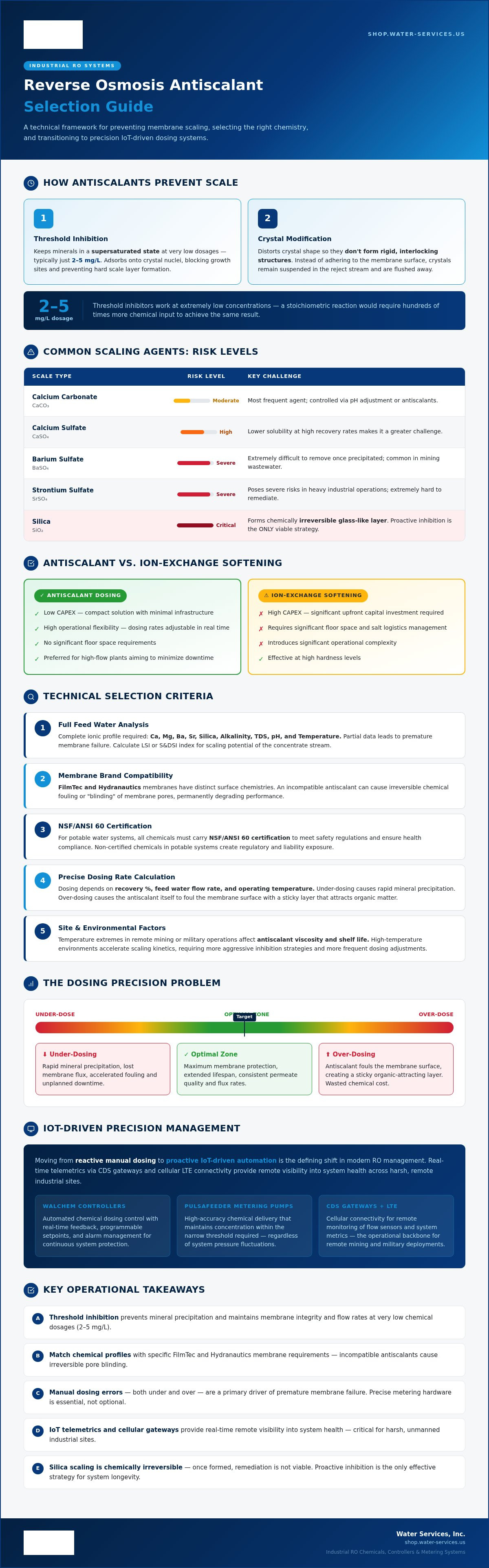
Antiscalants operate primarily through threshold inhibition. This mechanism allows high concentrations of scale-forming minerals to remain in a supersaturated state. Unlike traditional stoichiometric reactions, threshold inhibitors work at very low dosages, often just 2 to 5 mg/L. They adsorb onto the surface of crystal nuclei, blocking the growth sites and preventing the formation of a macroscopic scale layer. Additionally, crystal modification alters the physical shape of any crystals that do form. Instead of rigid, interlocking structures that adhere to the membrane, the crystals become distorted. They don't form a hard layer, ensuring they remain suspended in the reject stream.
Common Scaling Agents in Industrial Water
Calcium Carbonate (CaCO3) is the most frequent scaling agent, often controlled by pH adjustment or specialized antiscalants. Calcium Sulfate (CaSO4) presents a greater challenge due to its lower solubility at high recovery rates. In mining and heavy industrial wastewater, Barium Sulfate (BaSO4) and Strontium Sulfate (SrSO4) pose severe risks because they are extremely difficult to remove once precipitated. Silica scaling is particularly dangerous in high-recovery systems. It forms a glass-like layer that is often chemically irreversible, making proactive inhibition the only viable strategy for system longevity.
Antiscalant vs. Softening: When to Use Which?
Selecting between ion-exchange softening and chemical dosing depends on system scale and feed water hardness. Softeners involve high CAPEX and require significant floor space and salt logistics. They are effective but introduce operational complexity. Conversely, antiscalant dosing offers a compact, low-CAPEX solution with high operational flexibility. Modern operators often integrate these chemicals with other water treatment chemicals to optimize membrane performance. In high-flow industrial RO plants, the ability to adjust dosing rates based on real-time water quality means it's often the preferred choice for minimizing downtime.
Technical Criteria for Antiscalant Selection
Selection begins with a comprehensive feed water analysis. Relying on partial data leads to premature membrane failure. You must obtain a full ionic profile including calcium, magnesium, barium, strontium, silica, and alkalinity. This data allows for the calculation of the Langelier Saturation Index (LSI) or Stiff-Davis Stability Index (S&DSI) for high-salinity water. These metrics determine the scaling potential of the concentrate stream. This reverse osmosis antiscalant selection guide emphasizes that chemicals must be compatible with specific membrane brands. FilmTec and Hydranautics elements have distinct surface chemistries. Using an incompatible antiscalant can cause irreversible chemical fouling or "blinding" of the membrane pores. For potable water systems, ensure all chemicals carry NSF/ANSI 60 certification to meet safety regulations and ensure health compliance.
Calculating the Dosing Rate
Precision is the difference between a high-performing system and one plagued by downtime. The required dosage depends on the system's recovery percentage, feed water flow rate, and operating temperature. Under-dosing leads to rapid mineral precipitation and lost flux. Conversely, over-dosing can cause the antiscalant itself to foul the membrane surface, creating a sticky layer that attracts organic matter. To maintain a consistent delivery, industrial systems require high-accuracy metering pumps like those from Pulsafeeder or Walchem. These pumps ensure the chemical concentration remains within the narrow threshold required for effective threshold inhibition, regardless of system pressure fluctuations.
Environmental and Site-Specific Factors
Site conditions often dictate chemical performance. In remote mining or military operations, temperature extremes affect the viscosity and shelf life of liquid antiscalants. High-temperature environments accelerate scaling kinetics, requiring more aggressive inhibition strategies and frequent dosing adjustments. For projects in the Middle East and Africa, silica concentrations often exceed 100 mg/L in the feed water. High-silica water requires specific copolymer chemistries to prevent the formation of insoluble silicate scales which are nearly impossible to clean. Monitoring these environmental variables in real-time is critical for maintaining dosing accuracy and membrane health. Operators can gain better control by integrating telemetrics and IoT gateways to track site conditions and chemical efficacy from any remote location.
The Risks of Manual Monitoring and Dosing Errors
Manual water testing is a snapshot in time. It fails to capture the dynamic fluctuations of feed water chemistry in real-time. By the time an operator identifies a hardness spike or a pH shift through weekly sampling, mineral precipitation has likely already begun on the membrane surface. This reverse osmosis antiscalant selection guide emphasizes that intermittent monitoring creates a reactive environment. Relying on manual data leads to delayed responses, which are the primary drivers of irreversible scale formation. In industrial environments, the window to correct a dosing error before crystallization occurs is often measured in minutes, not days.
Human error introduces significant variability into chemical management. Operators often struggle with precise chemical dilution or fail to recalibrate metering pumps following maintenance cycles. These inaccuracies lead to either under-dosing, which triggers rapid scaling, or over-dosing, which causes chemical fouling. Additionally, manual systems create data silos. Auditing chemical usage across multiple containerized RO plants becomes nearly impossible when data is trapped in paper logs. This lack of centralized visibility prevents managers from identifying inefficiencies or predicting membrane failure before it impacts production schedules.
Membrane Autopsy: The Cost of Selection Failure
Failure to maintain proper inhibition leads to expensive membrane autopsies. While some mineral scale is cleanable through aggressive chemical washes, irreversible fouling often occurs when scale layers trap organic matter or silt. Scaling forces the system to operate at higher feed pressures to maintain flux, significantly increasing energy consumption and the workload on Goulds pumps. Monitoring differential pressure is essential. Utilizing high-accuracy Ashcroft pressure gauges allows operators to detect early buildup before it reaches a catastrophic level. Prevention is always more cost-effective than a total membrane rack replacement.
Operational Blind Spots in Remote Locations
Maintaining RO systems in remote mining or military sites presents unique logistical challenges. The "set and forget" approach to dosing is a common but dangerous practice in these environments. Without constant oversight, a single pump failure or a clogged injection line can go unnoticed for shifts, leading to total system failure. Real-time visibility into electric power controls and pump status is necessary to bridge these gaps. Remote visibility ensures that any deviation in motor load or chemical flow is flagged immediately, allowing for intervention before the membrane integrity is compromised in harsh, unstaffed locations.
Modernizing RO Management with IoT Telemetrics
Transitioning from reactive to proactive RO membrane management requires a digital layer that manual testing cannot provide. Integrating high-precision flow sensors and conductivity meters with industrial cellular gateways transforms the RO unit into an intelligent asset. This reverse osmosis antiscalant selection guide identifies IoT as the critical link between chemical efficacy and mechanical reliability. By monitoring the system continuously, operators can move beyond periodic sampling to a model of constant validation. Digital oversight ensures that the precise dosing levels calculated in your chemistry profile are actually delivered to the membrane surface 24/7.
Real-time alerts eliminate the lag time between a component failure and a scaling event. If a dosing pump loses prime or a chemical tank level drops below a set threshold, the system triggers an immediate notification to site technicians. This level of visibility is essential for maintaining the Langelier Saturation Index (LSI) within safe operating margins. Additionally, cloud-based data logging provides an immutable audit trail. This data is invaluable for regulatory compliance and for troubleshooting long-term performance trends across multiple containerized RO plants in diverse geographic regions.
Building a Connected Water Treatment System
Modernizing an RO system follows a logical three-step hardware integration process. First, install high-accuracy sensors for permeate flow, feed pressure, and concentrate conductivity. Second, connect these sensors to an industrial cellular router like the IR915L. This device acts as the central hub for data transmission. Third, configure cloud-based alerts for any parameters that exceed the safety margin. This setup ensures that deviations in water quality are addressed before they lead to irreversible membrane crystallization.
Edge Computing in Water Treatment
Edge computing provides a robust solution for mobile or containerized RO plants operating in remote environments. Hardware like the VG710 Vehicle Gateway processes data locally, reducing the volume of information transmitted over cellular networks. This approach slashes data costs by only transmitting critical scaling alerts or significant parameter shifts. To ensure 24/7 connectivity in harsh industrial sites, these gateways utilize LTE-FDD Band 2/4/13. This reliable communication backbone ensures that your "brain" of the RO system remains online even in mining or military deployments where traditional network infrastructure is absent.
Explore industrial communication hardware in our telemetrics and IoT collection to secure your remote RO operations and optimize chemical performance.
Telemetrics and IoT Selection Guide for RO Systems
Hardware selection for industrial water environments requires a different set of criteria than standard IT equipment. Vibration, extreme heat, and ambient dust are constant factors in mining and military sites. This reverse osmosis antiscalant selection guide emphasizes that digital monitoring is only as reliable as the hardware housing it. Engineers must evaluate equipment based on ingress protection (IP) ratings and operating temperature ranges. Additionally, seamless integration with existing SCADA or PLC systems via RS-232 or RS-485 serial ports is necessary to ensure data flows correctly from the RO sensors to the management dashboard.
Choosing between cellular LTE routers and vehicle-grade gateways depends on the mobility of the water plant. Fixed industrial installations benefit from high-port-density routers that handle multiple sensor inputs. Mobile or containerized plants deployed in the field require ruggedized gateways that manage power fluctuations and physical shock. Signal penetration is another critical factor. Selecting high-gain antennas for remote basins ensures that scaling alerts reach the cloud even when the RO unit is located in a topographically challenging area.
Featured Industrial Connectivity Hardware
- VG710 Vehicle Gateway: This is the preferred choice for mobile mining and military containerized RO plants. It features a ruggedized chassis designed to withstand constant movement and vibration.
- IR915L-FH20-WLAN-W-S: A robust 5-port LTE router optimized for fixed industrial sites. It provides stable high-speed connectivity for multiple sensor arrays.
- GNSS Antennas: These are essential for tracking the location and operational status of mobile water rental units across large geographic territories.
Cables and Integration Accessories
Integration accessories bridge the gap between water treatment hardware and telemetrics gateways. OBD-II and J1939 power cables allow for direct integration with heavy-duty vehicle power systems, which is common in trailer-mounted RO units. For the VG710 gateway, 20 PIN extension cords provide the flexibility needed for clean installations in tight control cabinets. Signal stability in remote basins is often achieved by pairing gateways with high-gain Wi-Fi and LTE antennas. These components ensure the communication backbone remains stable regardless of local interference.
Optimizing Your Digital Infrastructure
Securing your network access is just as important as the hardware itself. Use APN and VPDN authentication to ensure that only authorized users can access the RO performance data. For critical sites where downtime isn't an option, compare the benefits of LTE Cat. 6 high-speed WAN against dual SIM fallback configurations. Dual SIM setups provide redundancy by switching providers if the primary signal fails. This digital infrastructure ensures your dosing precision remains consistent throughout the membrane's life cycle. You can shop the complete Telemetrics & IoT Collection to find the exact hardware needed for your next deployment.
Securing Long-Term Membrane Integrity through Digital Precision
Effective scale prevention in 2026 requires more than just high-quality chemistry; it demands real-time operational visibility. This reverse osmosis antiscalant selection guide has detailed how matching specific ionic profiles to membrane surface chemistry is only the first step. To eliminate the risks of manual dosing errors and costly downtime, you must integrate durable hardware that provides constant oversight in harsh environments. Precision in chemical delivery is the only way to guarantee the longevity of your industrial assets.
Water Services, Inc. has provided expert engineering support since 1994, delivering reliable solutions for mining and military deployments worldwide. By utilizing industrial-grade LTE connectivity and ruggedized gateways, you can manage your RO plant as a proactive, data-driven system. These digital tools ensure your FilmTec and Hydranautics membranes operate at peak efficiency regardless of feed water fluctuations or remote site challenges. It's time to move beyond reactive maintenance and secure your infrastructure with hardware designed for the rigors of the field.
Optimize Your RO System with Advanced Telemetrics to gain remote visibility and reduce chemical waste today. Protecting your membranes is a continuous process, and the right digital tools make that process seamless and reliable.
Frequently Asked Questions
How do I determine the best antiscalant for my specific water chemistry?
Start with a complete ionic profile including TDS, pH, and temperature to calculate the saturation index. This data is the foundation of any reverse osmosis antiscalant selection guide. You must match the specific chemical formulation to the scaling potential of your feed water, such as calcium carbonate or silica. Since different manufacturers like FilmTec and Hydranautics have unique surface chemistries, verify that your chosen antiscalant is compatible with your specific membrane model to avoid irreversible fouling.
Can I use the same antiscalant for both brackish and seawater RO?
Chemistry requirements differ significantly between these applications. Seawater RO systems face higher ionic strength and specific risks from boron or magnesium precipitation. Brackish water systems typically focus on calcium carbonate and sulfate inhibition at higher recovery rates. While some broad-spectrum chemicals exist, most industrial operators require a tailored approach. Using a single product for both can lead to inefficient dosing or catastrophic scaling events in high-salinity environments where threshold inhibition limits are much tighter.
What are the signs that my RO antiscalant is not working effectively?
Look for a gradual decline in permeate flux and a corresponding increase in feed pressure. You'll often see these trends on your Ashcroft pressure gauges before total system failure occurs. Another indicator is an increase in salt passage as the scale layer disrupts the membrane's rejection properties. If your normalized permeate flow drops by 10% or more, it's a clear signal that your chemical inhibition strategy isn't keeping pace with the mineral concentration in the brine stream.
How does an IoT gateway like the VG710 help prevent membrane scaling?
The VG710 Vehicle Gateway functions as the system's brain by processing sensor data at the edge. It monitors real-time variables like permeate flow and concentrate conductivity, triggering immediate alerts if parameters drift outside the safe LSI margin. This proactive approach prevents scaling by identifying dosing pump failures or chemical tank depletion before mineral crystallization begins. For mobile mining or military containerized RO plants, this gateway ensures membrane health is maintained even when local operators aren't present.
Is it necessary to use a cellular router for a fixed-site RO plant?
Industrial sites often lack reliable hardwired internet, making a cellular router a necessity for consistent monitoring. These devices provide a dedicated, secure connection that isn't dependent on the facility's internal network. For a fixed-site RO plant, using an IR915L router ensures that your cloud-based data logging and regulatory audit trails remain uninterrupted. It's a reliable way to maintain 24/7 visibility into system health while avoiding the security complexities of integrating with a corporate IT infrastructure.
What is the difference between the IR915L and the VG710 for water treatment?
The IR915L is a robust 5-port LTE router designed for fixed industrial installations where physical stability is guaranteed. It provides a central hub for multiple sensor connections in a controlled environment. The VG710 is a vehicle-grade gateway built to withstand the extreme vibration, shock, and heat found in mobile mining or military RO units. While both offer cellular connectivity, the VG710 includes ruggedized components and power management features specifically for equipment powered by heavy-duty vehicle systems or generators.
How do I integrate telemetrics with my existing dosing pumps?
You can connect your metering pumps directly to the gateway's serial or digital I/O ports. Most industrial pumps, like those from Pulsafeeder, offer status outputs that indicate a loss of prime or motor failure. By integrating these with a Walchem controller and a cellular router, you create a closed-loop monitoring system. This setup allows you to track chemical consumption and pump performance remotely, ensuring that the dosing levels specified in your reverse osmosis antiscalant selection guide are always met.
Do I need special antennas for RO systems located in remote mining pits?
Signal penetration is a major challenge in deep mining pits or remote geographic basins. Standard internal antennas often fail to maintain a stable link with cellular towers in these environments. High-gain LTE and GNSS antennas are necessary to ensure that critical scaling alerts and location data reach your management dashboard without interruption. These specialized antennas are designed for harsh outdoor sites, providing the reliable communication backbone needed to protect your RO membranes from unexpected feed water fluctuations.
0 comments