

What if the best water-saving opportunity is reducing demand before adding treatment capacity? Reducing water consumption in mineral processing starts with understanding where water enters, where it leaves, and which streams can safely return to the circuit. Freshwater availability and competing site demands can constrain operations, while losses and reuse opportunities can be hard to trace across interconnected process areas.
These concerns are practical. A change that reduces make-up water can also affect recovery, throughput, equipment, or process-water quality if it isn’t properly assessed. Measure water reduction alongside operating performance, rather than considering it in isolation.
This 2026 guide explains how to map water flows, identify avoidable demands, and rank opportunities using measures relevant to site operations. It covers how to validate changes before wider implementation, account for water-quality requirements, and build a staged reduction plan. The approach is to reduce demand first, then recover and reuse suitable water streams. It also explains where pumps and treatment equipment may support site-specific water management, subject to application requirements and manufacturer data.
Key Takeaways
- Build a site water balance that distinguishes consumption, withdrawal, reuse, and discharge before setting reduction targets.
- Trace connected process-water flows and identify where water-quality requirements differ between stages.
- Assess reuse options against potential water savings, chemistry, suspended solids, process suitability, reliability, and monitoring needs.
- Use a staged approach to reducing water consumption in mineral processing: establish a baseline, screen opportunities, trial changes, and verify results under operating conditions.
- Define flow, head, fluid properties, and duty requirements before assessing whether pumps or treatment systems fit a reuse application.
Why reducing water consumption in mineral processing starts with a site water balance
Water demand, availability, and process requirements differ from one mineral-processing site to another. An operation drawing from a constrained source may have different priorities from a site with dependable supply but limited capacity to manage tailings water. A water balance maps where water comes from, how it moves, and where it leaves a defined system. Without that map, an apparent saving in one area may simply shift demand or loss elsewhere.
For reducing water consumption in mineral processing, first define the accounting boundary. A site-wide balance might include external water sources, the plant, tailings facilities, and site utilities. A process-area balance may focus on a single circuit. Choose the boundary and reporting period before comparing performance, and document what is included so later comparisons use the same basis.
What does water consumption mean at a processing site?
Withdrawal is water taken into the defined boundary from external sources. Reuse is water recirculated or used again within the operation. Discharge is water that leaves the boundary through a discharge or transfer. Consumption is water not returned from that boundary during the reporting period, such as water lost through evaporation or retained in product or tailings. Reporting definitions can vary, so state the site’s method clearly.
Internal recirculation can reduce the need for fresh make-up water, but it doesn’t automatically reduce freshwater demand. A recirculated stream may support production while external withdrawals remain unchanged. Track both total flows and external make-up water to determine whether an intervention changes demand, losses, or only the route water takes through the plant.
Which mineral-processing stages should the water balance include?
Map water users as connected flows, not separate departmental totals. Include grinding, flotation, dust suppression, and equipment washdown, then follow water into tailings handling, thickening, filtration, and storage. Include site utilities within the chosen boundary. These activities sit within the broader stages described in mineral processing fundamentals, including dewatering.
Record external inputs, transfers between areas, recirculation, discharge, and changes in storage. Where measurable, account for rainfall, seepage, and evaporation. For example, a tailings area may receive process water and rainfall while losing water through seepage or evaporation. Omitting those flows can distort the apparent recovery rate.
Use meter readings where available, and label estimates separately from measured values. Check that inlet and outlet records cover the same period and boundary. Before claiming an improvement, confirm the baseline accounts for material flows and identify measurement gaps. A consistent balance makes later trials easier to assess against water use and process performance.
How water moves through mineral processing, and where avoidable losses occur
A processing circuit is a sequence of connected water flows. Water added at grinding may travel with slurry to flotation, then move into tailings management, return to the plant, or leave the system. Looking at each department separately can hide transfers and losses between them. Trace each input through its users and return points to see where water is required, recoverable, or escaping control.
Not every water use is avoidable. Some supports the process or site safety; others may be reduced through better control. The distinction matters. Reducing water consumption in mineral processing means addressing avoidable losses without disrupting necessary operating duties or assuming every return stream is suitable for reuse.
Follow water through grinding, flotation, and tailings management
In grinding, water combines with ore to form slurry and may be added at more than one point. The slurry then moves to flotation, where process water and water carried with solids continue through the circuit. At each stage, compare water entering with water leaving in slurry, overflow, or transfer streams. Use the site’s actual flow paths rather than assuming a standard circuit.
After separation, thickening or filtration can concentrate solids and produce a water-bearing stream that may be recoverable. Tailings storage can also receive water and return some to the plant, depending on site design and operating conditions. Before increasing recirculation, have process personnel assess water chemistry. Dissolved constituents, residual reagents, and suspended solids can change as water circulates, and their effects may differ across process stages.
Find losses in storage, conveyance, and support operations
Inspect tanks, pipelines, sumps, valves, and transfer points for leakage, splashing, or uncontrolled overflow. Compare observed losses with operating records and flow measurements where possible. Review washdown and dust-suppression practices with operations and safety teams. The goal is to remove unnecessary use without compromising equipment cleaning, dust control, or safe working conditions.
Evaporation and seepage may be material at some sites, but their contribution depends on local climate, storage design, and ground conditions. Rainfall and seasonal changes can also affect measured flows. Treat these as site-specific terms to estimate or measure, not fixed assumptions.
Make each measurement answer an operational question. Prioritize flow readings at major inputs, return streams, and suspected loss points. Check water quality when the result will determine whether a stream can be reused or needs treatment. A focused set of reliable measurements is more useful than collecting data at every point without a clear purpose. Where treatment equipment may be relevant to a reuse stream, review industrial water-treatment equipment against the stream’s characteristics and process requirements.
Compare water-reduction options without putting process performance at risk
A water-saving measure is useful only if it fits the process and holds up in operation. Compare options by the freshwater they could displace, the receiving stage’s water-quality requirements, reliability, and monitoring or maintenance needs. A change that looks effective on a flow diagram may be unsuitable if it disrupts recovery, product quality, or stable plant operation.
Use a consistent comparison framework. For each option, record the expected water source and destination, checks required before implementation, operational trade-offs, and how results will be verified. Avoid universal savings claims: outcomes depend on the ore, flowsheet, existing equipment, water chemistry, and site conditions.
- Reclaim process water: Check the recovered flow, quality, storage, pumping, and control requirements. Verify freshwater make-up and process indicators during a controlled trial.
- Improve solids separation: Assess thickening or filtration against tailings-handling requirements and the quality and volume of recovered water. Verify solids performance and downstream process response.
- Reduce avoidable use: Review losses or non-essential water use without reducing necessary process, cleaning, or safety functions. Confirm flow reduction alongside throughput and product-quality measures.
- Add water treatment: Define the feedwater and required outlet quality before comparing treatment options. Verify treated-water quality, operating reliability, and suitability for the intended reuse point.
When can reclaiming process water make sense?
Thickening, filtration, and other solids-separation steps may offer opportunities to recover water, but the receiving process stage determines whether that water is usable. Compare its chemistry and suspended solids with the stage’s operating requirements. Include tanks, transfer pumps, controls, and maintenance in the evaluation. A reclaim stream that needs extensive handling or creates process instability may not be the best first option.
When is treatment needed before water reuse?
Start with water analysis. Identify which dissolved constituents or suspended solids limit reuse, then specify the feedwater conditions and outlet quality needed for the intended use. Only then compare filtration or membrane treatment, checking application suitability against equipment data. Treatment can bring additional operational and maintenance demands. For more treatment and compliance context, consult the site’s mining wastewater treatment solutions article.
Validate every trial against water and process measures. Track freshwater make-up and reclaimed flow alongside relevant recovery, throughput, and product-quality indicators. Set acceptable operating limits with the process team before the trial, then compare results under representative operating conditions. This makes reducing water consumption in mineral processing a controlled operational decision, not a trade-off based on water volume alone.
Build a practical water-reduction plan for a mineral-processing operation
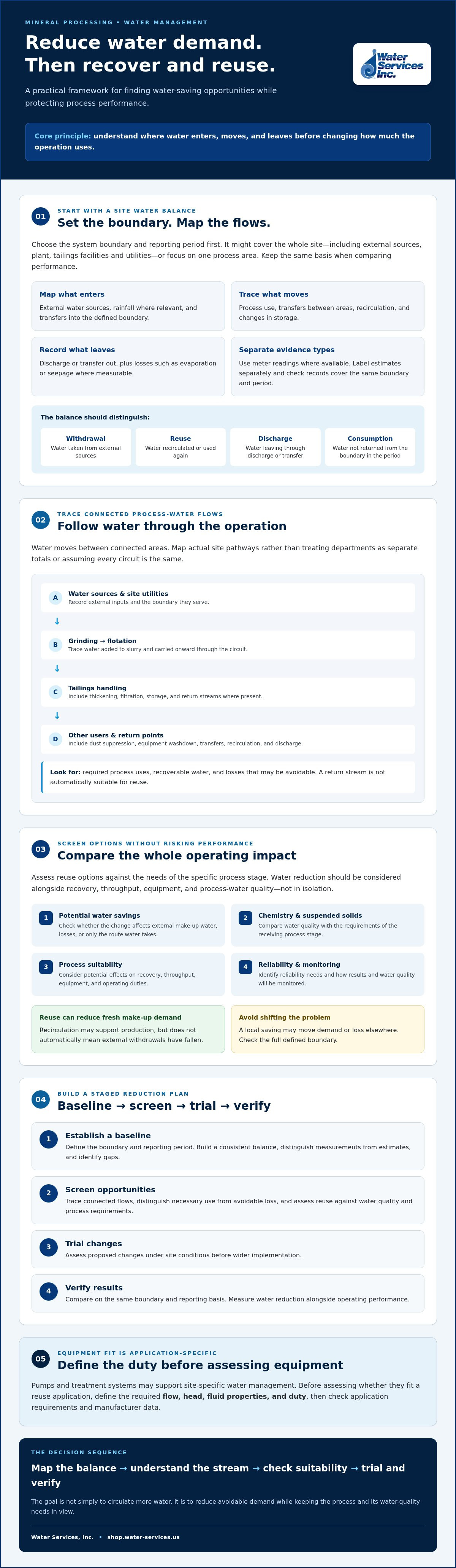
A workable plan turns the site water balance into actions with owners, checks, and measurable outcomes. For reducing water consumption in mineral processing, follow a staged sequence rather than setting a reduction target before the data and operating boundaries are dependable.
- Establish the baseline. Confirm the accounting boundary, reporting period, water sources, major users, and known losses. Record production and operating conditions alongside water flows.
- Prioritize flows. Focus on large freshwater inputs and avoidable losses, while noting which process stages depend on particular water qualities.
- Screen options. Compare potential water savings with process suitability, equipment requirements, reliability, and monitoring needs.
- Trial a change. Agree on operating limits, responsibilities, success measures, and a rollback plan before implementation.
- Verify before scaling. Review results under representative operating and production conditions, then decide whether to adjust, expand, or stop the change.
Set site-specific targets only after validating the measurement boundaries and baseline. Assign an accountable owner to each action: process teams assess effects on recovery and throughput; maintenance checks equipment condition and reliability; environmental staff review relevant discharge and water-quality considerations; and water-management personnel coordinate flow data and reporting.
How should a site establish a reliable baseline?
List external water sources, meters, storage points, and major process users. Check instrument condition, calibration records, units, and data gaps before drawing conclusions. Pair water readings with production rates and operating conditions, such as throughput or changes in the process circuit. This helps distinguish an actual efficiency change from differences in production or measurement coverage.
How can operators verify that a change is working?
Run a controlled trial with agreed operating limits and a rollback plan. Compare freshwater input alongside throughput, recovery, product quality, water quality, and operational reliability. Review results across representative production periods and operating conditions, not just a short favorable window. Investigate trade-offs with the relevant teams before extending the change to other circuits or the whole operation.
Keep the verification method consistent with the baseline. If water use falls but recovery, product quality, or reliability moves outside agreed limits, review the trial before considering it successful. If treatment forms part of the evaluated plan, review industrial water-treatment equipment against the site’s feedwater, required outlet quality, and operating conditions.
Where industrial pumps and treatment systems fit into water reuse
Select equipment only after defining the reuse opportunity. First establish the flow to be moved, water quality at the source, required quality at the reuse point, and the duty the equipment must perform. This process-first sequence keeps reducing water consumption in mineral processing focused on a verified operational need, rather than assuming that installing a pump or treatment unit will automatically reduce freshwater demand.
A pump moves water between process areas, storage, or treatment equipment. Its suitability depends on application-specific flow, head, fluid properties, and operating conditions. Slurry, solids content, temperature, and operating schedule can all affect selection. Review efficiency and control requirements at the actual duty point, then check the manufacturer’s data for the proposed application. A pump should support the reuse plan, not define it.
What pump information should an engineering review include?
Document fluid characteristics, required flow, total head, operating schedule, and site constraints such as available space and connection points. Include expected operating variation, not just a single design condition. Review how the selected pump and controls will perform across that duty range. For a wider system perspective, consult an industrial water treatment systems guide alongside the pump data. Water Services, Inc. supplies industrial pumps, including Goulds Water Technology Pumps, but selection still needs to be confirmed for the specific application.
How should a treatment system be scoped for reuse?
Define influent variability, required capacity, target water quality, and intended reuse point before comparing treatment technologies. The design basis should also account for pretreatment, residuals handling, monitoring, maintenance access, and how the system will operate alongside existing processes. Filtration or membrane treatment may be options to assess, but suitability depends on feedwater characteristics and required outlet quality. An industrial water filtration systems guide can provide additional context for comparing filtration approaches.
Modular treatment systems, including containerized reverse osmosis plants, may be worth evaluating where site conditions call for engineered treatment capacity. They aren’t a universal solution or a guarantee of water savings. Confirm treatment capability and equipment suitability against application requirements and manufacturer information. The same principle applies to pumps: the equipment must match the water stream and operating duty.
For a site-specific next step, discuss an industrial water-treatment requirement after defining the flow, water quality, capacity, and reuse objective.
Turn water data into a practical next step
Reducing water consumption in mineral processing starts with a clear site water balance, followed by targeted action and verification. Trace water across the circuit to distinguish necessary process use from avoidable losses. Compare reuse options with water-quality and operating requirements, then validate trials against freshwater input, recovery, throughput, and product quality.
Equipment supports this process when it matches a defined duty. Assess pumps and treatment systems against site-specific flow, water quality, and operating conditions rather than treating them as guaranteed water-saving solutions.
Founded in 1994, Water Services, Inc. supplies industrial equipment and provides engineering, rental, commissioning, and maintenance capabilities. The company serves mining and other industrial sectors internationally. Review Water Services, Inc.’s industrial water-treatment equipment for options to evaluate against your application.
Frequently Asked Questions
How can mineral processing plants reduce water consumption?
Plants can reduce freshwater demand by first mapping sources, users, recirculation, and losses in a site water balance. Prioritize avoidable losses, then assess recovery or reuse opportunities against the receiving process’s water-quality requirements. Validate each change using measures such as throughput, recovery, product quality, and operating reliability. The right sequence depends on ore, flowsheet, infrastructure, and water availability, so establish a measured baseline before setting site-specific targets.
What is a water balance in mineral processing?
A water balance tracks water entering, moving through, being reused within, and leaving a defined process or site boundary. It helps operators identify major users, quantify internal recirculation, and spot data gaps or apparent losses. Define the boundary, reporting period, units, and operating conditions before comparing results. The balance is only as reliable as its flow data, so check meter condition and distinguish measured values from estimates.
Can process water be reused in mineral processing?
Process water can often be evaluated for reuse, but it must suit the receiving stage. Water chemistry and suspended solids may affect whether a stream is appropriate for grinding, flotation, or another use. Analyze representative samples and involve process engineers before changing circuit flows. During a trial, monitor recovery, product quality, and operating stability. Base reuse on demonstrated compatibility, not an assumption that process water is interchangeable across the plant.
How do mines measure water consumption?
Start by defining whether measurement covers a process circuit, facility, or full site, then distinguish external withdrawal from internal reuse and consumption. Track flows at important sources, users, and return points, and record production and operating conditions alongside the readings. Check units, meter reliability, and data gaps. Consistent boundaries and reporting periods help teams interpret trends accurately and avoid mistaking a change in production output for improved water efficiency.
Does water recycling affect mineral recovery?
Water recycling can affect recovery, depending on water chemistry, solids content, and the process stage receiving the stream. Recycled water may need assessment for potential effects on flotation performance, reagent use, or product quality. Impacts are site-specific. Establish baseline measures, involve process specialists, and trial changes under controlled conditions. Don’t assume that more reuse will improve or reduce recovery without operational evidence from the relevant circuit.
What technologies can help recover water from mine tailings?
Thickening, filtration, and other solids-separation approaches may help recover water from tailings, depending on tailings characteristics and site requirements. Compare options based on expected water quality, residuals handling, energy use, maintenance, and infrastructure needs. Representative testing and engineering review can inform the design basis. A technology name alone doesn’t establish likely recovery or suitability, so assess each option against the intended reuse point and operating conditions.
How often should a mineral-processing water balance be updated?
Update the water balance when process conditions, production rates, water sources, equipment, or measurement systems change. Regular review can also help identify instrument issues and seasonal shifts in site flows. The right frequency depends on operational variability and reporting needs, so set it with site teams rather than applying a universal interval. Document assumptions, boundaries, and data quality each time to keep later comparisons meaningful.
0 comments