

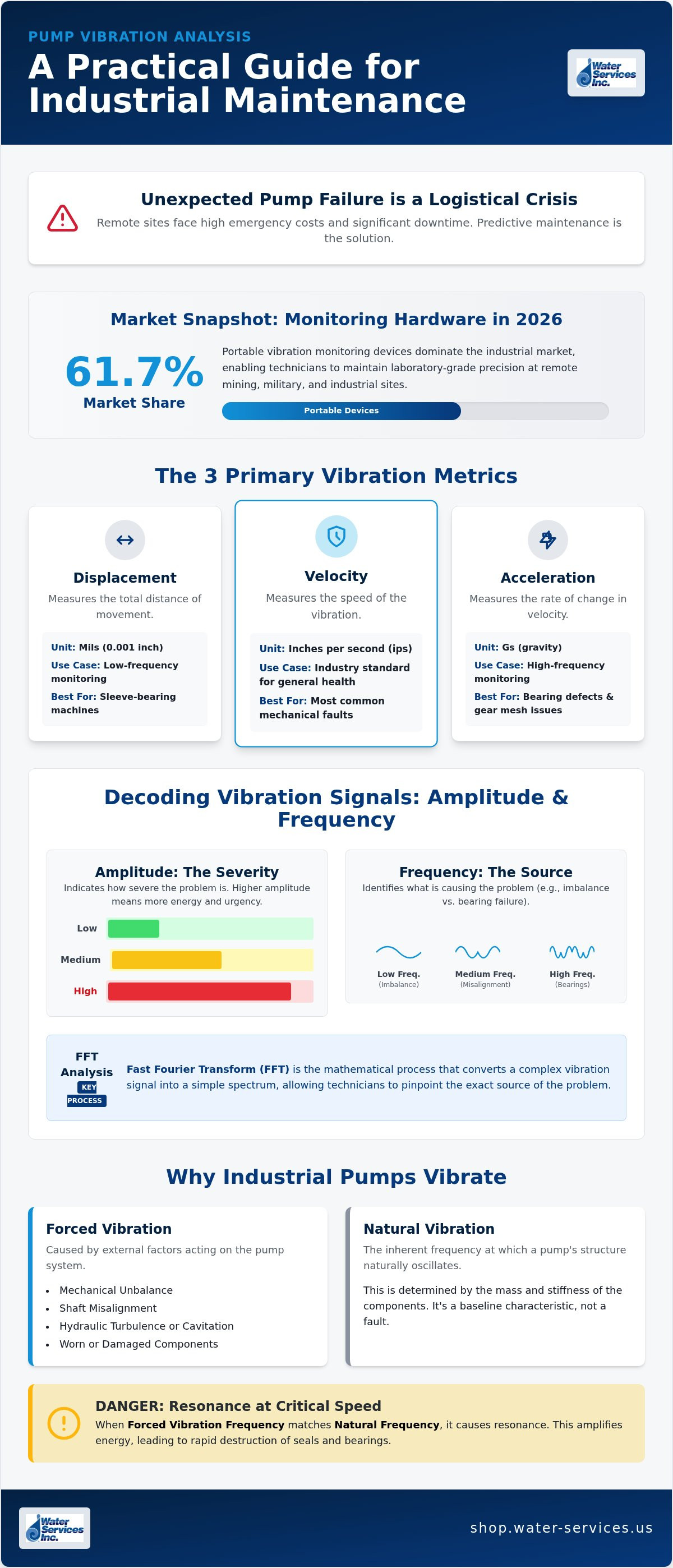
In 2026, portable vibration monitoring devices hold a 61.7% share of the industrial market, yet many remote mining and military sites still struggle with pump vibration analysis basics. You understand that an unexpected pump failure at a distant location is more than a mechanical issue. It's a logistical crisis involving high emergency replacement costs and significant downtime. Managing these risks requires a shift from run-to-failure habits toward precise, data-driven oversight.
This guide provides the technical foundation needed to identify mechanical imbalances or bearing wear before they cause a total system shutdown. You'll learn to master the fundamentals of vibration monitoring to detect early warning signs and extend the lifecycle of your industrial water systems. We'll cover the current ANSI/HI 9.6.4-2022 and ISO 10816-7 standards, explain how to establish a clear performance baseline for Goulds pumps, and show you how to use Ashcroft pressure gauges to correlate your frequency data. By the end of this article, you'll have a technical roadmap to reduce unplanned maintenance costs and maintain asset integrity in the harshest environments.
Key Takeaways
- Master the pump vibration analysis basics to transition from high-cost reactive repairs to a structured predictive maintenance strategy.
- Identify specific mechanical and hydraulic failure modes by matching real-time oscillatory data to known vibration signatures.
- Optimize the performance of Goulds pumps in harsh environments by establishing accurate operational baselines for early fault detection.
- Correlate vibration metrics with Ashcroft pressure gauge data to gain a complete diagnostic view of your industrial water systems.
- Utilize wireless IIoT sensors to monitor remote assets effectively while eliminating the logistical burden and cost of extensive cabling.
Fundamentals of Pump Vibration Analysis
Understanding pump vibration analysis basics is essential for maintaining mechanical integrity in heavy-duty applications. Vibration is the oscillatory motion of a component about a specific reference position. While every machine has an inherent level of motion, excessive oscillation indicates energy loss or mechanical degradation. You can review the Fundamentals of Vibration to understand how these waves move through solid structures and affect rotating equipment. For maintenance teams, this data serves as a diagnostic tool that reveals what's happening inside a pump casing without requiring a teardown.
Centrifugal pumps are dynamic systems. Vibration is the leading indicator of health because it responds to changes in load, alignment, and bearing condition long before temperature spikes or pressure drops occur. To collect accurate data, you must understand three primary metrics:
- Displacement: This measures the total distance of movement, typically in mils (0.001 inch). It is used for low-frequency monitoring of sleeve-bearing machines.
- Velocity: This measures the speed of the vibration in inches per second (ips). It is the industry standard for general pump health and identifies most common mechanical faults.
- Acceleration: This measures the rate of change in velocity, expressed in Gs. It is critical for detecting high-frequency bearing defects and gear mesh issues.
Establishing a baseline is mandatory for any reliability program. Without a known normal state for your specific Goulds Water Technology pumps, your data lacks context. Baselines prevent false alarms caused by environment-specific resonance and allow you to set realistic alert thresholds based on actual field performance rather than generic charts.
The Role of Frequency and Amplitude
Amplitude defines the severity of a problem. If the amplitude increases, the energy behind the fault is growing and requires immediate attention. Frequency identifies the source. By measuring how often a vibration occurs relative to the shaft's rotational speed, you can pinpoint whether the issue is a 1x RPM imbalance or a high-frequency bearing cage failure. Fast Fourier Transform (FFT) is the mathematical process that makes this possible. It breaks down a complex, messy time-waveform into a clear spectrum of individual peaks. This allows a technician to see exactly which component is generating energy.
Why Industrial Pumps Vibrate
Vibration is either natural or forced. Natural vibration is the frequency at which a pump structure inherently oscillates. Forced vibration comes from external factors like unbalance, misalignment, or hydraulic turbulence. When forced vibration matches the natural frequency, the pump reaches its "Critical Speed." This leads to resonance, a condition that can quickly destroy seals and bearings through amplified energy. Fluid dynamics also play a role; internal recirculation or cavitation creates high-frequency energy that erodes impellers and creates parasitic noise that can mask mechanical faults.
Essential Hardware for Vibration Measurement
Effective monitoring begins with selecting hardware that matches the machine's specific dynamics. While understanding pump vibration analysis basics is the first step, the quality of your diagnostic output depends on the transducer's sensitivity and frequency range. Portable data collectors now dominate the field, representing 61.7% of the industrial market in 2026. These devices allow technicians to move quickly between assets while maintaining laboratory-grade precision in remote mining or military sites. A high-quality analyzer must be capable of processing complex Fast Fourier Transform (FFT) data to distinguish between subtle mechanical signatures.
Accelerometers serve as the primary tool for high-frequency pump monitoring. These sensors convert mechanical energy into an electrical signal, typically measured in millivolts per G. They are essential for a robust program of Vibration Analysis for Predictive Maintenance because they detect the early stages of bearing degradation and gear mesh issues. For large industrial units equipped with sleeve bearings, proximity probes are required. Unlike accelerometers that measure the motion of the bearing housing, proximity probes measure the actual displacement of the shaft relative to the bearing. This provides a direct look at shaft orbit and internal clearances.
Selecting the Right Sensors
Industrial environments demand durability. Piezoelectric accelerometers remain the standard for harsh conditions due to their wide frequency response and rugged construction. However, high-end MEMS sensors are increasingly used in wireless deployments because they offer lower power consumption and smaller footprints. Mounting choice is equally critical. Magnetic bases offer convenience for routine routes, but permanent stud mounting is necessary for high-frequency accuracy and repeatability on Goulds industrial pump housings.
Correlating Data with Pressure and Flow
Vibration data provides a mechanical snapshot but doesn't tell the whole story. Hydraulic instability often manifests as mechanical vibration. To confirm if a fault is hydraulic, you must correlate vibration peaks with real-time system pressure. Integrating Ashcroft pressure gauges allows you to identify if a pump is operating too far to the left or right of its design curve. When paired with Signet flow sensors, this hardware suite enables technicians to map vibration against the pump curve, distinguishing between a bent shaft and simple cavitation. Ensuring your monitoring suite is properly configured is vital for long-term reliability. You can find the necessary industrial gauges and sensors to complete your diagnostic toolkit at our online shop.
Identifying Critical Pump Failure Modes
Mastering pump vibration analysis basics requires a shift from simply measuring noise to identifying specific frequency signatures. Every mechanical or hydraulic defect in a centrifugal pump generates a unique vibration pattern. By matching observed peaks to known fault signatures, technicians can diagnose internal issues without stopping production. This "fingerprinting" approach is the most effective way to manage assets in remote mining or military environments where logistical delays for replacement parts are significant.
Early detection of bearing wear provides the highest return on investment in any reliability program. A bearing that shows signs of fatigue in the high-frequency spectrum can be replaced during a scheduled maintenance window. If left undetected, that same bearing will eventually seize, potentially damaging the shaft and housing of your Goulds industrial pumps. Transitioning to this predictive model reduces emergency replacement costs and prevents the cascading failures that occur when mechanical integrity is compromised.
Mechanical Failures: Imbalance and Misalignment
Mechanical faults are usually the easiest to identify because they occur at low multiples of the shaft's rotational speed. Imbalance is the most common issue. It presents as a distinct, high-magnitude peak at exactly 1x the RPM of the pump. If the vibration is predominantly axial and shows strong peaks at 2x RPM, the likely culprit is angular or offset misalignment. Mechanical looseness, such as a loose mounting bolt or a cracked baseplate, often creates a "raised floor" in the vibration spectrum or appears as harmonics at 0.5x RPM intervals. These markers allow for precise corrective action before the pump suffers permanent structural damage.
Hydraulic Failures: Cavitation and Turbulence
Hydraulic issues are system-level failures that manifest as mechanical stress. Cavitation is the most destructive. While it often sounds like "gravel in the pump," it appears in a vibration spectrum as random, high-frequency energy. This occurs when vapor bubbles collapse against the impeller, causing pitting and erosion. For detailed diagnostic steps, you can reference this guide on Pump Vibration Troubleshooting. Vane pass frequency is another critical metric; it's calculated by multiplying the number of impeller vanes by the RPM. A spike at this frequency indicates impeller damage, blockages, or internal recirculation caused by operating the pump too far from its Best Efficiency Point (BEP).
Establishing a Predictive Maintenance Program
Transitioning from a reactive run-to-fail model to a proactive predictive maintenance (PdM) strategy is a financial necessity for high-output facilities. In 2025, the global vibration monitoring market reached a valuation of 1.87 billion USD, with the oil and gas sector alone accounting for 33.2% of that share. This growth reflects the clear economic case for monitoring, especially at remote mining or offshore sites where the cost of a catastrophic pump failure includes both hardware replacement and extensive logistical delays. Implementing pump vibration analysis basics as part of a formal program allows teams to schedule repairs during planned outages rather than responding to midnight emergencies.
Step 1: Asset Criticality Ranking
Not every asset requires continuous monitoring. You must rank your Goulds Water Technology Pumps based on their impact on production and the cost of failure. Mission-critical units, such as main process pumps in a containerized RO plant, often justify permanent wireless sensors for real-time oversight. Non-critical backup units may only require monthly walk-around routes with portable data collectors. This tiered approach ensures your maintenance budget is allocated where it provides the highest protection for your infrastructure.
Step 2: Defining Measurement Points
Data accuracy depends on sensor placement. You must take measurements directly on the bearing housings, as these provide the most direct path for vibration energy from the shaft to the transducer. Consistency is vital for trend analysis. Technicians must record data in three axes: Horizontal, Vertical, and Axial (HVA). Marking these points clearly on the pump housing ensures that every reading is taken from the exact same spot during every route. Always prioritize safety protocols when measuring near rotating couplings or high-pressure lines.
Step 3: Data Analysis and Reporting
Raw data is useless without a structured reporting cadence. Establish a weekly review for critical assets and a monthly summary for the general fleet. While on-site technicians can handle basic data collection, complex spectral analysis often requires specialized technical support to distinguish between subtle faults like resonance or vane pass issues. Documenting every repair alongside its preceding vibration signature allows you to refine your alarm limits over time. If your current system lacks the precision needed for these diagnostics, you can upgrade your industrial pump fleet with units designed for integrated monitoring through our online shop.
Advanced Monitoring for Remote Industrial Sites
Advanced monitoring systems have moved beyond periodic manual routes to continuous, wireless oversight. In 2026, the integration of the Industrial Internet of Things (IIoT) allows for real-time data streaming from assets in the most isolated regions. Wireless vibration sensors are now the standard for these applications because they eliminate the high cost and logistical difficulty of running extensive cabling through complex industrial plants. While early pump vibration analysis basics often relied on handheld devices, modern cloud-based platforms enable remote experts to analyze spectral data from containerized RO and wastewater systems thousands of miles away. This capability ensures that technical integrity is maintained regardless of the asset's geographic location.
Remote Monitoring in Mining and Military Operations
Mining and military operations face extreme environmental challenges; these include intense heat, abrasive dust, and high ambient vibration. These factors can create interference that masks critical mechanical faults. Integrating vibration alerts directly into Walchem controllers provides a critical safety layer by enabling automated system shut-offs when thresholds are exceeded. This prevents catastrophic damage to high-value assets. At a remote mining site in Africa, real-time wireless monitoring recently identified a developing bearing fault in a main process pump. The system triggered an alert before the unit reached its ISO limit, allowing the team to replace the component during a scheduled downtime and avoiding an estimated three-week operational stoppage.
Integrating Vibration Data into System Design
Reliability begins at the engineering stage. Understanding vibration patterns informs the design and fabrication of containerized reverse osmosis plants and mobile ultrafiltration units. Proper skid design is essential for dampening structural resonance. If left unaddressed, resonance can amplify minor mechanical vibrations into destructive forces that cause premature seal failure. Water Services, Inc. utilizes these analytics to ensure that every modular system is built to withstand the rigors of transport and high-pressure industrial use. By incorporating these diagnostics into the initial design, we provide our global clients with equipment that maintains technical integrity even in the most demanding commercial environments.
Optimizing Industrial Reliability Through Data-Driven Maintenance
Implementing pump vibration analysis basics is the most effective way to protect your infrastructure from the high costs of emergency downtime. Identifying spectral signatures for imbalance or cavitation allows you to move beyond reactive repairs. This technical approach is critical for maintaining integrity in remote mining and military sites where logistics are complex. Utilizing Ashcroft pressure gauges alongside wireless IIoT sensors provides the correlated data needed to extend the lifecycle of your critical water systems.
Water Services, Inc. supports global industrial operations with specialized engineering and reliable hardware. As an authorized distributor of Goulds and Ashcroft products, we provide technical support and global shipping for system commissioning in harsh environments. Our team ensures your equipment meets the rigorous demands of your specialized industry. Take the next step in securing your facility's operational uptime.
Browse Goulds Water Technology Pumps and Replacement Parts to find the components and technical expertise needed for your next reliability project. We're ready to help you maintain a steady, efficient operation.
Frequently Asked Questions
What is the most common cause of pump vibration in industrial settings?
Imbalance and misalignment are the primary drivers of mechanical vibration. Imbalance occurs when the center of mass is offset from the center of rotation; this creates centrifugal force that stresses bearings. Misalignment happens when the pump and motor shafts aren't perfectly collinear. These faults often present as distinct peaks at 1x or 2x rotational speed. Addressing these issues early prevents structural fatigue and extends the life of your rotating equipment.
How often should I perform vibration analysis on my Goulds pumps?
Monitoring frequency is determined by asset criticality. Mission-critical Goulds Water Technology pumps in remote mining sites often require continuous wireless monitoring to prevent logistical delays. For general industrial units, monthly or quarterly manual routes are sufficient. Establishing a consistent schedule allows you to trend data over time. This makes it easier to spot subtle changes in the vibration signature before they reach critical ISO thresholds.
Can vibration analysis detect cavitation before physical damage occurs?
Yes, spectral analysis identifies the high-frequency random energy associated with collapsing vapor bubbles. While cavitation sounds like gravel in the pump, it shows up as a floor of noise in the vibration spectrum. Catching this early allows you to correct hydraulic issues, such as suction blockages or incorrect valve settings. This proactive approach saves the impeller from the destructive pitting and erosion that eventually leads to total failure.
What is the difference between a 1x and 2x vibration frequency?
These metrics describe the relationship between vibration and shaft speed. A 1x frequency corresponds to the rotational speed of the shaft and typically indicates a mass imbalance. A 2x frequency occurs at twice the shaft speed and is the classic signature of angular or offset misalignment. Mastering these pump vibration analysis basics is essential for technicians to move from general observation to precise mechanical diagnosis of industrial assets.
Is wireless vibration monitoring reliable for remote mining sites?
Wireless monitoring is highly effective for remote mining and military sites in 2026. Modern MEMS sensors and robust mesh networks overcome the logistical challenges of traditional wired systems. These sensors stream real-time data to cloud-based analyzers, providing immediate alerts for equipment in harsh environments. This technology eliminates the need for expensive cabling and allows for continuous oversight of assets that are difficult to reach for manual inspections.
What ISO standards govern industrial pump vibration limits in 2026?
ISO 10816-7:2009 remains the primary international standard for rotodynamic pumps with a power rating above 1 kW. Although many other industrial machines have moved to the ISO 20816 series, Part 7 for pumps has not been superseded as of August 2026. It establishes the vibration velocity limits used to assess machine health. Adhering to these standards ensures your maintenance program remains compliant with global industrial reliability best practices.
Do I need a certified vibration analyst to start a monitoring program?
You can establish a baseline program using automated diagnostic tools and basic technician training. Modern hardware often includes software that interprets complex FFT data into actionable alerts. While you don't need a certified specialist for daily monitoring, expert technical support is recommended for initial system commissioning or complex troubleshooting. This ensures your thresholds are set correctly and your monitoring program provides the maximum protection for your infrastructure.
How does vibration analysis reduce the total cost of ownership (TCO)?
Vibration monitoring reduces TCO by shifting maintenance from reactive to predictive. By catching a bearing fault early, you avoid the high cost of emergency replacement and the lost revenue of unplanned downtime. This is especially critical in remote operations where shipping parts for Goulds pumps involves significant lead times. Extending the lifecycle of each asset ensures your capital expenditure is optimized over the long term.
0 comments