

The initial purchase price of an industrial pump typically accounts for only 10% to 20% of its total lifetime cost. The remaining 80% is consumed by operational expenses, primarily energy and maintenance. You've likely seen energy inefficiency drain your operational budget, especially with average U.S. commercial electricity rates reaching 13.51¢/kWh as of August 2026. It's difficult to manage unexpected maintenance costs and equipment downtime that halts production at remote sites, yet justifying the higher upfront cost of premium hardware remains a challenge.
This article provides the technical framework required to master pump lifecycle cost analysis to lower your total cost of ownership and improve system reliability. You'll learn how to apply the latest AACE International 138R-25 methodologies to evaluate long-term financial and technical variables. We'll examine how high-efficiency motors and modular containerized systems reduce commissioning costs and ensure compliance with the July 2026 DOE motor efficiency standards. By shifting your focus from procurement price to total lifecycle value, you can secure predictable maintenance schedules and maximize ROI in demanding industrial environments.
Key Takeaways
- Identify why the initial purchase price accounts for only 10% of total ownership costs compared to energy and maintenance expenses.
- Master the financial variables of pump lifecycle cost analysis to justify the ROI of premium efficiency motors and high-performance hardware.
- Evaluate the impact of logistics and harsh environment durability on LCC for remote mining and military installations in Africa and the Middle East.
- Lower installation and commissioning expenses by integrating modular, containerized reverse osmosis plants or mobile ultrafiltration systems.
- Update procurement protocols to prioritize total cost of ownership over the lowest initial bid in your next equipment RFP.
Understanding Pump Lifecycle Cost (LCC) in 2026
Industrial pump systems are long-term assets with service lives typically spanning 15 to 20 years. Understanding the total cost of ownership requires a comprehensive Life-cycle cost analysis (LCCA). This methodology accounts for every dollar spent from the initial engineering phase through to final decommissioning. In 2026, relying on the sticker price is a strategic error that leads to budget depletion. A pump lifecycle cost analysis provides the technical data necessary to reduce industrial waste while ensuring the long-term economic viability of water treatment operations.
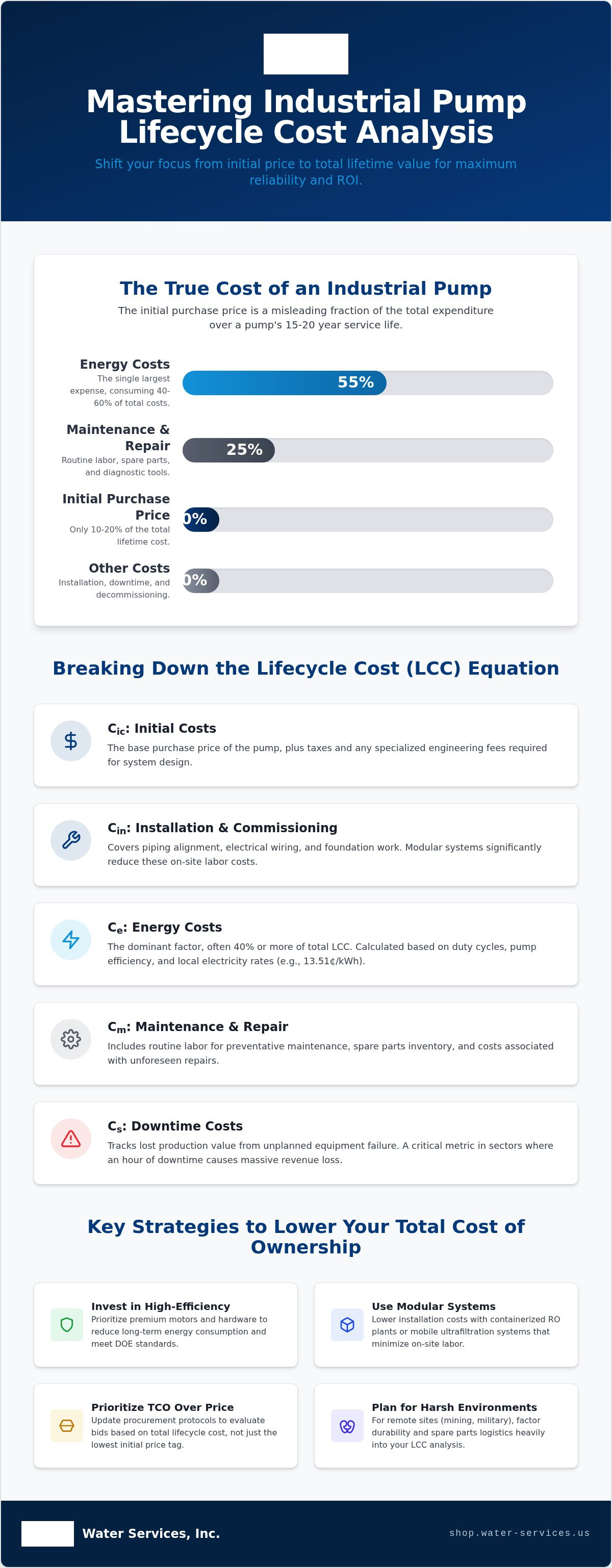
The sticker price of a pump is misleading because it represents a small fraction of the total expenditure. Industry data from 2026 confirms the 10/40/25 rule. The initial purchase price covers only 10% of the lifecycle cost. Energy consumption represents approximately 40% to 60%, while maintenance and repair costs account for 25%. Modern procurement has transitioned from simple component-buying to system-lifecycle engineering. This shift ensures that hardware selection aligns with the operational realities of demanding industrial environments.
The Economic Impact of Inefficient Pumping
Pumping systems represent the single largest opportunity for industrial energy savings. In many facilities, these systems consume 25% to 50% of total plant energy. Inefficient pumps contribute to a high carbon footprint and increased operational overhead. The hidden costs of low-quality equipment manifest as frequent seal failures and unplanned downtime. These failures are particularly costly in remote mining or military sites where spare parts logistics are complex. High-efficiency hardware reduces the kilowatt-hours required for water movement, which directly improves the plant bottom line.
LCC as a Decision-Making Tool for Stakeholders
A pump lifecycle cost analysis bridges the gap between engineering requirements and financial procurement goals. It allows managers to justify the higher upfront cost of Goulds Water Technology Pumps by demonstrating long-term savings in energy and maintenance. This data-driven approach facilitates accurate capital expenditure (CAPEX) planning. When stakeholders prioritize LCC, they ensure the system remains reliable under heavy duty cycles. It doesn't just track spending; it transforms procurement into a calculated investment in system uptime and resource efficiency.
The LCC Equation: Breaking Down the Components
A rigorous pump lifecycle cost analysis relies on a standardized mathematical framework to evaluate long-term asset value. According to the Europump LCC Analysis Guide, the equation is expressed as the sum of several distinct cost variables. Each component represents a specific financial obligation over the equipment's operational life. Understanding these variables allows engineers to move beyond simple price comparisons and toward total system optimization.
- Cic (Initial Costs): This includes the base purchase price, applicable taxes, and specialized engineering fees required for system design.
- Cin (Installation and Commissioning): This covers piping alignment, electrical wiring, and foundation structural work. Utilizing modular containerized systems significantly reduces Cin by minimizing on-site labor requirements.
- Ce (Energy Costs): This is the dominant factor, often representing 40% or more of total LCC. It's calculated based on duty cycles and local utility rates.
- Cm (Maintenance and Repair): These costs involve routine labor, spare parts inventory, and the use of specialized diagnostic tools.
- Cs (Downtime Costs): This variable tracks lost production value. In the mining and oil sectors, an hour of unplanned pump failure can result in massive revenue losses, making Cs a critical metric for reliability planning.
Accurately calculating these values requires precise technical data. You can review our industrial pump inventory to compare high-efficiency specifications that directly impact these variables.
Calculating Energy and Operational Costs (Ce & Co)
Calculating Ce requires analyzing pump curves against specific duty points to estimate annual kilowatt-hour consumption. It isn't enough to look at peak efficiency; you must evaluate efficiency at the actual operating point. Integrating Variable Frequency Drives (VFDs) can slash energy costs by up to 30% by matching motor speed to fluctuating system demand. Advanced electric power controls optimize motor performance and directly reduce the Ce variable in the LCC equation. Operational costs (Co) also include the labor required for daily monitoring and system adjustments.
Factoring in Environmental and Disposal Costs (Cenv & Cd)
Environmental costs (Cenv) involve regulatory compliance for wastewater discharge, which has become more stringent under 2026 EPA guidelines. These costs include the chemicals and filtration media required to meet discharge limits. Implementing Zero Liquid Discharge (ZLD) systems increases initial CAPEX but stabilizes the Cenv variable over the long term. Finally, disposal costs (Cd) cover the end-of-life recycling of industrial metals and the safe removal of hazardous components. A proactive pump lifecycle cost analysis ensures these terminal costs don't become an unfunded liability at the end of the pump's service life.
Industry-Specific LCC Factors: Mining, Military, and Oil
A standard pump lifecycle cost analysis often assumes a stable industrial setting with localized supply chains. For operations in remote Africa or the Middle East, logistics act as a massive LCC multiplier. Shipping a critical seal or impeller to a deep-pit mine involves expedited air freight, complex customs clearances, and specialized ground transport. These logistical variables can increase the effective cost of maintenance (Cm) by more than 200% compared to domestic sites. In these environments, the price of a spare part is secondary to the cost of getting it to the duty point.
Equipment durability in harsh environments is a primary driver of long-term ROI. Standard pumps often fail prematurely when exposed to the high-salinity or abrasive conditions common in oil fields and mining pits. Specialized hardware is engineered specifically for these rigors. While the initial purchase price (Cic) is higher, the drastic reduction in unplanned downtime (Cs) ensures a lower total cost over the asset's life. Reliability becomes the most effective hedge against the high costs of remote site intervention.
Military applications represent the extreme end of the reliability spectrum. In these scenarios, the "Cost of Failure" (Cs) is a non-negotiable factor where equipment must operate in mobile, temporary configurations. Containerized Reverse Osmosis Plants and mobile treatment systems solve this by significantly reducing installation and commissioning costs (Cin). These modular units arrive pre-configured and factory-tested. This eliminates the need for extensive onsite engineering and foundation work, which is often impossible in tactical or remote settings.
Mining Wastewater: A High-Stakes LCC Environment
Mining environments involve abrasive solids and corrosive fluids that accelerate wear on internal components like impellers and wear rings. This environment spikes maintenance frequency (Cm) and requires a robust inventory of specialized spare parts. For detailed compliance and technical requirements regarding these systems, refer to Mining Wastewater Treatment Solutions. Modular systems mitigate these risks by allowing for rapid component swaps. This reduces the total onsite engineering hours required for upkeep and minimizes exposure to hazardous fluids during repairs.
Mobile and Temporary Sites: Rental vs. Purchase
For short-term projects or emergency response, equipment rental is often the most cost-effective LCC strategy. This approach allows operators to avoid the terminal costs of disposal (Cd) and the long-term burden of maintenance (Cm). Mobile ultrafiltration systems provide immediate water purification capabilities without the multi-year capital commitment of a permanent installation. By utilizing mobile assets, organizations can align their pumping costs directly with the project duration. This strategy ensures a high ROI for temporary deployments while maintaining the flexibility to scale down once the project concludes.
Strategies to Lower LCC: Selection and Monitoring
Selecting a pump based on the specific duty point is the most effective way to optimize energy consumption. Many engineers over-size pumps by 20% to 30% to provide a safety margin, but this practice forces the equipment to operate far from its Best Efficiency Point (BEP). This inefficiency leads to excessive heat and vibration, which increases both energy (Ce) and maintenance (Cm) costs. A precise pump lifecycle cost analysis identifies the exact hydraulic requirements to ensure the motor operates at peak efficiency throughout its service life.
Investing in premium efficiency motors provides a documented ROI within 2 to 3 years. These motors meet the current 2026 DOE motor efficiency standards, which are designed to reduce industrial power demand across all sectors. High-efficiency hardware runs cooler and lasts longer, which directly lowers the long-term cost of ownership. When combined with Variable Frequency Drives, these motors allow the system to adapt to fluctuating demand without wasting power or stressing mechanical seals.
Labor-related maintenance risks are often overlooked in financial models. Utilizing proper Personal Protective Equipment (PPE) during chemical dosing or pump teardowns reduces the risk of expensive workplace injuries. Safety protocols ensure that routine maintenance doesn't turn into a high-cost liability. Protecting your technical staff is a fundamental component of maintaining a predictable maintenance budget and avoiding the indirect costs associated with safety incidents.
The Goulds Advantage: Engineering for Longevity
Goulds pumps feature heavy-duty bearings and optimized impeller designs that minimize wear in abrasive environments. These engineering choices reduce the frequency of part replacements, lowering the Cm variable. In a Provo-based project, Goulds pumps maintained their rated efficiency over a 10-year period with only minimal routine service. This durability makes them a preferred choice for high-uptime applications. For more on system design, see our guide on Industrial Water Treatment Systems.
Digital Monitoring and Real-Time LCC Tracking
Walchem controllers and Signet flow sensors provide the granular data needed for predictive maintenance. This real-time visibility allows for "Dynamic LCC" tracking, where operational parameters are adjusted to prevent component fatigue. By catching a drop in flow early, you can schedule repairs before they result in catastrophic downtime (Cs). Ashcroft pressure gauges are essential for monitoring suction and discharge pressure to prevent pump cavitation. This simple monitoring step prevents expensive repairs and ensures the pump lifecycle cost analysis remains accurate by avoiding unplanned asset degradation.
Browse our selection of Walchem controllers and Signet sensors to start monitoring your system health today.
Implementing LCC Analysis in Your Procurement Process
Transitioning from theory to practice requires a systematic shift in how your organization handles capital investments. A successful pump lifecycle cost analysis isn't a one-time calculation but a continuous procurement strategy. Most organizations fail because they prioritize the lowest initial bid, which often secures equipment with the highest long-term operational burden. To reverse this, your Request for Proposal (RFP) must mandate that vendors provide certified energy consumption data and Mean Time Between Failure (MTBF) projections for their hardware. Shifting the evaluation criteria to total cost of ownership ensures that you select assets based on their 20-year financial impact rather than a single budget cycle.
Writing a technical RFP that prioritizes LCC involves asking for specific metrics. You should require pump curves that reflect the actual duty point rather than peak efficiency. Demand detailed maintenance schedules and the current market cost of critical wear parts. This transparency allows your engineering team to model the Cm and Ce variables accurately before any purchase agreement is signed. Partnering with Water Services, Inc. provides access to custom engineering and LCC-optimized designs that align with these rigorous standards.
Conducting a System Audit
Identifying "energy hogs" in your existing water treatment infrastructure is the first step toward optimization. A field audit requires precise tools, including ultrasonic flow meters, power analyzers, and calibrated pressure gauges. These instruments identify pumps operating outside their Best Efficiency Point or those suffering from internal recirculation. If your audit reveals equipment that no longer meets 2026 efficiency standards, it's time to evaluate system upgrades. For detailed information on modern hardware benchmarks, see our Commercial Water Purification Systems 2026 Industrial Buying Guide.
The Role of Technical Support in LCC
Expert commissioning is vital to ensuring a pump starts its service life at peak efficiency, which directly impacts the Cin variable. Improper alignment or incorrect pipe sizing during installation can increase vibration and lead to premature seal failure. Ongoing maintenance contracts help stabilize the Cm variable by ensuring routine tasks are performed by specialized technicians. This proactive approach prevents the catastrophic downtime costs (Cs) discussed in previous sections. Water Services, Inc. offers global project consultations for industrial, mining, and military sites in Africa and the Middle East. Our team ensures your pumping systems are engineered for maximum reliability and the lowest possible total cost of ownership. Contact us today to secure long-term operational stability and reduce your facility's energy footprint.
Optimizing Industrial Pumping for Long-Term Profitability
Mastering pump lifecycle cost analysis allows your organization to move beyond reactive maintenance and toward strategic asset management. By prioritizing high-efficiency hardware and precise duty point selection, you can significantly reduce the energy and downtime costs that typically dominate 80% of a pump's lifespan. Shifting toward data-driven procurement and real-time monitoring ensures your water treatment infrastructure remains compliant with 2026 standards while protecting your bottom line.
Water Services, Inc. serves as a dependable partner for specialized industrial needs. As an authorized distributor of Goulds Water Technology Pumps, we provide the technical integrity required for demanding commercial environments. We offer custom engineering for mining and military applications, supported by global logistics expertise that ensures reliable delivery to remote sites in Africa and the Middle East. Our focus on technical specifications and durability helps you achieve a lower total cost of ownership across your entire fleet.
Optimize your system with Goulds Water Technology Pumps and secure your operational stability today.
Frequently Asked Questions
What is the most significant factor in pump lifecycle cost?
Energy consumption represents the most significant factor in a pump's lifecycle, often accounting for 40% to 60% of the total cost. This expenditure dwarfs the initial purchase price, which usually remains between 10% and 20% of the total financial burden. Selecting high-efficiency motors that meet 2026 standards is the most effective way to manage this variable over a typical 15-year service life.
How does pump over-sizing affect the LCC calculation?
Over-sizing forces a pump to operate away from its Best Efficiency Point (BEP), which significantly increases energy and maintenance costs. This practice leads to excessive heat generation and shaft vibration, accelerating seal and bearing failures. A precise pump lifecycle cost analysis prevents these inefficiencies by aligning hardware selection with exact hydraulic requirements rather than relying on excessive safety margins.
Can Variable Frequency Drives (VFDs) really pay for themselves?
Variable Frequency Drives (VFDs) typically pay for themselves within 2 to 3 years by reducing energy consumption by up to 30%. They allow the pump to match motor speed to fluctuating system demand rather than running at full capacity against a throttled valve. This reduction in operational stress also extends the mean time between failures for mechanical components, lowering long-term maintenance expenses.
What is the difference between CAPEX and OPEX in pump LCC?
CAPEX (Capital Expenditure) includes the initial purchase price, taxes, and installation costs, while OPEX (Operating Expenditure) encompasses energy, maintenance, and labor. In a standard pump lifecycle cost analysis, OPEX represents the majority of the long-term financial burden. Successful procurement strategies focus on reducing OPEX through higher-quality CAPEX investments that offer superior hydraulic efficiency and durability.
How often should a pump lifecycle cost analysis be updated?
Update your LCC analysis annually or whenever there is a significant change in utility rates or system duty points. Shifts in energy costs, such as the 13.51¢/kWh average commercial rate seen in August 2026, can drastically alter the ROI of existing hardware. Regular audits ensure that your maintenance and replacement schedules remain aligned with the actual operational performance of your infrastructure.
Why is downtime (Cs) so expensive in LCC analysis for mining?
Downtime is exceptionally expensive in mining because it results in immediate lost production revenue that can reach thousands of dollars per hour. In remote sites, the cost is compounded by the complex logistics of expedited shipping for specialized parts to Africa or the Middle East. High-reliability pumps are engineered to minimize this Cs variable by providing superior durability in abrasive wastewater environments.
How do Goulds pumps compare to generic brands in LCC terms?
Goulds Water Technology Pumps offer a lower total LCC than generic brands because of their higher hydraulic efficiency and superior material durability. Generic pumps often have lower initial prices but suffer from higher failure rates and shorter service lives. Goulds systems also benefit from a robust global supply chain, which reduces the logistical costs and time required to source critical replacement parts.
Is LCC analysis worth it for small pumps under 5 HP?
LCC analysis is valuable for small pumps under 5 HP, especially when they operate in large clusters or run continuously. While the individual energy savings might seem minor, the cumulative maintenance and energy costs across a facility are significant. Small pump failures can still cause system-wide disruptions that lead to expensive unplanned interventions and production delays.
0 comments