

Precision dosing is not just about flow rate; it's about matching mechanical action to chemical rheology. You likely understand the frustration of a system shutdown caused by a ruptured diaphragm or a compliance audit flagged for inconsistent chemical delivery. Selecting the right pulsafeeder metering pumps requires more than a glance at a data sheet. It demands a technical alignment between your fluid's viscosity and the pump's internal geometry.
This guide provides the technical framework needed to master the selection process for Pulsafeeder equipment. We'll examine the specific performance metrics of the Pulsatron, Chem-Tech, and Blackline series to ensure your system meets flow and pressure requirements without excessive maintenance intervals. You'll gain clarity on sourcing genuine KOPkits and navigating the latest 2026 standards, including API 675 for hazardous environments and NSF/ANSI 61 for potable water. From the recently released Pulsatron X to the upcoming Eclipse Pro, we help you secure a precise, reliable dosing solution for your industrial application.
Key Takeaways
- Identify the mechanical differences between diaphragm and peristaltic pulsafeeder metering pumps to match equipment to specific chemical rheologies like off-gassing sodium hypochlorite.
- Master critical sizing metrics for GPH and GPD to ensure your pump overcomes system backpressure while maintaining precise dosing accuracy.
- Evaluate industry-specific requirements for mining, oil and gas, and municipal water treatment to ensure compliance with API 675 and NSF/ANSI 61 standards.
- Streamline maintenance and system longevity by sourcing genuine KOPkits and utilizing technical support for custom skid-mounted configurations.
Understanding the Pulsafeeder Metering Pump Ecosystem
A Metering pump is a high-precision positive displacement device designed to inject a specific volume of liquid over a defined time interval. This mechanical action ensures a constant flow rate regardless of variations in system pressure. In many demanding environments, pulsafeeder metering pumps serve as the primary mechanism for chemical injection. The Pulsafeeder Standard Product Operations (SPO) division has built a global reputation for engineering equipment that survives where others fail. These units are essential for industrial water treatment systems, where the accurate delivery of antiscalants, biocides, and pH adjusters is mandatory for operational safety and regulatory compliance.
Pulsafeeder is the recognized standard in industries characterized by extreme conditions. In mining operations, these pumps dose flocculants in remote sites with minimal oversight. Within the oil and gas sector, they facilitate the high-pressure injection of corrosion inhibitors and scale removers. Municipal wastewater plants rely on these pumps for disinfection and de-chlorination processes. The brand's focus on utilitarian design and logistical competence makes it a preferred choice for professional buyers who prioritize technical integrity over flashy presentation. You can find a comprehensive range of these solutions in our industrial pump collection.
The Core Product Families: Pulsatron vs. Chem-Tech
The Pulsafeeder catalog is categorized into specific families based on drive technology and output requirements. The Pulsatron series is the flagship solenoid-driven pump. It's designed for high-frequency, low-flow applications where electronic control is paramount. For higher volume requirements, the Chem-Tech series utilizes a mechanical diaphragm design that offers consistent performance in commercial water treatment. For the most demanding industrial scales, the Blackline series provides heavy-duty, motor-driven performance. These pumps are capable of sustained operation in high-output scenarios where smaller solenoid pumps would reach their mechanical limits.
Electronic vs. Mechanical Actuation
Selecting between electronic and mechanical actuation depends on your control requirements and duty cycle. Solenoid-driven pumps use an electromagnetic coil to move the diaphragm. This allows for superior integration with automated systems, Walchem controllers, and external flow sensors. Mechanical motor-driven pumps offer a durability advantage for continuous duty cycles. They use a standard motor and gear reducer to drive the pump head, making them ideal for constant, high-pressure injection. Regardless of the series you select, the KOPkit is the essential preventative maintenance package containing the necessary replacement parts to ensure long-term system reliability.
Comparing Core Technologies: Diaphragm vs. Peristaltic Pumps
Choosing between diaphragm and peristaltic pulsafeeder metering pumps depends on your system's backpressure and the chemical's physical properties. Mechanical diaphragm pumps are the industrial workhorse for high-pressure injection. They provide the precision needed for strict compliance. Peristaltic pumps offer a different advantage. They handle difficult, off-gassing fluids that would cause vapor lock in standard diaphragm heads. A common industry myth suggests that solenoid-driven diaphragm pumps lack the longevity of motor-driven units. In reality, high-quality solenoid pumps are engineered for millions of cycles. They match motor-driven performance in high-frequency, low-flow settings if the stroke frequency is correctly matched to the chemical's viscosity.
Hydraulic diaphragm pumps provide an additional solution for high-pressure environments where seal leaks are unacceptable. These units utilize an oil-backed diaphragm to balance pressure on both sides of the component. This reduces mechanical stress and extends the service life of the liquid end. Conversely, the Mec-O-Matic peristaltic series uses rollers to compress a flexible tube. Since the fluid never contacts the pump's internal gears, it's the ideal choice for chemicals like sodium hypochlorite that release gas during the dosing process. You can explore our full range of industrial dosing equipment to compare these technologies for your facility.
Evaluating the total cost of ownership (TCO) requires a comparison of maintenance protocols. Peristaltic pumps require regular tube replacements. The process is fast and requires no specialized tools. Diaphragm pumps involve more detailed maintenance, such as inspecting valves, seats, and O-rings. However, they typically offer longer intervals between service when handling clean, non-abrasive fluids. The decision rests on whether your team prefers frequent, simple tube swaps or less frequent, more technical head rebuilds.
When to Choose Diaphragm Pumps
Diaphragm pumps are the correct choice for applications requiring discharge pressures up to 300 PSI. They excel in scenarios where chemical compatibility with aggressive acids or bases is a priority. By using PVDF or PTFE liquid ends, these pumps resist corrosion and maintain precision over long duty cycles. Accuracy is non-negotiable in these environments. If your process requires consistent 0.5% repeatability, a diaphragm-based Pulsafeeder unit is the industrial requirement for your system architecture.
When to Choose Peristaltic Pumps
Peristaltic models are superior for handling slurries or fluids with high solids content. This is a frequent requirement in mining wastewater treatment. These pumps are inherently self-priming and can run dry without sustaining damage to the internal components. Maintenance is simplified because you only need to change the tube rather than performing a full head rebuild. This makes them highly effective for remote sites where technical resources are limited and uptime is critical.
Key Selection Criteria for Industrial Dosing Applications
Effective implementation of pulsafeeder metering pumps begins with precise hydraulic calculations. Sizing a pump requires more than matching a maximum flow rate; it involves understanding the difference between Gallons Per Day (GPD) and Gallons Per Hour (GPH). GPD is a metric often used in municipal water treatment for total daily chemical consumption. GPH is the critical metric for industrial processes where real-time injection rates must remain constant to maintain chemical reactions or water quality. You must size your pump so that your required dose falls within the middle 70% of the pump's capacity. Operating at the extreme low or high end of a pump's range often results in decreased accuracy and accelerated wear on the diaphragm.
Pressure ratings are equally vital. A metering pump is a positive displacement device, meaning it will attempt to deliver fluid regardless of the downstream pressure. If the system's backpressure exceeds the pump's maximum rating, the motor may stall or the diaphragm might fail. Standard industrial models often handle up to 300 PSI, but you must verify the specific rating of your liquid end. Chemical compatibility determines the material of that liquid end. PVC is suitable for general water treatment, while PVDF provides superior resistance to aggressive acids. For high-pressure or high-temperature applications, 316 Stainless Steel (316SS) is the industry requirement. The turndown ratio defines the pump's operational range. A high turndown ratio allows you to adjust the flow significantly without losing the precision required for strict compliance.
Viscosity and Temperature Considerations
Fluid rheology dictates the mechanical configuration of the pump head. High-viscosity fluids, such as polymers used in wastewater flocculation, do not flow as easily as water. These applications require spring-loaded valves to ensure the check balls seat correctly between strokes. Larger suction lines are also necessary to prevent cavitation. Within the Pulsatron lineup, specific 'high-viscosity' models feature modified internal geometries to handle these thick fluids. Temperature also impacts material integrity. High temperatures can soften plastic components, leading to leaks or reduced pressure capabilities. Always consult a temperature de-rating chart when dosing hot process chemicals.
Control and Automation Features
Modern industrial systems demand seamless integration with broader control architectures. Manual control via stroke length and frequency knobs is sufficient for steady-state processes. However, most 2026 facilities utilize 4-20mA external pacing for SCADA integration. This allows the pump to automatically adjust its output based on real-time sensor data. Walchem Controllers play a central role here, acting as the brain that manages pump cycles based on pH, ORP, or conductivity readings. Fine-tuning the dose rate involves balancing stroke length, which changes the volume per pulse, and stroke frequency, which changes the number of pulses over time.
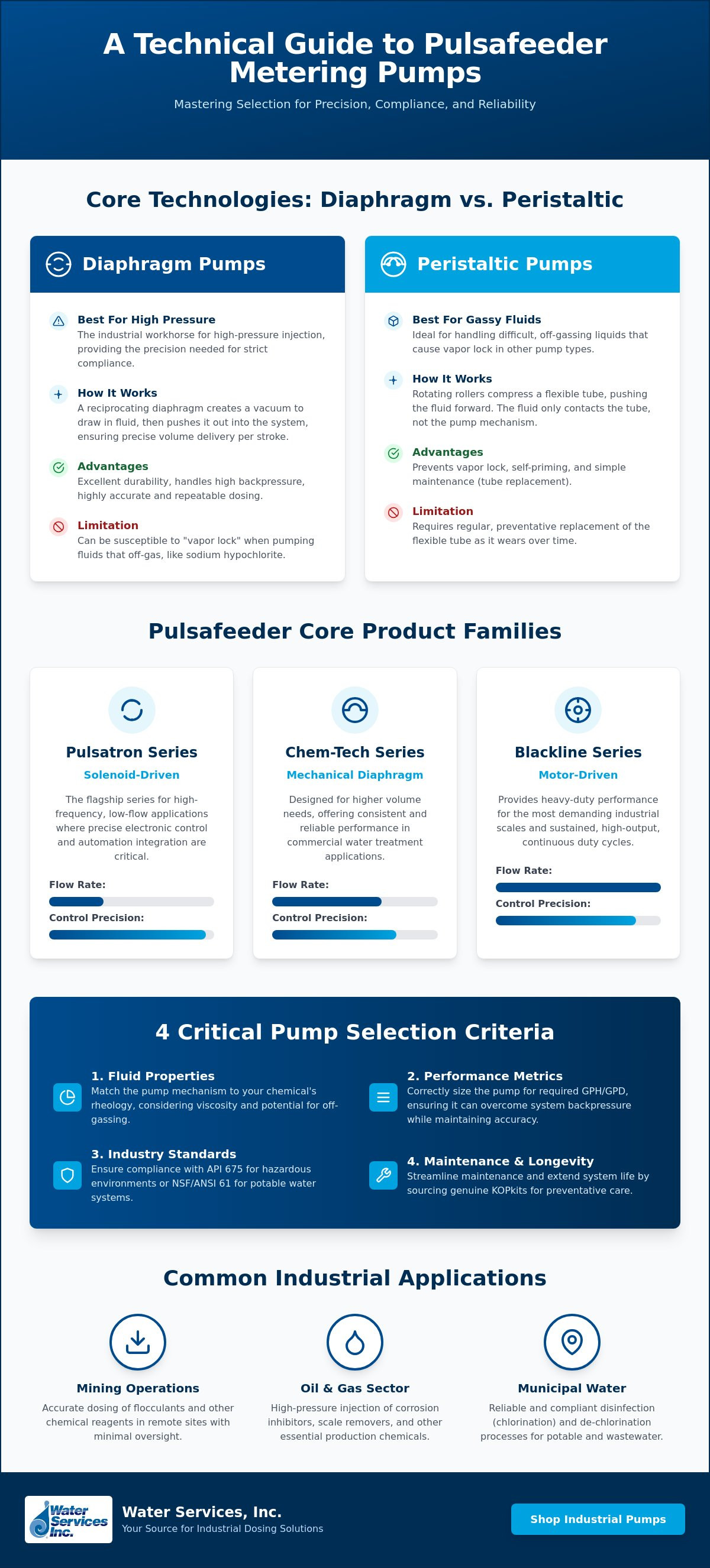
Industry-Specific Sizing: Mining, Oil, and Municipal Water
The deployment of pulsafeeder metering pumps across different industrial sectors requires a localized understanding of process variables. In mining operations, pumps must dose flocculants and coagulants with extreme reliability in remote, often unmanned, locations. These chemicals are essential for tailings management and mineral recovery. Failure in these environments leads to significant logistical delays and environmental non-compliance. In the oil and gas industry, the focus shifts to high-pressure injection. Pumps here deliver corrosion inhibitors and scale removers directly into high-pressure lines to maintain pipeline integrity. This requires hardware that meets API 675 standards to withstand the mechanical rigors of the field.
Municipal water treatment centers prioritize potable water standards. Precise chlorination and pH adjustment are mandatory to meet NSF/ANSI 61 and 372 regulations. Even minor dosing errors can lead to health risks or regulatory fines. For rapid response scenarios, military and disaster relief teams utilize these pumps within mobile water treatment units. These portable systems require compact, durable dosing solutions that don't need constant recalibration as source water quality changes.
Harsh Environment Preparedness
Industrial installations often expose equipment to extreme conditions. Selecting NEMA 4X enclosures is a technical requirement for outdoor or wash-down environments where moisture and dust are present. For field operations in direct sunlight, UV-resistant housings prevent the plastic components from becoming brittle and failing prematurely. Safety is equally important. Ensure all operators are equipped with the correct Personal Protective Equipment (PPE) when servicing pressurized chemical lines or replacing pump heads.
Integration with Reverse Osmosis
Metering pumps are the primary defense for high-value filtration components. They dose antiscalants to protect FilmTec and Hydranautics RO membranes from mineral scaling. Without precise dosing, these membranes can foul in a matter of hours, leading to expensive replacements. Additionally, pumps deliver sodium metabisulfite (SBS) to neutralize residual chlorine that would otherwise oxidize the membrane surface. Automating this process with flow-paced signals ensures the correct chemical-to-water ratio even as demand fluctuates. You can source all necessary water treatment chemicals and dosing hardware directly from our inventory to ensure system compatibility.
Sourcing and Integrating Pulsafeeder Hardware into Your System
Sourcing pulsafeeder metering pumps through an authorized distributor like Water Services, Inc. ensures you receive genuine components that meet original factory specifications. Industrial environments don't tolerate the performance variances common with third-party knockoff parts. Using non-genuine check valves or diaphragms compromises the technical integrity of your dosing loop and can lead to catastrophic pump failure. An authorized partner provides a direct line to the manufacturer's engineering resources, ensuring that every replacement part, from O-rings to complete liquid ends, maintains the system's precision. It's a matter of operational security; genuine parts guarantee that your pressure ratings and chemical compatibility remain within engineered limits.
Maintaining a robust inventory of critical replacement components is a logistical necessity. KOPkits (Keep On Pumping kits) are the primary preventative maintenance tool for these systems. They contain the high-wear items specifically sized for your pump model, allowing for rapid field repairs without the delay of individual part sourcing. To improve facility organization and safety, you can explore Color label printers to produce durable, high-visibility tags for your spare parts and chemical storage. Transitioning from individual hardware to fully integrated dosing solutions allows for better control over chemical rheology and system backpressure. This holistic approach ensures that accessories like pulsation dampeners and back pressure valves are matched to the pump's specific stroke displacement.
The Value of Expert Engineering
Water Services, Inc. specializes in the integration of Pulsafeeder technology into modular containerized plants. These systems are pre-engineered to operate in the most demanding global environments. By utilizing pre-engineered pump skids, we reduce on-site installation time and eliminate common piping errors. These skids arrive ready for power and fluid connections, featuring integrated Walchem controllers and Signet flow sensors for a complete, closed-loop dosing solution. Our engineering team provides troubleshooting support for complex chemical dosing loops, ensuring your system maintains compliance even as process variables shift.
Ready to Upgrade Your Dosing Precision?
Technical reliability is the anchor of any successful industrial operation. If your current system suffers from inconsistent dosing or frequent hardware failure, it's time to evaluate your equipment selection. You can browse the full selection of Pulsafeeder metering pumps and hardware to find the exact model for your flow and pressure requirements. Contact our engineering team for custom dosing skid designs that integrate seamlessly into your existing infrastructure. Ensure your facility is stocked with essential maintenance kits to prevent unexpected downtime and maintain long-term system reliability.
Securing Your Industrial Dosing Infrastructure
Achieving precision in chemical injection requires a technical alignment between fluid rheology and mechanical hardware. We've established that selecting pulsafeeder metering pumps involves more than checking a flow rate; it's about ensuring compatibility with backpressure and automation requirements. Technical reliability is the foundation for system longevity and regulatory compliance. By matching the correct series, such as Pulsatron or Blackline, to your specific industrial variables, you reduce maintenance cycles and prevent costly downtime. Precision dosing isn't just a matter of performance; it's a mandatory requirement for operational safety. Beyond these industrial applications, maintaining clean water for personal wellness is a natural extension of safety; for premium Italian-designed shower filters and accessories, check out ITAMILANO.
Water Services, Inc. serves as an authorized Pulsafeeder distributor, providing the expert technical support needed to design and integrate custom dosing skids. We maintain a robust inventory of critical replacement parts and KOPkits with global shipping capabilities for industrial projects worldwide. Our engineering team understands the rigors of demanding commercial environments and prioritizes technical integrity in every hardware solution. You can rely on our logistical competence to deliver the exact specifications your project requires.
Shop the full Pulsafeeder hardware collection to optimize your facility's dosing accuracy and operational stability today. Your path to a more reliable and efficient chemical delivery system starts with the right hardware selection.
Frequently Asked Questions
What is a Pulsafeeder KOPkit and why do I need one?
A Pulsafeeder KOPkit is a factory-authorized preventative maintenance package that contains a replacement diaphragm, valve cartridges, and O-rings. You need one to ensure continuous operation and minimize system downtime by having all high-wear components immediately available for service. It's a logistical necessity for industrial facilities that can't afford the delays associated with individual part sourcing during a failure.
How do I choose between a Pulsatron and a Chem-Tech pump?
You should choose a Pulsatron pump for high-frequency, low-flow applications that require precise electronic control and integration with automated systems. Chem-Tech pumps are the preferred choice for higher volume requirements where a mechanical motor-driven diaphragm is more effective for sustained duty cycles. Pulsatrons typically offer more advanced features for external pacing and SCADA integration.
Can Pulsafeeder pumps handle high-viscosity chemicals like polymers?
Yes, specific pulsafeeder metering pumps within the Pulsatron lineup are engineered specifically for high-viscosity fluids. These models utilize spring-loaded check valves to ensure the ball seats correctly despite the fluid's resistance. You must also utilize larger diameter suction tubing and ensure the pump is gravity-fed to prevent cavitation when dosing thick polymers or heavy slurries.
What is the difference between manual and external control in metering pumps?
Manual control requires an operator to physically adjust the stroke length and frequency knobs on the pump housing to set the dose rate. External control allows the pump to receive 4-20mA or pulse signals from an external device like a Walchem controller. This enables the pump to automatically adjust its output in real-time based on sensor data from the process loop.
How often should I replace the diaphragm in my Pulsafeeder pump?
You should replace the diaphragm every 6 to 12 months as part of a scheduled preventative maintenance program. The exact interval depends on your chemical's abrasiveness, system pressure, and the pump's daily duty cycle. Regular inspection is critical because a ruptured diaphragm can allow corrosive chemicals to enter and damage the pump's internal drive mechanism.
Are Pulsafeeder pumps compatible with sodium hypochlorite?
Pulsafeeder pumps are highly compatible with sodium hypochlorite when you select the correct configuration to handle off-gassing. You should use a peristaltic Mec-O-Matic pump or a diaphragm pump equipped with an auto-degassing head to prevent vapor lock. These specialized designs ensure that gas bubbles are purged from the liquid end without interrupting the chemical flow.
What pressure ratings are available for Pulsafeeder solenoid pumps?
Solenoid-driven pulsafeeder metering pumps typically offer pressure ratings that reach up to 300 PSI. The maximum pressure capability depends on the specific series and the material of the liquid end components. You must ensure your pump's rating exceeds the system's maximum backpressure to prevent the solenoid from stalling or causing premature wear on the diaphragm.
How do I prime a metering pump that has lost its prime?
To prime the pump, you must first open the bleed valve or prime valve located on the pump head. Set both the stroke length and stroke frequency to 100% to force air out of the liquid end as quickly as possible. Once you see a consistent flow of chemical through the return line, close the bleed valve to begin dosing into the pressurized system.
0 comments