

What happens when a process change coincides with variable influent quality and a critical pump or sensor failure? The result can be more than an isolated equipment issue. Unplanned downtime may interrupt water supply or production while operators work to restore stable treatment. Managing operational risks in water treatment means anticipating how hazards interact, not simply recording them in an assessment.
A useful risk process fits the site and the way its systems operate. It helps teams distinguish high-consequence hazards from lower-priority issues, assign controls, and define which monitoring results trigger escalation. It must also work during a disruption, when decisions depend on clear roles and practical contingency actions.
This guide outlines a repeatable method for identifying site-specific hazards, prioritizing controls, and linking them to monitoring and response procedures. It also explains how treatment equipment and modular system design can support operational resilience, while recognizing that no single configuration suits every facility.
Key Takeaways
- Map treatment stages and dependencies to distinguish hazards, credible failure scenarios, and potential consequences.
- Use consistent, site-specific likelihood and consequence criteria to prioritize risks for action.
- Managing operational risks in water treatment means matching preventive, detective, mitigating, and recovery controls to each priority risk.
- Make controls part of daily practice by assigning monitoring indicators, action thresholds, owners, and documented response steps.
- Connect risk priorities to fit-for-purpose equipment and modular system design for industrial treatment applications.
Managing operational risks in water treatment starts with mapping the process
Operational risk is uncertainty that could affect treatment performance, worker or public safety, compliance, or continuity of operations. A hazard is a condition or event that could cause harm, such as a failed pump or changing source-water quality. A consequence is the resulting impact, such as interrupted production or off-specification water. A control is a safeguard that prevents an event, detects it, limits its effects, or supports recovery. Keeping these terms distinct makes a risk register more useful than a simple list of equipment problems.
Start by defining the facility boundary. Trace water from its influent source through pretreatment, core treatment, storage, and distribution or point of use. Include residuals handling, such as concentrated reject streams or spent filter media, when these are part of the operation. Requirements vary with facility type, location, permits, and intended water use. Document the obligations that apply to the site rather than treating one jurisdiction’s rules as universal. Operational Risk Management Principles offer broader context for structuring this work.
Which operational risks can disrupt a treatment facility?
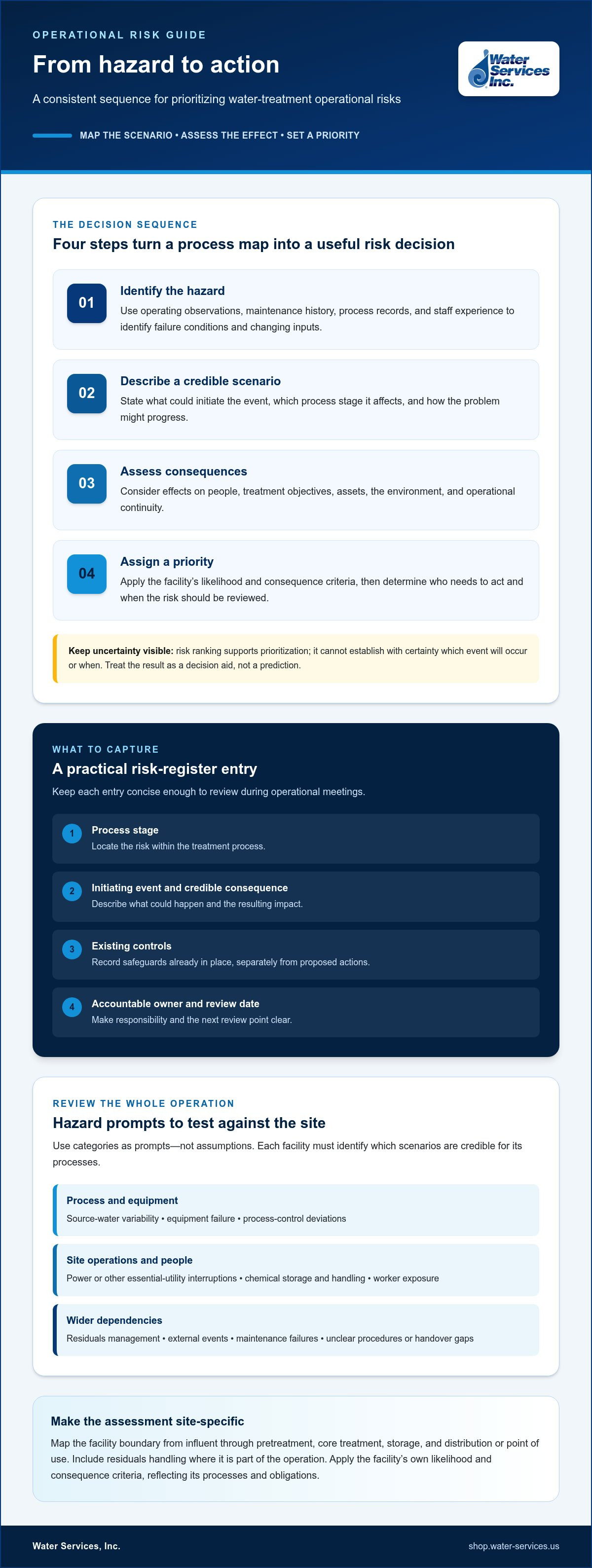
Group hazards so the review covers more than equipment condition. Consider source-water variability, equipment failure, process-control deviations, and interruptions to power or other essential utilities. Add site-specific categories for chemical storage and handling, worker exposure, and residuals management. Distinguish routine process risks from external events, maintenance failures, and human-factor risks such as unclear procedures or handover gaps. These categories are prompts, not assumptions: each facility must identify which scenarios are credible for its processes.
For example, a mining operation using reverse osmosis might assess how a change in influent quality could affect pretreatment and membrane operation. The relevant hazard, consequence, and safeguards depend on the process design and operating records. Another site may prioritize a loss of transfer-pump capacity or an interruption to chemical dosing.
How to map treatment stages before assessing risk
Walk the process flow with operators and maintenance personnel. At each stage, record the equipment, process interfaces, responsible roles, and dependencies. Trace connections between units, including how an upstream failure could alter downstream conditions. Note shared dependencies such as electrical supply, instrumentation, chemicals, and access to replacement components. This makes single points of failure and handoff responsibilities easier to identify.
Use facility records to capture water-quality inputs, documented operating limits, alarm conditions, and existing safeguards. Compare process flow diagrams, operating procedures, maintenance records, and control-system documentation with what staff observe in the field. An alarm alone is not a complete control: record who responds, what action follows, and how the response is documented. Verify thresholds and sampling frequencies against the facility’s design and operating documentation.
A process map also clarifies how equipment fits into the treatment train. For context on industrial system components and treatment stages, see the industrial water-treatment equipment range. Use the completed map as the working boundary for the next step: describing credible scenarios and comparing their consequences.
How to identify and prioritize water-treatment operational risks
A process map becomes useful for decisions when each hazard is expressed as a credible scenario and evaluated for its possible effects. For managing operational risks in water treatment, use the same sequence across treatment stages so teams can compare risks consistently: identify the hazard, describe how it could develop, assess consequences, and assign a priority for action.
- Identify the hazard. Use operating observations, maintenance history, process records, and staff experience to identify failure conditions and changing inputs.
- Describe a credible scenario. State what could initiate the event, which process stage it affects, and how the problem might progress.
- Assess consequences. Consider effects on people, treatment objectives, assets, the environment, and operational continuity.
- Assign a priority. Apply the facility’s likelihood and consequence criteria, then determine who needs to act and when the risk should be reviewed.
Risk ranking supports prioritization; it cannot establish with certainty which event will occur or when. Treat the result as a decision aid, not a prediction.
Build a practical water-treatment risk register
Keep each entry concise enough to review during operational meetings. Record the process stage, initiating event, credible consequence, existing controls, accountable owner, and review date. Separate safeguards already in place from proposed actions. This shows what currently reduces risk and prevents planned work from being mistaken for an active control.
Scenario prompts can include a pump failure, a feed-water change, or loss of a critical utility. A mine-site review might assess how a disruption in wastewater treatment could affect process continuity and residuals handling. The relevant pathways differ by operation, and mining wastewater treatment solutions provide context for treatment considerations at these sites.
Prioritize risks without hiding uncertainty
Define likelihood and consequence categories in site procedures, with clear descriptions for each rating. Record the assumptions and evidence behind a score, including when frequency data is limited. Consider separate consequences for worker safety, treatment targets, equipment, environmental impact, and continuity rather than letting a single overall score obscure a serious effect in one area.
Escalate high-consequence scenarios even when a reliable likelihood estimate is unavailable. A credible event with potentially severe consequences may warrant additional safeguards or response planning despite sparse operating history. Review cyber, physical, and natural-event scenarios as part of the same structured assessment. WaterISAC Security Network provides water-sector security and resilience information that can inform preparedness discussions.
Close each register review by confirming an owner and a practical next step, such as validating a safeguard, improving a procedure, or documenting a contingency. If the assessment identifies an equipment or process gap, industrial water-treatment equipment can be considered as part of a site-specific control decision.
Compare operational controls for water-treatment risks
Controls work best in layers, with each one addressing a different point in a failure scenario. A preventive measure reduces the chance of an event; a detective measure identifies a change; a mitigating measure limits its impact; and a recovery measure supports a return to stable operation. Managing operational risks in water treatment means choosing and maintaining controls that fit the hazard, process design, staffing, and operating conditions. No single technology removes every operational risk or guarantees compliance.
Use the table to compare each control’s intended role with its limitations and the evidence needed to confirm it is functioning. Assign a responsible owner, then check that the safeguard can be tested and maintained under actual site conditions.
| Control type | Purpose and examples | Limitations to consider | Evidence and owner |
|---|---|---|---|
| Preventive | Reduce the likelihood of failure through equipment selection, preventive maintenance, procedures, and operator training. | Wear, incorrect settings, or missed tasks can weaken the control. | Maintenance records, inspection results, and training records; assigned maintenance or operations owner. |
| Detective | Identify developing deviations through monitoring, instruments, and alarms. | A sensor may not detect every failure, and an alarm has limited value without a timely response. | Instrument checks, alarm logs, and response records; assigned control-room or operating owner. |
| Mitigating | Limit consequences with isolation procedures, protective devices, or process arrangements that reduce the impact of a fault. | Effectiveness depends on correct design, availability, and staff understanding. | Inspection and functional-test records; assigned engineering or operations owner. |
| Recovery | Restore operations using documented contingency steps, spare parts, and defined restart checks. | Recovery may depend on utilities, staffing, replacement components, or safe access. | Exercise results, parts records, and restart documentation; assigned incident or site owner. |
Match controls to treatment-process failure modes
Choose controls according to process function. Pumps move water or treatment chemicals; filtration stages remove targeted material; disinfection provides a treatment barrier; and control components support process measurement and adjustment. These functions are not interchangeable. A pump safeguard will not address a filtration problem, and a monitoring instrument will not correct a process deviation by itself.
Connect each instrument or alarm to a defined action: who checks the reading, which procedure applies, and when the issue must be escalated. Set thresholds and sampling frequencies using process design and operating documentation. When a documented control strategy identifies a component need, water-treatment equipment can be considered as part of the process solution.
Evaluate control reliability and operational fit
Before relying on a safeguard, confirm it can be tested, maintained, understood by assigned staff, and accessed under operating conditions. Review spare-parts access, staff competence, redundancy design, and dependencies on power or other utilities. A technically suitable control may be ineffective in practice if the site cannot maintain it or operators do not know how to respond. Reassess fit when the process, staffing, or operating conditions change.
Put monitoring, maintenance, and contingency actions into daily operations
A risk control only works in practice if staff know what to observe, what action to take, and who owns the next step. Convert each priority risk into an operating instruction: identify the indicator, set its approved action threshold, assign a responsible role, and document the response. This makes managing operational risks in water treatment part of routine work rather than a separate assessment exercise.
Connect process monitoring to clear operator actions
Select indicators that relate directly to the scenarios identified at the facility. Depending on the process, these may include flow, pressure, water-quality results, or equipment status. Define the response before an alarm occurs. Specify who acknowledges it, which immediate checks are safe and appropriate, how the result is recorded, and which conditions require escalation to a supervisor or technical lead.
Separate routine operating checks from preventive maintenance. Operators may review readings and confirm equipment status during normal rounds; maintenance personnel follow planned inspection and servicing tasks; incident-response procedures cover abnormal conditions that require containment, shutdown, or recovery. Include pump dependencies in the control plan. Pump equipment options can be considered alongside documented process requirements and site operating needs.
Use shift handoffs to communicate active alarms, temporary safeguards, equipment taken out of service, and outstanding maintenance. Training should cover the actions staff are expected to perform, not just where to find procedures. Sampling schedules, alarm setpoints, and operating limits must follow process design and applicable facility requirements. Do not substitute generic thresholds for documented, site-specific values.
Prepare contingency plans and review them after changes
Write contingency steps for credible disruptions such as equipment outages, supply interruptions, or abnormal influent conditions. Each plan should tell staff how to operate safely, when to isolate or reduce a process, who has decision authority, and how operations will be restored. Define communication routes and documentation responsibilities in advance. State recovery priorities clearly, including what must be checked before equipment or a treatment stage returns to service.
Keep plans usable at the point of work. Identify relevant procedures, contact roles, equipment dependencies, and alternative operating arrangements where the facility’s design supports them. Do not assume a spare unit, utility, chemical supply, or trained operator will always be available. Record limitations and include them in response decisions.
Review the risk register and operating instructions after process modifications, incidents, recurring alarms, or source-water changes. Confirm whether the original assumptions remain valid, whether thresholds or tasks need revision, and whether staff have been briefed. Document the change and assign follow-up actions. For treatment projects where pump selection is part of a documented risk-control plan, review pump options for your application.
Apply a site-specific risk-management program with Water Services
A practical program connects the process map and risk register to decisions about safeguards, equipment, operating procedures, and review. Start with the highest-priority scenarios. Define the treatment function or operational gap that needs attention, then compare possible controls against site conditions and operating objectives. Record why a control was selected, who owns implementation, and what evidence will show whether it remains suitable. This keeps managing operational risks in water treatment tied to engineering and operations, rather than leaving the assessment as a standalone document.
Water Services, Inc. supports industrial projects through equipment supply and custom modular system design. Equipment decisions should follow the documented need. A pump may address a transfer or dosing requirement; filtration, ultraviolet disinfection, reverse-osmosis equipment, or controls may serve different functions in a treatment train. Consider each component in relation to the process, not as a general solution to operational risk.
Translate prioritized risks into equipment and system requirements
Turn each identified control need into a clear requirement. Specify the process duty, relevant influent conditions, intended water use, operating objectives, and connections to upstream or downstream stages. For example, a risk register may identify a treatment-stage dependency that warrants reviewing pump or filtration arrangements. A separate water-quality objective may lead to consideration of ultraviolet treatment or reverse osmosis. The appropriate option depends on the facility’s process design and the risk being addressed.
Modular or containerized systems can address defined project requirements, including industrial applications where the configuration must suit a particular site. They are not a universal fit. Site conditions, influent characteristics, intended water use, and operating objectives shape the system design. Industrial water-treatment solutions can be evaluated as part of a documented control strategy.
Define practical next steps for an industrial facility
Before developing an equipment or system scope, assemble the information that explains the operating need:
- Process-flow diagrams and descriptions of treatment stages.
- Available operating records, water-quality information, and documented process limits.
- Known failure scenarios, existing safeguards, and recurring operational concerns.
- Project objectives, intended water use, and relevant site constraints.
These inputs connect risk priorities to equipment selection and system engineering. Depending on the project, Water Services, Inc. can support implementation through equipment supply, custom modular design, rental options for temporary needs, and technical support for ongoing operations. The right pathway depends on the project scope and facility requirements.
Bring your process information and project objectives to the Water Services, Inc. team to discuss an industrial water-treatment project. A site-specific review can help define equipment and system requirements that align with your documented operational needs.
Turn risk priorities into your next project decision
Decide which operational gaps require a change in equipment, system design, or project planning. A clear project scope keeps those decisions tied to actual site conditions and treatment objectives. It also gives operations and engineering teams a shared basis for evaluating options as requirements change.
Water Services has supplied industrial water-treatment equipment and developed custom modular systems since 1994. Its international project experience includes work across Africa, Central and South America, and the Middle East. This experience supports practical discussions about equipment supply and system design for varied industrial settings, without assuming a single configuration will suit every facility.
For teams managing operational risks in water treatment, progress comes from translating operating needs into decisions that can be reviewed and implemented. Bring your project requirements to Water Services and discuss your industrial water-treatment project. Start with your process information, priority risks, and project objectives.
Frequently Asked Questions
What are the most common operational risks in water treatment?
Operational risks vary by facility and process, so a common category is not automatically a priority at every site. Teams often assess source-water variability, equipment or utility failures, control deviations, chemical handling, maintenance gaps, and human factors such as unclear handoffs. A change in incoming water, for example, may affect one treatment stage but not another. Which scenarios matter depends on treatment objectives, site conditions, and operating procedures.
How do you conduct an operational risk assessment for a water-treatment plant?
Start by defining the system boundary, then identify hazards and describe credible ways they could affect operations. Assess likelihood and consequences using criteria established for the facility, and document safeguards already in place. Assign further actions to named owners and set a review date. Operators can explain actual operating conditions, while technical staff can clarify process design and equipment dependencies. Managing operational risks in water treatment also requires alignment with local requirements and facility procedures.
What happens if a critical water-treatment pump fails?
The consequences depend on the pump’s duty, system design, available redundancy, storage, and current operating conditions. A failure could reduce flow, interrupt a treatment stage, or contribute to a shutdown, but the effect differs between facilities. Follow the approved response procedure rather than assuming a standby unit or bypass is available. Assess effects on downstream processes and water quality, notify responsible personnel, and document the event and follow-up findings.
How often should water-treatment operational risks be reviewed?
Set review timing through site procedures, applicable requirements, and the significance of each risk; there is no universal interval for every plant. Reassess sooner after process modifications, an incident, repeated alarms, maintenance findings, a source-water change, or a shift in operating objectives. Record the review date, participants, assumptions, and resulting actions. This record helps the next review distinguish a changed risk from one that remains stable under current conditions.
Which operational indicators should a water-treatment facility monitor?
Select indicators based on identified risks and process objectives. Depending on the system, useful examples may include flow, pressure, water-quality measurements, equipment status, and alarm history. A trend can reveal a gradual change that a single reading misses, but its value depends on reliable measurement and review. Set thresholds and sampling frequency using process design, operating documentation, and applicable requirements. Assign each indicator an owner and define the response to an abnormal result.
Can a risk register prevent water-treatment downtime?
A risk register cannot prevent every failure or guarantee uninterrupted operation. Its value is making hazards, active safeguards, accountable owners, and unresolved actions visible so teams can direct attention where it is needed. For example, a register may reveal that a recurring alarm has no documented follow-up owner. It is most useful when linked to maintenance records, operating procedures, monitoring, and contingency plans, then updated after changes that affect how the facility runs.
How can industrial facilities prepare for water-treatment disruptions?
Prepare by identifying dependencies that could constrain operation, such as critical equipment, utilities, or essential treatment inputs. Define safe response actions, decision authority, communication routes, and recovery priorities for credible disruption scenarios. A plan should clarify who documents the event and what must be assessed before normal operation resumes. Align it with site procedures, treatment objectives, and applicable requirements, then review it after exercises, incidents, or operational changes.
0 comments