

An incorrectly specified UV reactor isn't just a budget error; it's a critical point of failure for your entire facility's compliance strategy. In the high-stakes environment of 2026 industrial operations, getting your industrial UV water treatment system sizing wrong leads to two equally expensive outcomes: pathogen breakthrough or massive energy waste. You likely recognize that meeting the NSF/ANSI 55 Class A requirement of 40 mJ/cm² is non-negotiable for microbiologically unsafe water. However, balancing that mandate against the realities of lamp aging and quartz sleeve fouling requires more than a simple flow rate calculation.
This engineering guide provides the technical framework to master these variables, ensuring 99.99% pathogen inactivation and long-term industrial reliability. We'll examine how to accurately measure UV Transmittance (UVT) and account for peak hydraulic flow to prevent undersizing. You'll learn to optimize power consumption for Viqua UV systems and other professional-grade hardware, moving beyond guesswork toward a data-driven disinfection stage. By the end of this analysis, you'll have the tools to establish a simplified maintenance schedule and a system designed for maximum uptime in demanding commercial environments.
Key Takeaways
- Identify the 2026 engineering requirements for 4-log pathogen reduction to ensure regulatory compliance and prevent breakthrough.
- Execute precise industrial UV water treatment system sizing by calculating the intersection of peak hydraulic flow, UV Transmittance (UVT), and target dose.
- Recognize the critical necessity of 5-micron pre-filtration to eliminate particle shadowing and protect the integrity of the disinfection stage.
- Design robust UV systems for modular and remote operations that remain effective despite fluctuating water quality in mining and military environments.
- Optimize long-term reliability through the integration of real-time digital sensors and automated quartz sleeve cleaning systems.
The Critical Role of Precision in UV System Sizing
Precision in industrial UV water treatment system sizing is the difference between a compliant facility and a regulatory liability. By 2026, the global engineering standard for industrial disinfection has solidified around a 4-log (99.99%) reduction of target pathogens. This level of inactivation requires a calculated approach to Ultraviolet germicidal irradiation (UVGI) to ensure that every milliliter of water receives the necessary energy. The primary metric for this calculation is the UV Dose, or Fluence, measured in millijoules per square centimeter (mJ/cm²). It represents the product of UV intensity and the time the water is exposed to the light source.
Inaccurate sizing creates immediate operational risks. Undersizing leads to pathogen breakthrough, where microorganisms like Cryptosporidium or Giardia survive the treatment stage, resulting in contaminated process water and severe regulatory fines. Conversely, oversizing is not a safe fallback. Excessive lamp capacity causes unnecessary energy consumption and accelerates lamp solarization, which shortens the effective life of expensive components. In stagnant or low-flow conditions, oversized systems also cause significant heat buildup within the stainless steel reactor, potentially damaging internal sensors or quartz sleeves.
Defining Your Disinfection Goals
Engineering a UV solution starts with identifying the most resistant microorganism in your specific water matrix. While standard bacteria might require a lower dose, 2026 industrial standards often mandate a Class A rating. This requires a minimum dose of 40 mJ/cm² to address robust viruses and protozoa. There's a clear distinction between drinking water standards and process water requirements. For instance, mining discharge in 2026 must meet stringent environmental safety levels that often exceed municipal requirements. Your sizing must account for these specific microbial targets to ensure the system remains compliant throughout its service life.
The Impact of Peak Flow vs. Average Flow
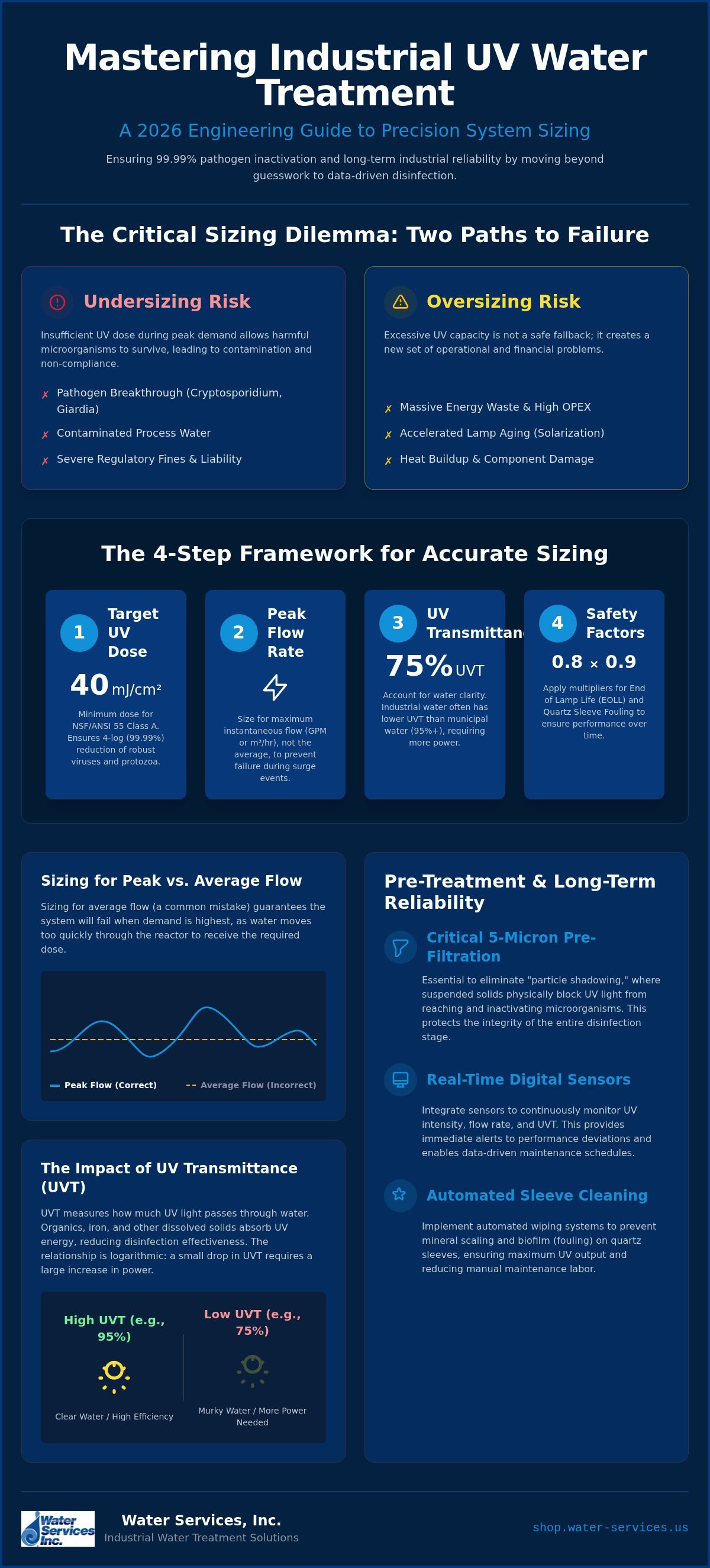
Sizing for average flow is a common engineering mistake that leads to system failure during high-demand periods. Industrial UV systems must be sized based on the maximum instantaneous peak flow. When flow velocity increases, the hydraulic retention time inside the UV chamber decreases. If the water moves too fast, it won't receive the required 40 mJ/cm² dose. Engineers should utilize accurate water flow meter gpm data to model these peak events. This ensures the reactor maintains the necessary contact time even during the highest plant demand cycles, preserving the integrity of the disinfection barrier without compromise.
Calculating the Core Variables: Flow, Dose, and UVT
Executing accurate industrial UV water treatment system sizing requires a multi-step engineering approach. You can't rely on nominal flow rates provided by manufacturers for general use. Instead, you must calculate the system's performance based on the specific water chemistry of your site. This process ensures the equipment maintains a 4-log reduction of pathogens even during peak demand. Follow these four steps to establish your baseline requirements:
- Step 1: Determine Target UV Dose. Identify the most resistant pathogen in your stream. For most industrial applications in 2026, the NSF/ANSI 55 Class A standard of 40 mJ/cm² is the benchmark for treating microbiologically unsafe water.
- Step 2: Establish Peak Flow Rate. Use your highest instantaneous flow, measured in GPM or m³/hr. Sizing for average flow is a common failure point that leads to insufficient contact time during surge events.
- Step 3: Quantify UV Transmittance (UVT). This metric defines how much UV light actually reaches the target pathogens. Industrial sites often deal with UVT levels as low as 75%, compared to 95% in municipal drinking water.
- Step 4: Apply Safety Factors. Account for "End of Lamp Life" (EOLL) and "Fouling Factors." Typically, engineers apply a 0.8 multiplier for lamp aging and a 0.9 multiplier for quartz sleeve scaling.
Understanding UV Transmittance (UVT)
UVT is the most volatile variable in industrial UV water treatment system sizing. Organic compounds, tannins, and dissolved minerals like iron or manganese absorb UV-C energy before it can penetrate a cell wall. It's vital to understand that the relationship between UVT and required power is logarithmic, not linear. A small drop in water clarity often requires a significant increase in lamp intensity or the addition of multiple reactors in series. For high-turbidity industrial sites, engineers should use a 254nm spectrophotometer to take daily grab samples or install an inline UVT sensor for real-time monitoring. If you need to upgrade your monitoring hardware, you can find industrial-grade components in the Water Services, Inc. catalog.
The Inverse Square Law in Industrial UV Chambers
Chamber geometry dictates how effectively the UV energy is distributed. The Inverse Square Law states that UV intensity decreases proportionally to the square of the distance from the lamp. In large industrial reactors, this creates "shadow zones" near the chamber walls where the dose might fall below the required threshold. High-flow reactors often utilize internal baffles or turbulators to mix the water, ensuring every pathogen passes close to the quartz sleeve. UV Fluence Rate is defined as the sum of radiant power from all directions incident on a specific point, quantified as millijoules per square centimeter (mJ/cm²) when calculating the total energy delivered over time. Properly sized Viqua UV Water Purification Systems account for these geometric variables to eliminate bypass risks.
Pre-Treatment Requirements for Industrial UV Systems
Effective industrial UV water treatment system sizing is directly dependent on the quality of the influent water. Without rigorous pre-treatment, it's impossible to maintain the 4-log disinfection standards required in 2026 industrial operations. Suspended solids and dissolved minerals create physical and chemical barriers that impede UV-C penetration, rendering the reactor ineffective regardless of its lamp wattage. Engineering a reliable system requires a multi-stage approach to water conditioning before the stream enters the UV chamber.
The most critical requirement is the removal of particles larger than 5 microns. These solids cause "shadowing," a phenomenon where pathogens hide behind debris and escape the lethal UV-C dose. To prevent this, 5-micron pre-filtration is a non-negotiable standard for industrial installations. Additionally, dissolved minerals like iron and manganese must be managed. Levels exceeding 0.3 ppm of iron or 0.05 ppm of manganese cause rapid scaling on the quartz sleeves. This fouling acts as a physical shield, reducing the intensity of the light reaching the water. Goulds Water Technology Pumps play a vital role here by maintaining constant pressure through these pre-filtration stages and the UV reactor, ensuring the hydraulic retention time remains consistent with the design specifications.
Filtration Synergy: Removing Suspended Solids
Multimedia filter tanks are essential for reducing turbidity and Total Suspended Solids (TSS) in raw water sources. High TSS levels scatter UV light, significantly lowering the UV Transmittance (UVT) and forcing engineers to oversize the system to compensate for the loss of efficiency. For high-flow environments, Harmsco Filtration Products provide high-capacity cartridge solutions that offer the necessary surface area to handle heavy particulate loads without significant pressure drops. This pre-treatment stage ensures the water entering the UV reactor is clear enough for maximum photon penetration.
RO Membrane Integration
In a commercial reverse osmosis water filtration system, UV is often integrated as a dual-purpose barrier. Placing a UV unit upstream of the RO stage prevents biofouling on FilmTec Reverse Osmosis Membranes, extending their service life and reducing the frequency of chemical cleanings. In containerized mining wastewater treatment solutions, UV is also used as a final polishing step. This multi-barrier approach is essential for remote operations where water quality fluctuates and regulatory compliance is mandatory for discharge or reuse.
Sizing for Remote and Modular Industrial Sites
Engineering for a fixed facility differs significantly from industrial UV water treatment system sizing for remote or modular environments. In locations such as isolated mining camps or military outposts, the influent water quality is rarely stable. A system sized for a 90% UVT baseline will fail if seasonal runoff or geological shifts suddenly drop the transmittance to 70%. For these high-risk scenarios, engineers must size reactors based on the lowest recorded UVT to maintain 99.99% pathogen inactivation during worst-case conditions. This conservative approach is a standard requirement for mobile water treatment plant rental units that operate in unpredictable global environments.
Redundancy is another critical factor in remote site sizing. We recommend N+1 configurations for mission-critical disinfection loops. This strategy involves installing an additional UV reactor beyond the calculated capacity, allowing the system to maintain the required dose even if one unit is offline for lamp replacement or quartz sleeve cleaning. Because logistical chains to remote areas are often slow, sizing calculations must also account for extended lamp replacement intervals. Utilizing high-output lamps with a 12,000-hour service life ensures the system remains operational between scheduled supply drops.
Containerized UV System Design
Integrating UV sterilization into 20ft or 40ft modular containers requires precise spatial management. The reactor must be positioned to allow for the full withdrawal length of the UV lamps and quartz sleeves during maintenance. Vibration resistance is also mandatory for mining wastewater treatment solutions that are frequently transported over rough terrain. We utilize reinforced mounting brackets and industrial-grade seals to prevent leaks or lamp breakage caused by mechanical stress. Additionally, thermal management is essential. UV ballasts generate significant heat; in desert or tropical climates, the containerized plant must include active ventilation or climate control to prevent ballast failure and subsequent system shutdown.
Power Reliability and Surge Protection
Remote sites often rely on diesel generators, which can produce unstable voltage and frequency. These fluctuations are detrimental to UV lamp strike success and overall ballast longevity. Integrating specialized electric power controls is necessary to stabilize the input and protect sensitive electronics. We mandate the use of uninterruptible power supplies (UPS) for the UV control circuit to prevent short-cycling during power transitions. This ensures that the lamps remain at full intensity and the disinfection barrier is never compromised by a temporary power dip. For custom-engineered modular systems, you can source the necessary components directly from the Water Services, Inc. power tools and controls collection.
Operational Maintenance and Monitoring Tools
The long-term success of industrial UV water treatment system sizing depends on consistent monitoring and hardware upkeep. Even a perfectly sized reactor will fail to deliver the required 40 mJ/cm² dose if the quartz sleeves are fouled or the lamps have exceeded their effective service life. In 2026, industrial compliance mandates the use of real-time digital sensors to monitor UV intensity. These sensors provide a continuous readout of the UV-C energy reaching the water, allowing operators to detect performance drops before they lead to pathogen breakthrough. If intensity falls below the calibrated setpoint, the system should trigger an automated shut-off valve or an alarm to prevent the distribution of untreated water.
Quartz sleeve cleaning is the most frequent maintenance requirement for industrial systems. You must choose between manual cleaning and automatic wiping systems based on your influent water's mineral content. High-hardness environments or sites with elevated iron levels require automatic wipers that mechanically clear the sleeve surface at programmed intervals. This prevents the "baking" of minerals onto the quartz, which otherwise necessitates a system shutdown for acid cleaning. Technicians must also prioritize safety during these procedures. Exposure to UV-C radiation causes permanent eye and skin damage. All service personnel should utilize certified personal protective equipment (PPE), including UV-blocking face shields and gloves, whenever the reactor is open or the lamps are energized.
Essential Tools for UV System Technicians
Servicing high-output industrial UV reactors requires specialized hardware. Technicians need precision calibration equipment to verify the accuracy of UV intensity monitors and flow sensors against secondary standards. Standard hand tools are often insufficient for the delicate removal of long-format lamps or high-pressure quartz seals. Using the correct torque and alignment tools prevents sleeve breakage and ensures a watertight seal during reassembly. You can browse our specialized Power Tools for water system maintenance to equip your facility's service team with industrial-grade hardware designed for these high-stakes environments.
Maintenance Scheduling for 2026 Compliance
Predictive maintenance is the standard for modern industrial water treatment. Rather than waiting for a lamp failure, operators must use digital lamp hour meters to track usage. Most industrial UV lamps require replacement every 9,000 to 12,000 hours to ensure they maintain the intensity used in the initial industrial UV water treatment system sizing calculations. Documenting these maintenance events and the corresponding UV dose readings is essential for environmental compliance reporting. Utilizing Viqua UV Sterilizers with genuine replacement parts ensures that the system's validated performance remains intact, providing the reliability needed for mining, military, and high-purity process water applications.
Advancing Your Facility's Disinfection Strategy
Successful industrial UV water treatment system sizing requires a rigorous analysis of peak hydraulic loads and specific water chemistry variables. By prioritizing accurate UVT measurements and implementing 5-micron pre-filtration, you establish a robust barrier against pathogen breakthrough. This data-driven approach minimizes energy consumption while ensuring your facility meets the 4-log reduction standards mandatory for 2026 industrial operations.
Long-term reliability is maintained through proactive monitoring and the use of genuine replacement parts. Water Services, Inc. has served as a global leader in specialized remote mining and military water solutions since 1994, delivering equipment to the Middle East, Africa, and the Americas. As an authorized distributor for Viqua and Goulds Water Technology, we provide the technical expertise and hardware necessary for mission-critical disinfection loops. Maintaining your equipment with the correct calibration tools preserves the validated performance of your treatment stage.
Shop Industrial Power Tools for UV System Maintenance to ensure your technicians have the precision hardware required for long-term system integrity. We look forward to supporting your next engineering project with durable, field-tested solutions.
Frequently Asked Questions
How do I calculate the required UV dose for my specific industrial application?
Calculate the required UV dose by multiplying the light intensity within the reactor by the exposure time of the water. For industrial applications, you must identify the target pathogen's sensitivity. Most engineering standards for 2026 require a minimum dose of 40 mJ/cm² to achieve a 4-log reduction of robust microorganisms. This calculation is a central component of industrial UV water treatment system sizing, ensuring the system maintains compliance during peak flow events.
What is the difference between UVT and turbidity in water treatment?
UV Transmittance (UVT) measures the percentage of UV-C light that passes through a water sample, whereas turbidity measures the concentration of suspended solids. Water can be visually clear but have low UVT due to dissolved organic matter or minerals. Conversely, high turbidity physically blocks or scatters light, creating "shadowing" where pathogens survive. Both metrics are vital for system design, but UVT is the primary variable used to determine lamp power.
Can I use a UV system for wastewater with high iron content?
You can use UV for high-iron wastewater only if you implement effective pre-treatment. Iron levels exceeding 0.3 ppm cause rapid scaling on quartz sleeves, which blocks UV-C output and renders the system ineffective. We recommend using multimedia filter tanks or specialized iron removal systems upstream. Automated mechanical wipers are also essential for these applications to maintain sleeve clarity and ensure the disinfection barrier remains functional between manual cleanings.
How often should industrial UV lamps be replaced for maximum efficacy?
Industrial UV lamps typically require replacement every 9,000 to 12,000 hours of operation. While a lamp may still produce visible light, its UV-C output diminishes over time due to a process called solarization. Operating lamps beyond their rated life compromises the safety factor built into your industrial UV water treatment system sizing. Use digital hour meters to track usage and schedule replacements before intensity falls below the required threshold for 4-log inactivation.
What happens if the flow rate exceeds the UV system's rated capacity?
Exceeding the rated flow capacity reduces the hydraulic retention time within the UV chamber. When water moves too quickly past the lamps, it doesn't receive the lethal dose required for disinfection. This leads to pathogen breakthrough and potential regulatory non-compliance. If your facility experiences frequent flow surges, you must install flow restrictors or upgrade to a larger reactor capable of handling the maximum instantaneous peak flow of your stream.
Is pre-filtration always necessary before an industrial UV sterilizer?
Pre-filtration is mandatory for all industrial UV installations to prevent the shadowing of microorganisms. Particles larger than 5 microns can shield pathogens from UV-C radiation, allowing them to pass through the reactor alive. We recommend a multi-stage approach using Harmsco filtration products or similar high-capacity sediment filters. This ensures the water entering the UV chamber meets the clarity requirements necessary for the lamps to achieve their rated disinfection performance.
How do I monitor UV system performance in a remote mining location?
Monitor remote performance by integrating real-time digital UV intensity sensors with your facility's SCADA system. These sensors provide continuous data on lamp output and water transmittance. For isolated mining sites, we utilize Walchem controllers and Signet flow sensors to provide remote alerts if performance metrics drop below safety limits. This hardware allows for predictive maintenance, ensuring that technicians only deploy for service when the lamp hour meter or intensity sensor indicates a requirement.
What safety equipment is required when servicing high-output UV systems?
Servicing high-output UV systems requires specialized personal protective equipment (PPE) to prevent skin and eye damage. Technicians must wear UV-blocking face shields, long sleeves, and gloves to eliminate exposure to germicidal radiation. Never look directly at an energized UV lamp without certified protection. Additionally, ensure the system is de-energized and locked out before opening the reactor chamber. Proper safety protocols are essential for protecting personnel from the intense UV-C energy used in industrial reactors.
0 comments