

The global UV disinfection market is valued at USD 6.62 billion in 2026, with the water segment accounting for over half of that total. You're likely managing the dual pressure of strict NSF/ANSI 55 compliance and the operational risks of lamp failure. Relying on outdated chemical treatment isn't just costly; it's a liability for modern facility management. Integrating a high-performance industrial UV water sterilizer is now a standard requirement for achieving 99.99% pathogen reduction while minimizing your chemical footprint.
This article provides the technical specifications and flow rate requirements needed to select the ideal system for your infrastructure. You'll learn to calibrate for a UV dose of at least 40 mJ/cm² to meet Class A standards and evaluate the reliability of Viqua Professional Series components. We'll analyze the transition to UV-C LED technology and how smart monitoring reduces system downtime. This guide delivers the exact metrics and disinfection standards required for a compliant, high-efficiency water treatment stage.
Key Takeaways
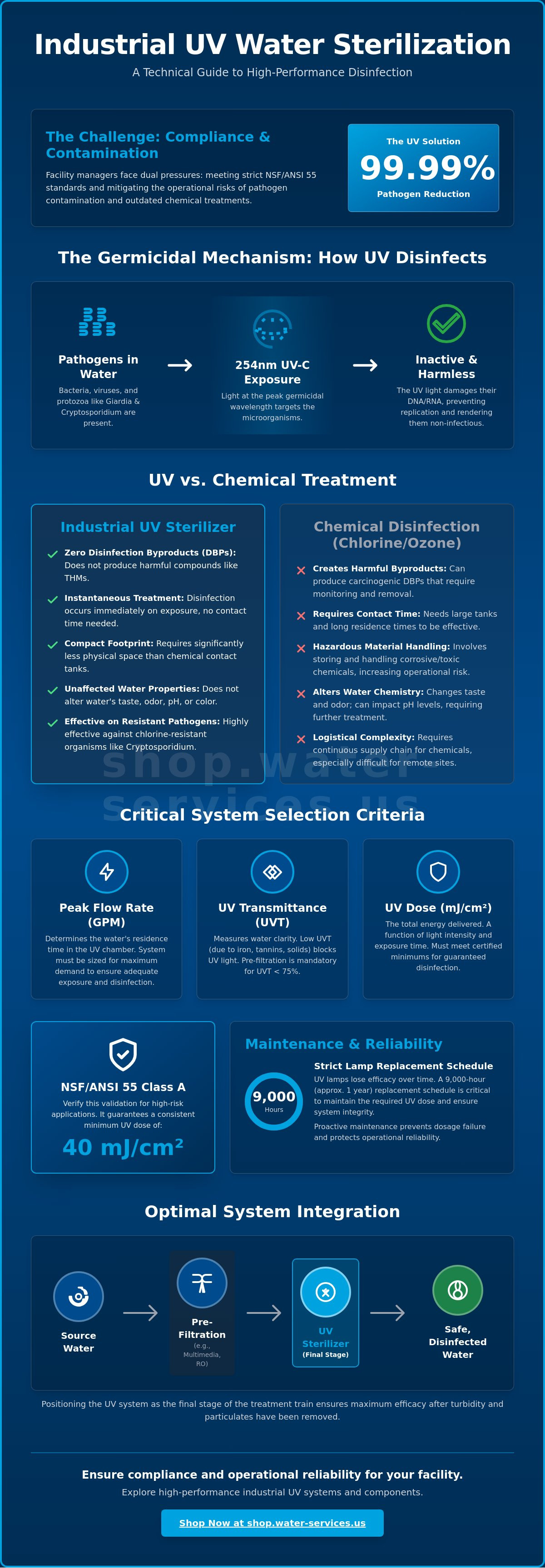
- Calibrate your industrial UV water sterilizer based on a 254nm wavelength to achieve 99.99% pathogen reduction without the byproduct risks associated with chemical disinfection.
- Prioritize Peak Flow Rate in GPM and UV Transmittance (UVT) metrics during the procurement process to ensure accurate system sizing and prevent dosage failure.
- Verify NSF/ANSI Standard 55 Class A validation for high-risk applications to guarantee a consistent minimum UV dose of 40 mJ/cm².
- Implement a strict 9,000-hour lamp replacement schedule and proactive maintenance plan to maintain technical integrity and operational reliability.
- Position UV systems as the final stage of the treatment train to ensure maximum efficacy after pre-filtration or commercial reverse osmosis processes.
Understanding Industrial UV Sterilization Technology
Industrial UV sterilization serves as a critical barrier in modern water treatment. It utilizes short-wavelength ultraviolet light to inactivate pathogenic microorganisms. An Ultraviolet germicidal irradiation (UVGI) system specifically targets the 254nm wavelength. This is the peak germicidal output required for industrial disinfection. Unlike chemical methods, an industrial UV water sterilizer provides a physical treatment process that doesn't alter the water's pH, color, or taste. It's a utilitarian solution designed for high-flow environments where technical integrity is a priority.
The Germicidal Mechanism
UV-C light penetrates the cell walls of bacteria, viruses, and protozoa to target the nucleic acids (DNA and RNA) within the organism. By disrupting these molecular bonds, the light prevents the pathogen from replicating. This renders the microorganism biologically inactive and unable to cause infection. This mechanism is particularly effective against chlorine-resistant pathogens like Cryptosporidium and Giardia. Industrial source water often contains these hardy cysts that survive traditional chlorination. The 254nm peak ensures maximum energy absorption by the DNA, making it the industry standard for high-level disinfection in mining and military applications.
UV vs. Chemical Treatment: A Comparative Analysis
Choosing between UV and chemical disinfection involves evaluating operational safety and environmental impact. Chemical systems like chlorine or ozone require strict Chemical Hazard Protocols (CHP). These protocols are difficult to maintain at remote mining sites or oil fields. Storing and handling hazardous liquids increases liability for facility staff and necessitates specialized training. An industrial UV water sterilizer eliminates the need for chemical storage, reducing the overall operational footprint.
Primary advantages of UV over chemical treatment include:
- Zero Disinfection Byproducts (DBPs): UV doesn't produce trihalomethanes (THMs) or haloacetic acids that can contaminate effluent.
- Compact System Footprint: UV chambers require significantly less space than the large contact tanks required for chlorination or ozone.
- Instantaneous Treatment: There's no required contact time. Disinfection occurs immediately as water passes through the reactor.
- Lower Environmental Risk: There's no risk of toxic chemical discharge into local ecosystems, which is essential for hospitality sites and ecological compliance.
For hospitality sectors and military installations, the reliability of UV technology is paramount. It ensures drinking water safety without the logistical burden of complex chemical supply chains. In these commercial settings, water management often includes recreational features like spas, and to ensure their longevity and cleanliness, facility managers can find out more about durable cover solutions from Northern Hot Tub Covers. This technology provides a steady, authoritative solution for demanding environments where performance and safety cannot be compromised.
Critical Selection Criteria: Flow Rate, UVT, and Dosage
Selecting an industrial UV water sterilizer requires precise calculation of hydraulic and optical parameters. You can't treat it as a generic hardware purchase. System sizing depends on the interaction between water quality and flow dynamics. If these variables aren't calibrated correctly, the system will fail to meet disinfection standards during peak demand periods. Reliable procurement starts with a detailed analysis of your facility's specific water profile and throughput requirements.
Peak Flow Rate, measured in Gallons Per Minute (GPM), is your primary metric for hydraulic sizing. It determines the residence time of water within the UV reactor. If the flow rate exceeds the system's design capacity, the exposure time decreases. This results in an insufficient UV dose. Engineers must also account for pressure drops across the UV chamber. A significant pressure loss can disrupt downstream processes, especially in high-pressure RO systems or cooling tower feeds.
UV Transmittance (UVT) and Water Clarity
UV Transmittance (UVT) measures the percentage of UV light that passes through a 1 cm water sample. Suspended solids, iron, manganese, and tannins absorb UV energy, preventing it from reaching target pathogens. When source water has a UVT below 75%, pre-filtration becomes mandatory. Using Multimedia Filter Tanks optimizes UV performance by removing turbidity that shields bacteria from radiation. To maintain technical integrity, you should always test UVT under worst-case seasonal conditions. To ensure your system meets these rigorous metrics, consider sourcing high-grade industrial water treatment components from a specialized provider.
Calculating the Required UV Dose
Microbial inactivation is a function of the total energy delivered to the water. Standard industrial applications often utilize a dose of 30 mJ/cm² for basic bacterial control. However, NSF/ANSI Standard 55 Class A compliance requires a validated dose of 40 mJ/cm². This higher threshold is necessary for treating water known to contain viruses or chlorine-resistant cysts. UV dosage is defined as the mathematical product of UV light intensity and the duration of exposure within the reactor. Specialized industrial contaminants may require even higher dosages, necessitating a modular approach where multiple industrial UV water sterilizer units are placed in series to achieve the target log reduction.
Environmental factors like water temperature also influence lamp output. Most UV lamps are designed to operate efficiently at water temperatures between 35°F and 104°F. Temperatures outside this range can derate the lamp's intensity, requiring a larger system to compensate for the loss of efficiency. Always verify that your chosen system includes a UV intensity sensor to provide real-time feedback on dosage delivery.
Viqua and Trojan UVMax: Industrial Standards and Compliance
Viqua and Trojan UVMax represent the primary benchmark for industrial water safety. These systems are engineered to meet the stringent criteria of NSF/ANSI Standard 55 Class A. This validation ensures the equipment delivers a consistent UV dose of at least 40 mJ/cm². In critical industrial environments, this standard is non-negotiable for the inactivation of bacteria, viruses, and cysts. Choosing a validated industrial UV water sterilizer provides the technical documentation necessary for regulatory audits and operational safety. Viqua UV Water Purification Systems offer a range of professional-grade reactors designed for continuous duty in demanding applications.
High-Flow Industrial Solutions
Large-scale facilities require throughput that exceeds the capacity of standard single-lamp units. The Viqua H and K series address this by supporting flow rates exceeding 100 GPM per reactor. For critical mining wastewater treatment or municipal-scale hospitality sites, implementing N+1 redundancy is a standard engineering practice. This configuration involves installing an additional unit beyond the peak flow requirement. It allows for seamless maintenance without system downtime. Maintaining constant flow pressure is vital for these high-capacity setups. Integrating Goulds Water Technology Pumps ensures that the water moves through the UV chambers at the precise velocity required for the target dosage.
High-capacity configurations benefit from:
- Parallel Reactor Arrays: Distributes flow across multiple chambers to maintain low pressure drops.
- Modular Scalability: Allows for the addition of more units as facility demand increases.
- Redundant Power Supplies: Prevents total system failure if a single ballast or controller malfunctions.
Smart Monitoring and Controls
Reliability in an industrial UV water sterilizer is maintained through real-time feedback loops. Advanced monitoring systems utilize calibrated UV intensity sensors to track lamp performance and water clarity. If the UV dose falls below the programmed threshold, an alarm system immediately notifies the operator. Walchem Controllers are often integrated to manage system status and data logging. These controllers provide a centralized interface for monitoring multiple parameters across the treatment train. For absolute safety, automated solenoid shut-off valves are installed at the reactor outlet. These valves trigger a fail-safe shut-off if the system loses power or detects a lamp failure, preventing untreated water from entering the distribution network.
Maintenance Logistics and Total Cost of Ownership
Operational reliability for an industrial UV water sterilizer extends beyond the initial installation. It requires a disciplined maintenance schedule to ensure the system continues to meet its validated disinfection dosage. Neglecting consumable replacement or failing to monitor component degradation compromises water safety and increases the risk of regulatory non-compliance. A proactive maintenance strategy focuses on two primary components: the UV lamp and the quartz sleeve. For facilities in remote locations, maintaining an on-site inventory of these critical spares is essential to prevent extended downtime during a component failure.
The 9,000-hour lamp replacement rule is a critical safety benchmark for mercury-vapor systems. While a lamp may appear functional after 12 months of continuous duty, its germicidal output significantly diminishes. The mercury-vapor mixture inside the lamp loses its ability to emit the necessary 254nm wavelength over time. Operating a lamp beyond its rated life means the system is no longer delivering the 40 mJ/cm² dose required for Class A compliance. Failure to replace lamps on schedule leads to a false sense of security regarding water safety.
Lamp and Sleeve Optimization
Replacing a lamp involves a specific protocol to maintain technical integrity. You must first isolate the reactor, shut off the water flow, and disconnect the power supply. Remove the lamp carefully to avoid breaking the fragile glass. When inspecting the quartz sleeve, look for mineral fouling caused by calcium or magnesium deposits. Fouled sleeves can reduce UV output by 50% or more. To clean a sleeve, use a mild acid solution such as citric or phosphoric acid to dissolve scale without scratching the quartz. If the sleeve shows signs of permanent etching or cloudiness, it must be replaced to restore full UVT performance. You can source replacement UV lamps and quartz sleeves directly to ensure component compatibility.
Safety and PPE Requirements
Maintenance staff must follow strict safety protocols when handling UV equipment. Mercury-vapor lamps are hazardous and require careful management to avoid breakage and exposure. Always wear appropriate Personal Protective Equipment (PPE), including nitrile gloves and safety glasses, during the replacement process. Skin oils left on a new lamp can create "hot spots" that cause premature failure. Additionally, never look directly at an energized UV lamp without specialized eye protection, as it can cause permanent retinal damage. Spent lamps must be handled according to local hazardous waste disposal protocols due to their mercury content. Implementing these safety standards ensures a stable and professional working environment for your technical team.
Integrating UV with Multi-Stage Treatment Systems
An industrial UV water sterilizer functions as the final safety barrier in a comprehensive treatment train. It is positioned after all physical filtration and chemical adjustment stages. Because UV light does not provide a residual disinfectant, any downstream piping or storage tanks must be sterile to prevent recontamination. Placing the UV reactor at the point of exit ensures that pathogens are inactivated immediately before the water enters the distribution network. To maintain technical integrity, the water entering the UV chamber must meet specific clarity standards. Pre-treatment typically involves sediment filtration to remove particles larger than 5 microns, as these solids can shield microorganisms from the light.
Specific water chemistry parameters also dictate pre-treatment requirements. High concentrations of iron, manganese, and calcium lead to rapid mineral fouling on the quartz sleeve. Iron levels should be below 0.3 ppm and hardness below 7 gpg to prevent scaling. If these levels are exceeded, the system requires a dedicated iron filter or water softener upstream. This proactive approach ensures the 254nm wavelength remains unobstructed, preserving the validated disinfection dose.
UV and Reverse Osmosis Synergy
The technical synergy between UV radiation and Commercial Reverse Osmosis Systems is a standard in high-purity industrial applications. When installed upstream of RO membranes, UV light reduces the microbial load and prevents biofouling. Biofilm accumulation on membrane surfaces increases feed pressure requirements and shortens the operational life of the elements. Reducing this biological growth maintains the efficiency of FilmTec or Hydranautics membranes. Conversely, using UV as a post-RO polishing step ensures that any bacteria present in the permeate storage or distribution lines are neutralized. Engineers must calibrate the flow rates between the RO unit and the UV chamber to avoid excessive backpressure that could damage the membranes.
Procurement Checklist for 2026
Successful procurement of an industrial UV water sterilizer requires a focus on long-term reliability and compliance. Use the following checklist to evaluate your 2026 system selection:
- Verify NSF/ANSI Standard 55 Class A validation for all potable water applications.
- Confirm the reactor is sized for the lowest recorded seasonal UV Transmittance (UVT).
- Ensure the system includes a calibrated UV intensity sensor for real-time monitoring.
- Validate the availability of local technical support and a 12-month supply of replacement lamps.
- Check for compatibility with Walchem or Signet electronic controllers for integrated facility management.
As you finalize your system design, browse the latest industrial equipment and supplies to identify the auxiliary components required for your next infrastructure project. Selecting a system backed by established manufacturers like Viqua ensures that your facility remains compliant with evolving global water safety regulations.
Optimizing Industrial Water Safety for 2026 and Beyond
Since 1994, our expert engineering team has provided the specialized support needed to maintain complex treatment trains in harsh environments. As an authorized distributor for Viqua and Goulds Water Technology, we offer the logistical competence required to deliver critical components to remote mining and industrial sites worldwide. We ensure your facility meets strict NSF/ANSI Standard 55 Class A requirements with durable, utilitarian solutions designed for peak performance. Browse High-Performance Industrial Supplies and Equipment to secure the components and technical expertise your next project requires. We look forward to supporting your long-term operational reliability and facility safety goals.
Frequently Asked Questions
What is the difference between a residential and an industrial UV sterilizer?
Industrial units are engineered for continuous high-flow duty and rigorous 40 mJ/cm² dosage requirements. While residential systems focus on smaller GPM for home safety, an industrial UV water sterilizer features 316L stainless steel reactors and advanced sensors. These systems meet NSF/ANSI 55 Class A standards, ensuring they can treat water with known contamination. They also integrate with facility-wide controllers for automated monitoring and data logging.
How often do I need to replace the UV lamp in a commercial system?
You must replace lamps every 9,000 hours of operation to maintain technical integrity. This period equals roughly 12 months of continuous use. Even if the lamp still emits visible light, the germicidal UV-C output at the 254nm wavelength degrades over time. Operating beyond this limit risks delivering an insufficient dose. This compromises the disinfection standard and leads to potential regulatory non-compliance in industrial environments.
Does a UV sterilizer remove chemicals like chlorine or lead?
No, UV sterilization is a physical process that only targets microorganisms like bacteria, viruses, and protozoa. It doesn't remove dissolved chemicals, heavy metals like lead, or minerals. To address chemical contaminants, you must integrate the UV system with other technologies. Combining UV with FilmTec RO membranes or carbon filtration provides a comprehensive treatment solution for both biological and chemical hazards in your water supply.
What happens if the water flow rate exceeds the UV system rating?
Exceeding the rated flow rate reduces the water's residence time within the UV chamber. This results in a lower UV dosage that may fall below the required 40 mJ/cm² threshold. When contact time is insufficient, pathogens like Cryptosporidium or Giardia might survive the treatment process. Always size your system based on peak GPM to ensure the target log reduction is maintained during maximum demand periods.
Is pre-filtration necessary before an industrial UV sterilizer?
Pre-filtration is essential for the effective operation of any industrial UV water sterilizer. Suspended solids and turbidity create a "shadowing" effect that shields pathogens from UV-C radiation. Industry standards require pre-filtration to at least 5 microns. Removing iron, manganese, and hardness minerals is also necessary to prevent scale buildup on the quartz sleeve. This maintenance step preserves the system's optical clarity and overall disinfection performance.
What is UV Transmittance (UVT) and why does it matter for my facility?
UV Transmittance (UVT) measures the percentage of UV light that successfully penetrates a water sample. It's a critical metric for system sizing because it defines how much energy reaches the pathogens. Low UVT indicates the presence of tannins or organic matter that absorb light. If your facility has a UVT below 75%, you must install a larger UV reactor or improve pre-treatment to ensure compliant disinfection.
Are Viqua UV systems compliant with NSF Standard 55?
Yes, the Viqua Professional Series systems are validated to meet NSF/ANSI Standard 55 Class A requirements. This certification confirms that the equipment delivers a minimum UV dose of 40 mJ/cm² at the rated flow. These systems include mandatory features like UV intensity sensors and solenoid shut-off valves. This ensures that only properly treated water moves through the distribution lines, providing a stable safety barrier for your facility.
Can I install multiple UV units in parallel for higher flow rates?
Parallel configurations are a standard engineering practice for achieving high flow rates and N+1 redundancy. By installing multiple UV reactors in an array, you can distribute the hydraulic load and reduce pressure drops. This setup also allows for maintenance on a single unit without shutting down the entire water line. It provides a scalable and reliable solution for mining sites or large-scale hospitality facilities requiring continuous operation.
0 comments