

Operational costs represent approximately 75% of an RO plant's total lifecycle cost, yet many facilities treat performance declines as an inevitable expense rather than a diagnostic signal. When permeate flow drops or salt passage increases, the immediate reaction is often a costly, premature membrane replacement. Effective industrial reverse osmosis system troubleshooting requires a shift from trial-and-error parts swapping to a forensic analysis of pressure, conductivity, and Silt Density Index (SDI) data. You likely recognize that even a few hours of production downtime can jeopardize downstream processes and inflate CAPEX through shortened equipment lifespans.
This 2026 diagnostic guide provides a systematic framework to restore your system to its original design specifications. We'll show you how to identify the specific root causes of failure, such as distinguishing between calcium carbonate scaling and organic fouling. By implementing the advanced monitoring techniques and preventative maintenance schedules outlined here, you can extend the life of your FilmTec or Hydranautics membranes. We'll also examine how integrating high-efficiency Goulds pumps and smart sensors can stabilize water quality and reduce the 3 to 6 kWh per 1,000 gallons typically required for industrial RO operations.
Key Takeaways
- Identify early warning signs of system decline, such as a 10% drop in Normalized Permeate Flow (NPF), before they lead to irreversible membrane damage.
- Utilize the diagnostic matrix to distinguish between front-end biofouling and tail-end mineral scaling by analyzing Delta P and permeate TDS levels.
- Implement a rigorous industrial reverse osmosis system troubleshooting protocol that prioritizes data normalization and a comprehensive pretreatment audit.
- Restore design flow and water quality by mapping specific symptoms to targeted chemical cleaning or mechanical corrective actions.
- Minimize 2026 lifecycle costs by standardizing on high-reliability components, including Goulds Water Technology pumps and FilmTec or Hydranautics membranes.
Common Symptoms of Industrial Reverse Osmosis System Failure
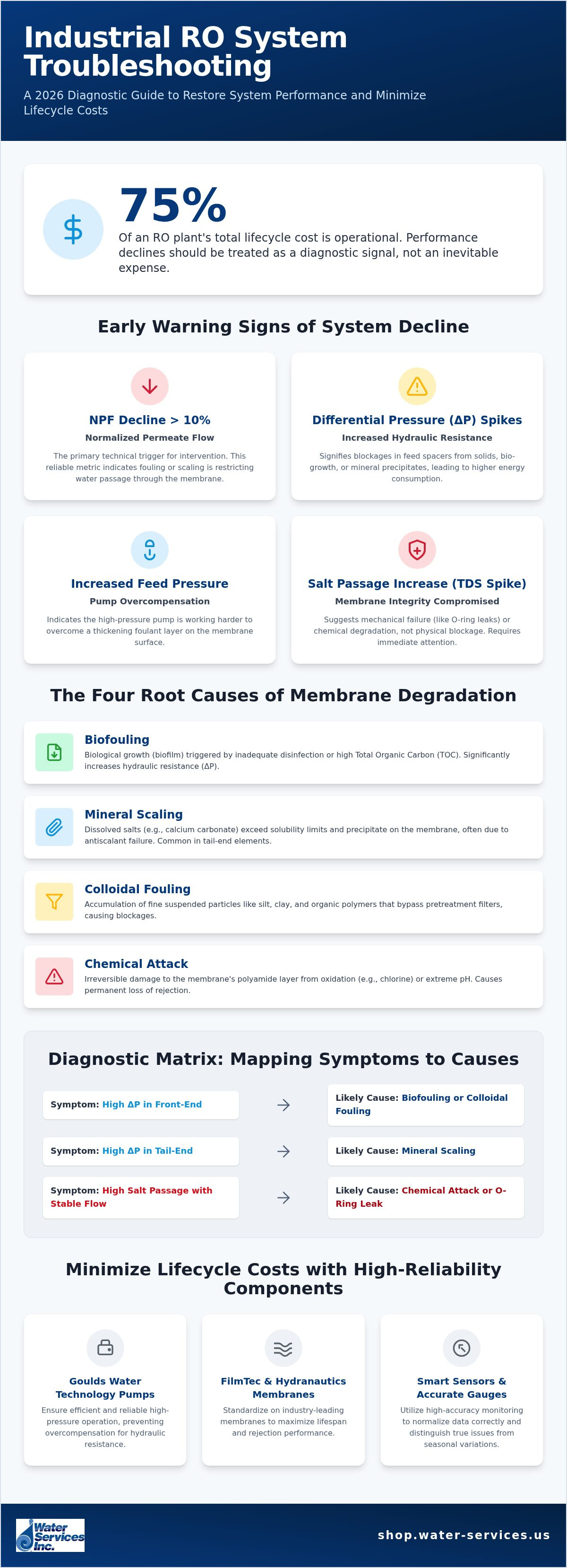
Effective industrial reverse osmosis system troubleshooting begins with identifying deviations from baseline performance. A decline in Normalized Permeate Flow (NPF) of 10% or more serves as the primary technical trigger for system intervention. This metric indicates that the membrane surface is likely experiencing fouling or scaling, which restricts the passage of water through the polyamide layer. While raw flow rates fluctuate based on feed conditions, the NPF remains the most reliable early warning sign for operators in 2026 industrial environments.
Differential pressure, or Delta P, measures the hydraulic resistance across the membrane elements. Spikes in Delta P typically signify blockages within the feed spacers, often caused by suspended solids, biological growth, or mineral precipitates. The fundamental physics of Reverse osmosis require a precise balance between osmotic pressure and applied hydraulic pressure. When feed pressure requirements increase to maintain a constant flux, the system energy consumption rises. This often indicates the pump is working harder to overcome a thickening foulant layer on the membrane surface. If high feed pressure requirements exceed design limits, operators should evaluate the performance of high-pressure Goulds Water Technology pumps to ensure the motor is not overcompensating for hydraulic resistance.
Salt passage increase is a secondary symptom that often occurs independently of flow loss. A spike in permeate Total Dissolved Solids (TDS) while flow remains steady suggests mechanical failure or chemical degradation rather than physical fouling. This symptom requires immediate diagnostic attention to prevent downstream process contamination.
Distinguishing Between Flow Loss and Quality Loss
Flow loss usually points to physical fouling or mineral scaling. These contaminants create a boundary layer that increases the required driving pressure. Conversely, quality loss indicates a compromise in the membrane's semi-permeable integrity. High salt passage often stems from "leaking" O-rings in the pressure vessel or membrane degradation caused by accidental chlorine exposure. Normalization is the process of adjusting data for temperature and feed concentration changes. By normalizing data, technicians can determine if a performance drop is a genuine equipment failure or a result of shifting feed water chemistry.
The Role of Feed Water Temperature in 2026 Operations
Feed water temperature significantly dictates permeate production capacity. A 1-degree Celsius shift in water temperature can change permeate flow by approximately 3%. Seasonal changes often mask underlying membrane issues; for instance, rising summer temperatures might hide a fouling-induced flow drop by naturally increasing membrane flux. Precise monitoring is essential to prevent these false negatives. Operators should utilize high-accuracy Ashcroft pressure gauges to verify sensor readings and ensure that temperature-compensated data reflects the true state of the FilmTec or Hydranautics membranes.
The Root Causes: Fouling, Scaling, and Chemical Attack
Identifying the precise source of system failure is the most critical phase of industrial reverse osmosis system troubleshooting. Four primary mechanisms drive membrane degradation: biofouling, mineral scaling, colloidal fouling, and chemical attack. Biofouling results from biological growth, often triggered by inadequate disinfection or high Total Organic Carbon (TOC) in the feed water. This creates a resilient biofilm that significantly increases hydraulic resistance and Delta P. Mineral scaling occurs when the concentration of dissolved salts exceeds solubility limits, typically due to antiscalant dosing failure. Common precipitates include calcium carbonate and various sulfates, which frequently settle in the tail-end elements where brine concentration is highest.
Colloidal fouling involves the accumulation of silt, clay, and organic polymers that bypass pretreatment. This is frequently a result of breakthrough in multi-media filter tanks or sediment filter bypass. Chemical attack represents a more severe, irreversible failure mode. Oxidation from free chlorine or exposure to extreme pH levels destroys the polyamide thin-film composite layer. This degradation leads to a permanent loss of rejection capabilities that specialized cleaning chemicals cannot rectify. Understanding these Common Issues with Reverse Osmosis (RO) performance is essential for maintaining 2026 operational standards and protecting capital investments.
Membrane Autopsy: What Your Cartridge Filters Are Telling You
Visual inspection of the lead-end versus tail-end elements reveals specific deposit patterns. Lead-end fouling typically indicates colloidal or biological issues, while tail-end deposits strongly suggest mineral scaling. Technicians should use standardized color-coding to categorize findings: brown signifies iron or silt, white indicates mineral scale, and a slimy texture confirms biofouling. For those looking to optimize their upstream processes, reviewing Industrial Water Filtration Systems provides insights into preventing these accumulations before they reach the RO membranes.
Pretreatment Failure: The Silent RO Killer
Most RO failures originate in the pretreatment stage. Inaccurate chemical dosing, often caused by poorly calibrated Pulsafeeder metering pumps, directly leads to rapid scaling. Similarly, water softener hardness leakage provides the raw materials for calcium carbonate buildup, which immediately impacts RO flux. Operators must verify the Silt Density Index (SDI) daily to prevent colloidal overload. If your SDI exceeds the 2026 FilmTec specification of 5.0, your pretreatment system requires immediate adjustment. Maintaining a stock of high-quality replacement filters and antiscalants is the most effective way to mitigate these operational risks.
Diagnostic Matrix: Mapping Symptoms to Solutions
Effective industrial reverse osmosis system troubleshooting requires a structured correlation between operating parameters and physical conditions. Operators shouldn't rely on guesswork when system performance deviates from the 2026 design baseline. Instead, use a diagnostic matrix to map specific data points to their likely root causes. This approach reduces unnecessary downtime and prevents the destruction of expensive membrane assets. By analyzing the relationship between permeate flow, salt passage, and differential pressure, you can pinpoint exactly where the system is failing.
- High Delta P + Normal TDS: This combination signifies front-end fouling. It's typically caused by silt, clay, or biological growth in the lead elements. If the pressure drop is concentrated in the first stage, verify your pretreatment filtration efficiency.
- Low Flow + High TDS + High Delta P: This profile indicates tail-end scaling. Calcium carbonate or sulfate precipitates are likely restricting flow in the final stages. This often happens when antiscalant dosing pumps fail or feed water hardness exceeds design limits.
- High Flow + High TDS: This is a critical failure. It indicates membrane oxidation from chlorine exposure or a mechanical bypass. Rolled or damaged O-rings in the permeate tube are common culprits that allow raw feed water to contaminate the permeate stream.
- Low Flow + Normal TDS: This often points to membrane compaction from over-pressurization or a significant increase in feed water salinity. It can also occur if the feed water temperature has dropped significantly without a corresponding adjustment in pump pressure.
Mechanical Troubleshooting: Pumps and Controls
Verify the mechanical integrity of your delivery system before assuming membrane failure. Check for cavitation or seal leaks in your Goulds Water Technology pumps, as these issues introduce air and cause erratic pressure readings. Ensure Walchem controller calibration is current to guarantee the flow data you're analyzing is accurate. Incorrect VFD settings can also mimic fouling symptoms by failing to provide the required torque to maintain design flux. Use Ashcroft pressure gauges to cross-verify digital sensor data during these mechanical audits.
Membrane Performance Comparison: FilmTec vs. Hydranautics
Selecting the correct replacement element is vital for long-term reliability. FilmTec and Hydranautics membranes utilize different chemistries that respond uniquely to aggressive cleaning cycles. FilmTec elements often provide superior rejection rates in high-salinity applications, while specific Hydranautics series offer enhanced fouling resistance for wastewater reuse. Consult the Commercial Reverse Osmosis Water Filtration System Guide to match your feed water profile with the appropriate membrane technology. Rejection rates shouldn't be the only metric; consider how well the membrane recovers its original flux after a Clean-In-Place (CIP) procedure.
Step-by-Step Industrial RO Troubleshooting Protocol
Systematic resolution of performance issues prevents catastrophic membrane failure and protects your equipment investment. Operators shouldn't guess when a system underperforms. Instead, follow this structured five step protocol to identify and correct faults. This sequence ensures that you address the most common points of failure before committing to expensive chemical cleanings or membrane replacements.
- Step 1: Data Normalization. Raw data lies. You must convert raw flow and pressure readings to baseline conditions to account for temperature and salinity fluctuations. This allows you to see the true state of the membrane regardless of seasonal changes.
- Step 2: Pretreatment Audit. Verify the operational status of multimedia filters, water softeners, and carbon tanks. Ensure Pulsafeeder metering pumps are delivering the correct antiscalant dosage. Most industrial reverse osmosis system troubleshooting ends here, as pretreatment failure is the leading cause of RO upsets.
- Step 3: Profile Testing. Sample permeate from individual pressure vessels or use a "probing" technique. This identifies specific fouled stages or damaged O-rings that a total system sample might hide.
- Step 4: Cleaning-In-Place (CIP) Evaluation. Analyze your diagnostic data to determine if your foulant requires a low pH solution for mineral scale or a high pH solution for organic and biological growth.
- Step 5: Element Replacement Strategy. If a professional CIP fails to restore 90% of the design flux, or if salt rejection remains below 2026 industry standards, membrane replacement is necessary.
How to Perform an Effective CIP (Cleaning-In-Place)
Success depends on maintaining the correct flow rate and temperature specified by FilmTec or Hydranautics. Use a "Soak and Recirculate" method for stubborn bio-growth. This allows cleaning chemicals sufficient contact time to break down the biofilm layer. Monitor pH shifts throughout the cycle. A significant change in pH indicates that the cleaning solution is actively reacting with and neutralizing contaminants. If the pH shifts by more than 0.5 units, you must adjust the solution to maintain cleaning strength.
Remote Monitoring and 2026 Digital Diagnostics
Modern industrial reverse osmosis system troubleshooting relies on real-time data integration. Utilizing Walchem controllers allows for automated data logging and immediate alert systems. These controllers, paired with Signet flow sensors and Ashcroft pressure transducers, enable continuous Normalized Permeate Flow (NPF) calculation. This digital oversight captures performance trends before they reach critical thresholds. If your current control panel lacks these diagnostic capabilities, purchase updated process control hardware to safeguard your production line.
Preventative Maintenance and High-Quality Components
Transitioning from reactive industrial reverse osmosis system troubleshooting to a predictive maintenance model is the most effective way to lower the total cost of ownership (TCO). In 2026, the return on investment for Tier 1 membranes from FilmTec and Hydranautics is documented through extended service life and reduced chemical consumption. These high-performance elements maintain flux stability longer than generic alternatives. This durability directly reduces the frequency of cleaning cycles and prevents the premature membrane replacement that often inflates operational budgets.
Standardizing on Goulds Water Technology high-pressure pumps ensures the system receives a steady, reliable feed. Mechanical stability prevents the pressure fluctuations that often lead to membrane compaction. Operators should establish a daily log sheet that tracks normalized data for proactive trend analysis. This allows for technical intervention before a performance decline reaches critical thresholds. Maintaining a local inventory of critical spares is equally vital. Your facility should stock O-rings, interconnector kits, and Ashcroft pressure gauges to minimize downtime when a mechanical failure is detected during routine inspections.
Sourcing Replacement RO Components
Procuring the correct hardware is essential for maintaining system compliance and performance. Technicians can navigate the Water Treatment Collection to find specific membranes, antiscalants, and specialized cleaning chemicals. Using genuine manufacturer parts ensures that all seals and connectors meet the exact tolerances required for high-pressure operation. 2026 system efficiency depends entirely on component precision. Substituting generic parts can lead to bypass leaks or hydraulic imbalances that complicate future industrial reverse osmosis system troubleshooting efforts.
Mobile and Containerized Solutions for Remote Sites
Troubleshooting sometimes reveals that an existing system is simply undersized for current production demands. This is common in rapidly expanding mining or military operations where water quality requirements have evolved. In these scenarios, modular and containerized RO plants provide a scalable solution without the lead times of traditional civil construction. These systems are engineered for rapid deployment and include integrated pretreatment and monitoring hardware. For facilities managing complex effluent streams, reviewing Mining Wastewater Treatment Solutions provides a roadmap for integrating modular technology into existing infrastructure to ensure environmental compliance and resource recovery.
Optimizing 2026 Water Treatment Performance
Maintaining system integrity requires a shift from reactive repairs to a data-driven diagnostic framework. You've learned that distinguishing between front-end biofouling and tail-end scaling is the foundation of effective industrial reverse osmosis system troubleshooting. Adopting these advanced diagnostic protocols ensures your operations remain compliant with 2026 efficiency standards and water reuse priorities. By implementing a rigorous normalization protocol and standardizing on high-reliability components, you can significantly extend the operational life of your membrane assets and stabilize downstream water quality.
Water Services, Inc. serves as an authorized distributor for Goulds Water Technology, FilmTec, and Hydranautics. We've provided global shipping and specialized engineering support for remote mining and industrial sites since 1994. Our technical experts understand the rigors of demanding commercial environments and offer the component precision required for 2026 system efficiency. Proactive management of your RO assets is the most reliable strategy for minimizing production downtime and protecting your CAPEX.
Shop High-Performance Industrial RO Membranes and Components
Your facility can achieve its design flux and recovery goals through consistent monitoring and quality parts. We're here to support your logistical and technical requirements every step of the way.
Frequently Asked Questions
Why is my RO permeate flow decreasing while feed pressure is constant?
Decreasing flow at a constant pressure typically indicates fouling or scaling on the membrane surface. As contaminants accumulate, they create a physical barrier that increases hydraulic resistance. Since the pump pressure remains steady, the flux must drop to compensate for the added resistance. This is a primary signal used in industrial reverse osmosis system troubleshooting to trigger a Clean-In-Place (CIP) procedure before the 10% Normalized Permeate Flow (NPF) threshold is exceeded.
How often should industrial reverse osmosis membranes be cleaned?
Cleaning frequency depends on feed water quality, but standard 2026 protocol dictates a CIP when NPF drops by 10%, salt passage increases by 10%, or differential pressure (Delta P) rises by 15%. For most stable industrial applications, this occurs every 3 to 12 months. Delaying cleaning beyond these setpoints often leads to irreversible compaction or "telescoping" of the membrane elements, which significantly shortens their 3 to 5 year expected lifespan.
What is the maximum allowable Silt Density Index (SDI) for industrial RO?
The industry standard maximum for spiral-wound polyamide membranes, such as FilmTec or Hydranautics, is an SDI of 5.0. However, for optimal performance and minimized fouling rates, 2026 engineering specifications often recommend maintaining an SDI below 3.0. If your SDI consistently exceeds 5.0, your pretreatment system, specifically multi-media filters or ultrafiltration units, is failing to protect the RO membranes from colloidal overload and rapid flux decline.
Can I clean my RO membranes if they have been oxidized by chlorine?
No, chemical cleaning cannot repair membranes damaged by oxidation. Chlorine and other strong oxidants permanently destroy the thin-film composite layer of the polyamide membrane. This damage results in a permanent increase in salt passage and often a slight increase in flow. Once the membrane structure is compromised, the only solution is to identify the source of the chlorine breakthrough and replace the damaged elements with new FilmTec or Hydranautics membranes.
How do I know if my RO system needs a new high-pressure pump?
A pump requires replacement or major overhaul if it can no longer maintain the design feed pressure required to achieve target flux. Physical signs include persistent seal leaks, excessive vibration, or cavitation noises. In 2026 systems, you should cross-reference Walchem controller data with Ashcroft pressure gauge readings. If the pump motor is running at maximum VFD frequency but failing to meet osmotic pressure requirements, the hydraulic end is likely worn.
What are the signs of biofouling in a containerized RO plant?
Biofouling is characterized by a rapid increase in differential pressure (Delta P) across the first stage and a slimy film on the lead-end membrane surfaces. You may also notice a distinct odor during cartridge filter changes. Because containerized plants often operate in remote or high-temperature environments, biological growth can accelerate quickly. Effective industrial reverse osmosis system troubleshooting for biofouling involves verifying the performance of Viqua UV systems and ensuring consistent biocide dosing.
What is the difference between RO scaling and RO fouling?
Scaling is the precipitation of dissolved mineral salts, such as calcium carbonate, typically occurring in the tail-end elements where brine concentration is highest. Fouling is the accumulation of external matter, like silt, organics, or bacteria, which usually impacts the lead-end elements first. While both reduce permeate flow, scaling is often managed with antiscalants and low pH cleanings, whereas fouling requires improved filtration and high pH cleaning cycles.
How does feed water temperature affect RO system performance in 2026?
Feed water temperature directly impacts membrane permeability and osmotic pressure. As water temperature decreases, the viscosity increases, requiring higher feed pressure to maintain the same permeate flow. Conversely, warmer water increases flux but also increases salt passage. Modern 2026 systems use Walchem controllers to normalize this data, ensuring that operators don't mistake seasonal temperature shifts for actual membrane fouling or mechanical failure within the high-pressure pump system.
0 comments