

Did you know that integrating IoT-enabled monitoring into your industrial pumps can reduce energy consumption by up to 20%? It's a critical efficiency gain as the global industrial pumps market is projected to reach USD 96.95 billion by 2034. Selecting the wrong equipment leads to more than just high utility bills; it causes system downtime and premature failure due to corrosion or cavitation. You've likely dealt with the frustration of a pump that meets the flow requirements but fails to handle the specific fluid chemistry or pressure demands of your system.
We understand that reliability depends on precision engineering, not just choosing the highest horsepower motor available. This guide teaches you how to evaluate flow rates, pressure requirements, and fluid characteristics to select the ideal industrial pump for your 2026 operations. We will examine the impact of the American Innovation and Manufacturing (AIM) Act's 2026 GWP limits, the latest ASME B73.1-2026 standards for chemical process interchangeability, and the technical steps required to calculate Total Dynamic Head for optimized energy consumption and long-term mechanical reliability.
Key Takeaways
- Differentiate between centrifugal and positive displacement technologies to maintain flow consistency across varying fluid viscosities and system pressures.
- Master the calculation of Total Dynamic Head (TDH) to ensure your industrial pumps are sized for peak mechanical reliability and performance.
- Evaluate technical specifications for Goulds Water Technology and Pulsafeeder equipment to match hardware to specific water movement or chemical dosing applications.
- Assess fluid chemistry and pH levels to select pump materials that prevent premature failure and corrosion in harsh industrial environments.
- Integrate friction loss data into procurement decisions to avoid incorrectly sized motors that lead to excessive energy consumption and system downtime.
Understanding the Primary Categories of Industrial Pumps
A pump is a mechanical device designed to convert mechanical energy into hydraulic energy. This energy transfer increases the fluid's pressure and velocity, allowing it to move through a piping network. In heavy industries such as mining, oil and gas, and wastewater management, these machines are the primary drivers of process flow. Mining operations rely on them to transport abrasive slurries, while the oil and gas sector utilizes high-pressure injection for extraction. Understanding the Primary Categories of Industrial Pumps is the first step in designing a system that avoids energy waste and mechanical failure.
Matching pump metallurgy to the corrosivity of the fluid is a technical requirement that cannot be overlooked. Chemical compatibility determines whether a pump survives for years or fails in weeks. At Water Services, Inc., we prioritize these technical data points to ensure long-term reliability. From our base in Provo, Utah, we coordinate the global distribution of high-quality equipment. We provide industrial operators with the exact specifications required for their specific environments, ensuring that every component meets the rigors of the field.
Dynamic (Centrifugal) Pumps
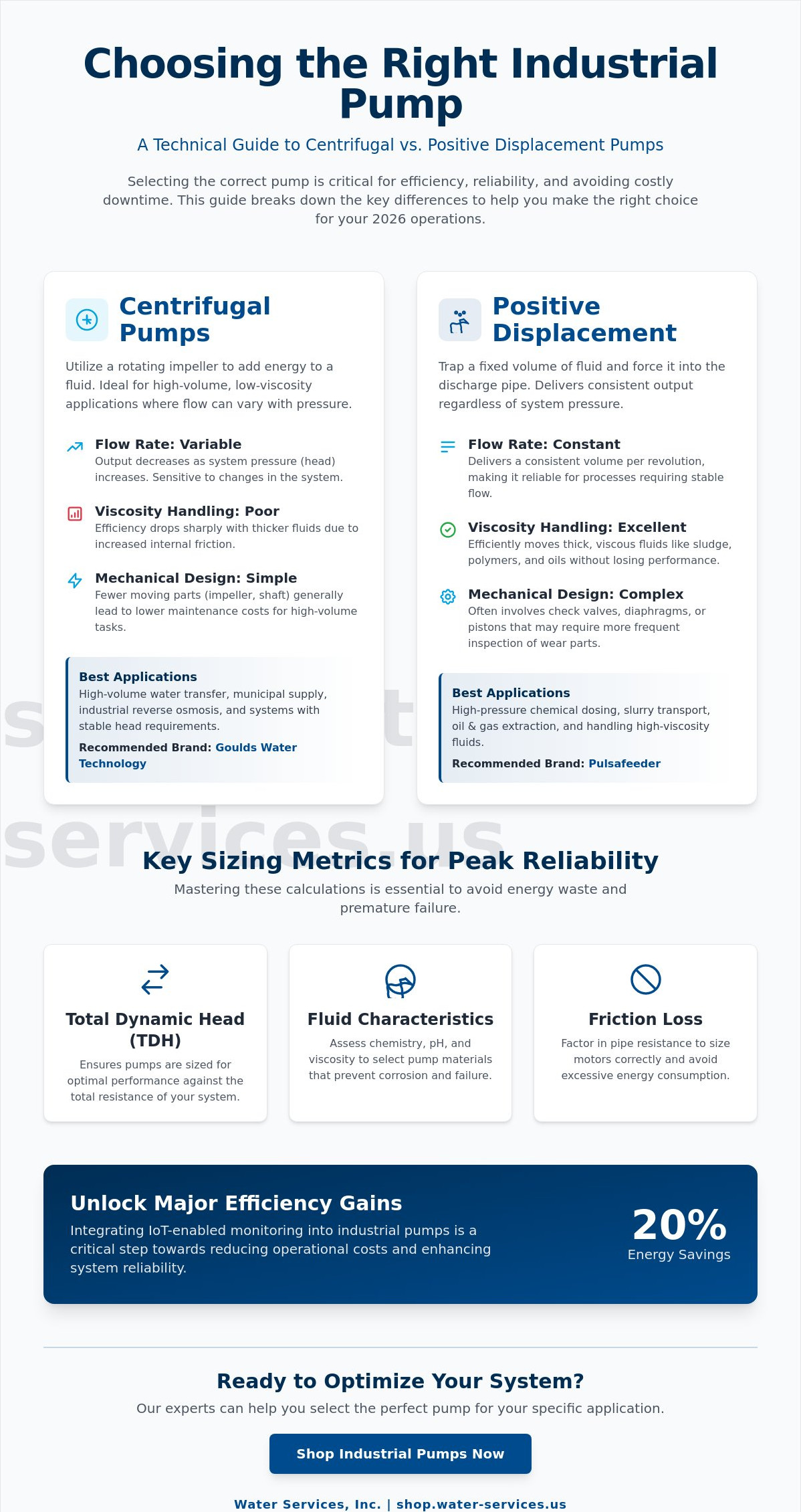
Centrifugal pumps are the industrial standard for applications requiring high flow rates and low-viscosity liquids. These units utilize a rotating impeller to impart kinetic energy to the fluid. As the impeller spins, centrifugal force pushes the liquid outward, converting velocity into pressure at the discharge point. It's an efficient design for moving large volumes of water in industrial reverse osmosis systems or municipal supply lines. Because they're sensitive to pressure changes, they're best suited for systems with stable head requirements and fluids with low thickness.
Positive Displacement Pumps
Positive displacement pumps function by trapping a fixed volume of liquid and forcing it into the discharge pipe. This mechanism ensures a constant flow rate even when system pressure fluctuates. These units are the preferred choice for high-pressure applications or for handling high-viscosity fluids like thick oils, polymers, and sludge. For specialized tasks, we offer Pulsafeeder metering pumps. These units are designed for precision chemical dosing in water treatment plants, where exact GPH measurements are required to maintain chemical balance and system integrity. Their ability to handle high-viscosity chemicals without losing accuracy makes them indispensable for industrial sterilization and pH control.
Centrifugal vs. Positive Displacement: A Technical Comparison
Selecting the correct technology requires analyzing how the equipment interacts with system pressure. Centrifugal pumps exhibit a variable flow rate based on the resistance they encounter. In contrast, positive displacement (PD) pumps deliver a constant volume per cycle regardless of pressure changes. This distinction is vital for maintaining process stability in complex industrial networks. If your system experiences fluctuating head pressure, a centrifugal model's output will shift, while a PD model will maintain its discharge volume until it reaches its mechanical limits.
Performance shifts significantly when fluid viscosity increases. Centrifugal pumps experience a steep drop in efficiency as the liquid thickens because the internal friction against the impeller increases. Positive displacement units handle high-viscosity fluids efficiently by physically displacing the volume. Industrial operators must identify the Best Efficiency Point (BEP) on a pump's curve to ensure long-term reliability. Operating far from the BEP leads to excessive vibration, heat, and premature seal failure. Understanding these technical curves is a fundamental step in Avoiding Common Mistakes in Pump Procurement.
Maintenance requirements vary between these two categories. Centrifugal units typically have fewer moving parts, often relying on a single rotating shaft and a mechanical seal. PD pumps may involve check valves, diaphragms, or pistons, which require more frequent inspection of wear components. For high-volume applications, the simplicity of a centrifugal design often results in lower long-term labor costs. However, for specialized tasks, the complexity of a PD system is necessary to achieve the required precision and pressure.
When to Choose a Goulds Centrifugal Pump
Goulds Water Technology pumps are engineered for continuous, high-volume water transfer. These centrifugal models are the industry standard for clean water or wastewater containing minor solids. They integrate seamlessly into larger industrial water treatment systems where consistent pressure is maintained. Their robust design allows for prolonged operation in municipal supply and reverse osmosis pre-treatment without frequent downtime.
When Positive Displacement is Non-Negotiable
Positive displacement is essential for precision chemical metering and handling abrasive slurries. Pulsafeeder pumps provide the exact GPH required for dosing antiscalants or disinfectants, ensuring chemical balance is maintained. In mining operations, these pumps move thick slurries that would quickly erode a high-speed centrifugal impeller. They're also the only viable solution for maintaining flow against extremely high system pressures that would cause a centrifugal pump to "deadhead." If you're unsure which technology fits your specific GPM and pressure requirements, view our technical catalog for detailed hardware specifications.
Key Sizing Metrics: Flow Rate, Head, and Horsepower
Accurate sizing is the foundation of industrial system longevity. When selecting pumps, engineers must apply the affinity laws to understand how performance shifts with mechanical changes. These laws dictate that flow is proportional to shaft speed, while head is proportional to the square of the speed. Increasing an impeller diameter or RPM significantly raises the horsepower required, often leading to motor overload if not calculated correctly. Every technical specification must align with the system's intended duty point to ensure the motor operates within its service factor.
Net Positive Suction Head (NPSH) is another critical metric that determines mechanical reliability. It represents the margin between the pressure at the suction port and the vapor pressure of the liquid. If the NPSH available is lower than the NPSH required by the manufacturer, cavitation occurs. This phenomenon creates vapor bubbles that implode against the impeller, causing severe pitting and mechanical seal failure. Maintaining a positive margin of at least 2 to 3 feet of head is a standard engineering practice to prevent these destructive forces.
Determining Your GPM Requirements
Calculating Gallons Per Minute (GPM) requires an analysis of peak demand versus average demand. In commercial water systems, sizing for average flow leads to pressure drops during high-use periods. Conversely, industrial reverse osmosis systems rely on specific membrane flux rates. For example, brackish water systems using FilmTec or Hydranautics membranes typically target 12 to 18 gallons per square foot per day (GFD). Oversizing a system by more than 10% to 15% is often a liability rather than a benefit. It forces the equipment to operate too far to the left on the performance curve, which increases internal heat and wastes energy.
Total Dynamic Head (TDH) Breakdown
Total Dynamic Head (TDH) is the total equivalent height a fluid must be pumped, accounting for both physical elevation and resistance. This metric is the sum of two primary components: static head and friction head. Static head is the vertical distance the fluid travels from the source to the discharge point. Friction head accounts for the resistance caused by pipe walls, elbows, and valves. In a 100-foot pipe run, a single 90-degree elbow can add the equivalent of 5 to 10 feet of straight pipe friction. We recommend using Ashcroft pressure gauges at both suction and discharge points to verify these calculations in real-world conditions. Accurate TDH data ensures that the selected Goulds or Pulsafeeder hardware maintains the required discharge pressure without straining the mechanical components.
While industrial sizing involves complex variables, the core principles of matching pressure and flow are also vital for smaller-scale applications. For those looking to implement automated efficiency in commercial or residential irrigation, check out Garden Watering for specialized equipment and professional systems.
Top Pump Recommendations for Industrial Applications
Selecting hardware requires matching your calculated TDH and GPM to specific manufacturer performance curves. The Water Services collection includes 2,522+ pumps designed for diverse industrial environments. This inventory covers everything from precision chemical metering to high-volume water transfer. Reliability in the field depends on using brands with proven mechanical integrity. We stock Goulds Water Technology and Pulsafeeder to ensure our clients receive equipment that meets rigorous engineering standards. Whether your application involves remote mining sites or municipal treatment, the choice between submersible and surface-mounted configurations will dictate your site's infrastructure requirements.
Pulsafeeder models are the industry standard for precision chemical injection in wastewater treatment. These positive displacement units handle aggressive antiscalants and disinfectants with exact GPH accuracy. For remote locations like mining camps or military installations, submersible options are often preferred to eliminate suction lift issues. Surface-mounted units remain the choice for accessible process plants where ease of maintenance and motor cooling are priorities. Every selection must prioritize the chemical compatibility of the pump's internal components with the fluid being moved.
Goulds Centrifugal Pumps for Process Water
Goulds Water Technology offers a robust line of centrifugal hardware for high-volume commercial movement. Their 3 HP models are frequently utilized in industrial reverse osmosis pre-treatment and HVAC cooling loops. We recommend stainless steel construction for these units to ensure longevity in corrosive or high-purity environments. A typical Goulds 3 HP centrifugal unit operating at 3500 RPM can deliver significant head pressure while maintaining high efficiency. These pumps are engineered for continuous duty, making them a staple in process water applications where downtime is not an option.
For managers looking to maintain peak performance in their facility's climate systems, check out Ultra Air Heating and Cooling for specialized commercial HVAC services.
Submersible Sewage Pumps for Harsh Environments
Handling solids and effluent in mining and military camps requires specialized submersible sewage hardware. These units must feature non-clog impellers and heavy-duty mechanical seals to survive abrasive environments. Reliability in remote operations depends on selecting pumps with a high solids-handling capacity, typically up to 2 inches in diameter. We suggest units with cast iron or stainless steel housings to resist external corrosion. For high-uptime requirements, ensure your selection includes thermal overload protection and moisture sensors to alert operators before a catastrophic failure occurs. Shop Goulds Centrifugal Pumps for high-performance water movement solutions.
Avoiding Common Mistakes in Pump Procurement
Ignoring fluid chemistry is a primary cause of accelerated mechanical wear. A fluid's pH and temperature dictate the required metallurgy for the casing and impeller. High-temperature fluids above 140°F increase vapor pressure, which reduces the NPSH margin calculated in earlier engineering phases. If the metallurgy isn't matched to the pH level, chemical corrosion will pit the internal surfaces. This leads to a loss of efficiency and eventual casing breach. Procurement teams must provide exact fluid characteristics to ensure the hardware survives the intended application.
Neglecting friction loss in long pipe runs is another frequent error. Operators often size equipment based on vertical lift alone. They forget that every 1,000 feet of pipe and every elbow adds significant resistance. To prevent this, integrate Walchem controllers and Signet flow sensors into the system. These smart components allow for real-time monitoring and automated adjustment. Smart pumps can reduce energy consumption by 15% to 20% by matching motor speed to the actual process demand, as confirmed by 2026 industry efficiency data.
Failing to stock critical replacement parts results in extended system downtime. Industrial operators should maintain an on-site inventory of mechanical seals and impellers. These components are the most susceptible to wear in abrasive or corrosive environments. Planning for these parts at the time of initial purchase ensures that maintenance doesn't halt production for weeks while waiting for international shipping. Precision in the procurement phase is the only way to guarantee long-term mechanical reliability.
The Hidden Costs of Improper Sizing
Premature motor failure occurs when a pump is over-specced and cycles constantly. This short-cycling generates excessive heat in the motor windings, leading to insulation breakdown. Cavitation damage remains the silent killer of industrial impellers. It occurs when vapor bubbles implode, physically removing metal from the impeller blades. Running a pump off its curve also wastes significant energy. An over-specced unit operating at low efficiency increases the total lifecycle cost far beyond the initial purchase price. Accuracy at the Best Efficiency Point (BEP) is essential for cost control.
Integrating Pumps into Modular Systems
Water Services, Inc. designs and assembles containerized reverse osmosis plants and pre-integrated pump skids. These systems are engineered at our Provo, Utah headquarters for global deployment. A pre-integrated skid ensures that the Goulds pumps, Pentair housings, and Ashcroft gauges are perfectly matched for dimensional and technical compatibility. This modular approach eliminates the sizing errors common in field-built systems. It also simplifies the logistics for remote mining or military sites requiring high-purity water solutions. Browse our full inventory of industrial pumps to find the hardware required for your next modular project.
Optimizing Your Industrial Process Flow for 2026
Maintaining industrial efficiency requires a precise alignment between fluid chemistry and mechanical specifications. Successful operators prioritize the Best Efficiency Point (BEP) and account for total friction loss to prevent cavitation and premature motor failure. By applying the sizing metrics and technology comparisons discussed in this guide, you ensure your system remains reliable throughout the 2026 operational year. Precision in selection is the only way to avoid energy waste and unexpected downtime.
Water Services, Inc. has provided expert engineering support since 1994. As an authorized Goulds Water Technology distributor, we maintain the technical integrity of every component we sell. We offer global shipping to Africa, the Middle East, and the Americas from our Utah headquarters. We're ready to support your global water movement projects with precision and reliability.
Shop the full collection of over 2,500 industrial pumps and secure the hardware your facility requires.
Frequently Asked Questions
What is the difference between a centrifugal pump and a positive displacement pump?
Centrifugal pumps move fluid using a rotating impeller that converts kinetic energy into pressure, making them ideal for high-volume, low-viscosity applications. Positive displacement pumps move a fixed volume per cycle by trapping fluid and forcing it into the discharge. These are necessary for high-pressure or high-viscosity fluids. Choosing the wrong mechanism leads to inconsistent flow and increased mechanical wear on the internal components.
How do I calculate the Total Dynamic Head (TDH) for my system?
Calculate Total Dynamic Head by adding the static lift to the friction loss of the piping system. Static lift is the vertical distance from the water source to the highest discharge point. Friction loss includes resistance from every pipe foot, elbow, and valve. Accurate calculations ensure the motor isn't overloaded and the pumps operate near their Best Efficiency Point for maximum reliability.
Can I use a standard water pump for chemical dosing?
You shouldn't use a standard water pump for chemical dosing because they lack the necessary chemical compatibility for harsh fluids. Chemical injection requires Pulsafeeder metering pumps constructed from materials like PVC, PVDF, or 316 stainless steel. These specialized units provide exact GPH accuracy. Standard units will experience rapid seal degradation and casing failure when exposed to industrial antiscalants or pH-adjusting chemicals.
What are the benefits of Goulds Water Technology pumps for industrial use?
Goulds Water Technology pumps provide industrial operators with high-quality construction and predictable performance curves. These units are available in diverse metallurgies, including stainless steel for corrosive process water. They're engineered for continuous duty in heavy-duty environments like mining and municipal treatment. This reliability reduces long-term maintenance costs and minimizes unexpected system downtime in critical operations where flow consistency is mandatory.
How much horsepower (HP) do I need for my industrial water system?
The required horsepower is a function of your system's flow rate, head pressure, and fluid density. Use the formula (GPM x TDH x Specific Gravity) / (3960 x Efficiency) to determine the brake horsepower. Selecting a motor that matches the specific gravity of your fluid is vital. For example, pumping heavy slurries requires significantly more horsepower than pumping clean water at the same flow rate.
What happens if a pump is oversized for its application?
If a pump is oversized, it will operate far to the left of its Best Efficiency Point, causing internal turbulence and heat. This leads to shaft deflection, bearing failure, and cavitation damage to the impeller. It also results in significant energy waste. Correct sizing ensures the equipment runs smoothly and consumes the minimum amount of electricity for the required hydraulic work.
How often should industrial pumps undergo routine maintenance?
Routine maintenance should be performed every 2,000 to 3,000 operating hours or at least twice per year. Inspect mechanical seals, check for bearing noise, and verify that the motor is running within its rated amperage. Applications involving abrasive solids or corrosive chemicals require more frequent monthly inspections. Consistent monitoring prevents small leaks from becoming major failures that stop production for extended periods.
Do you ship industrial pumps internationally from your Utah headquarters?
We ship all industrial hardware internationally from our logistics hub in Provo, Utah. Our experience includes coordinating deliveries to remote sites in Africa, the Middle East, and across the Americas. We manage the technical specifications and export requirements to ensure your equipment arrives intact. This global capability allows us to support large-scale water treatment and mining projects worldwide with American industrial reliability.
0 comments