

What if the most important decision in specifying an industrial water treatment system is made before anyone selects equipment? A proposal built around an equipment list can overlook process requirements, changing influent quality, and site constraints that determine whether the system can meet its intended purpose.
Clear project inputs make proposals easier to scope and compare. Start by defining influent water quality, expected flow and operating conditions, treatment targets, and the intended use or discharge of treated water. Record assumptions, exclusions, and acceptance criteria as well. When details are unclear or differ between proposals, teams cannot evaluate treatment approaches on a consistent basis.
This practical 2026 proposal template shows what to capture and how to connect project requirements to a treatment concept. Use it to document water quality goals, compare process options, and make site conditions and scope boundaries visible before equipment selection advances. The result is a clearer engineering basis for planning design and implementation, with pumps, filtration, reverse osmosis, UV treatment, and process controls considered in the context of the stated requirements.
Key Takeaways
- Build a design basis from available analyses, sampling details, flow ranges, and known operating variation.
- When specifying an industrial water treatment system, compare complete treatment trains against measurable requirements, not equipment lists.
- Use a consistent proposal structure to clarify scope, performance criteria, interfaces, and owner responsibilities.
- Separate confirmed project inputs from assumptions, then identify the decisions needed to close each information gap.
Why an Industrial Water Treatment System Proposal Must Start with Project Requirements
A treatment proposal is more than an equipment list. It documents the project scope, design basis, assumptions, and deliverables used to develop and evaluate a system. Together, these give the project team a shared reference for what the system must treat, what performance it must achieve, and where the proposed work begins and ends.
Start with the required water quality outcomes, then evaluate processes and equipment that can achieve them. The same source water may need different treatment depending on its intended use. Drinking water objectives relate to the requirements for its intended use; process water objectives depend on the needs of the operation; wastewater objectives address the intended discharge or reuse destination. These are distinct design cases, not interchangeable targets. Industrial water treatment involves managing issues like scaling, corrosion, and microbial growth. Which issues matter, and how they are controlled, depends on the project’s feedwater and performance requirements.
A reliable system specification depends on verified feedwater data and clearly defined target-water requirements. If either is missing, process selection rests on assumptions rather than an agreed engineering basis.
Turn the project need into measurable treatment objectives
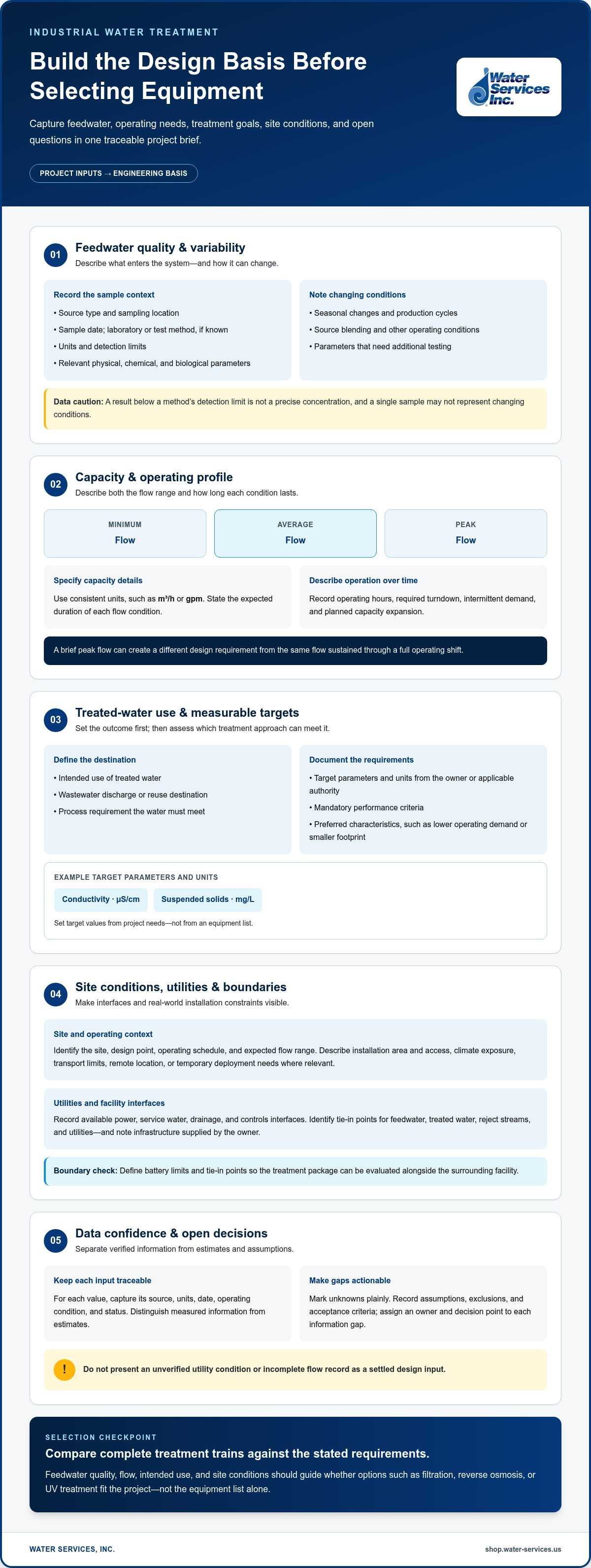
State how treated water will be used, where wastewater will go, whether water will be reused, or what process requirement it must meet. Record the target parameters and units provided by the project owner or applicable authority. Separate mandatory performance criteria from preferred characteristics, such as lower operating demand or a smaller footprint. This makes clear which outcomes are requirements and which are trade-offs.
For example, replace “improve water for production” with a requirement to treat a defined flow for a stated production use and meet owner-specified limits for conductivity and suspended solids, recorded in µS/cm and mg/L. Set the values from the project’s needs, not from an equipment list.
Set the project boundary before requesting a proposal
Identify the site, design point, operating schedule, and expected flow range. Define battery limits and tie-in points, including where feedwater, treated water, reject streams, and utilities connect. Note which infrastructure the owner supplies. These details shape equipment integration and help prevent gaps between the treatment package and the surrounding facility.
Mark unknowns plainly. For example, identify an unverified utility condition or incomplete flow record as an assumption requiring confirmation during engineering. Don’t present an assumption as a settled design input. Assign an owner and decision point to each gap before it affects scope or process selection.
When specifying an industrial water treatment system, use a consistent project brief to connect objectives and boundaries to the proposed process. Relevant industrial water treatment equipment may include filtration, reverse osmosis, or UV treatment, but the stated water quality goals and site conditions should guide whether those categories fit. A clear proposal explains that reasoning and gives engineering a practical starting point.
Build the Design Basis for an Industrial Water Treatment System
The design basis turns project needs into documented engineering inputs. It should show what is known about the feedwater, how much water the system must handle, and what conditions the equipment will face at the site. Record the source and units for each value. This helps the project team distinguish measured information from estimates and identify where more investigation may be needed.
Treatment selection depends on feedwater quality, flow, and the intended use of the treated water. A process suited to one source and operating profile may not suit another, even when the target use appears similar.
Record feedwater quality and variability
Identify the source type and sampling location, then list available analyses with the sample date, laboratory or test method if known, units, and detection limits. Include physical, chemical, and biological parameters relevant to the project. Note seasonal changes, production cycles, source blending, and other operating conditions that could affect water quality.
Flag parameters that need additional testing before final design. A result below a method’s detection limit does not establish a precise concentration, and a single sample may not represent changing conditions. Include these limitations in the proposal basis rather than treating uncertain data as a fixed design value.
Document capacity, utilities, and site conditions
Capture minimum, average, and peak flow in consistent units, such as m³/h or gpm, and state the expected duration of each condition. Record operating hours, required turndown, intermittent demand, and planned capacity expansion. A peak flow that occurs briefly can create a different design requirement from the same flow sustained through a full operating shift.
Describe available power, service water, drainage, controls interfaces, and installation area. Add site conditions that affect equipment layout or access, including climate exposure, transport limits, remote location, and temporary deployment needs. These inputs help determine whether a modular arrangement or a particular equipment configuration is practical.
Use a design-basis table to keep inputs traceable. For each item, capture the parameter, value and units, source, date, operating condition, and status as confirmed or pending. For flow, distinguish a measured operating record from an owner estimate, and identify whether the figure represents normal or peak demand.
Missing or unrepresentative data lowers design confidence because process sizing and expected performance must then rely on assumptions. Don’t substitute a default value. Mark the gap, state how it affects the proposal, and identify what sample, operating record, or site detail would resolve it. This makes uncertainty visible before it becomes an unspoken design constraint.
Once the design basis is assembled, it can guide selection of relevant industrial water treatment equipment, including filtration or reverse osmosis, based on documented feedwater conditions and project targets.
Compare Treatment Approaches Against the Specification, Not the Equipment List
A useful proposal explains why each treatment stage is included and how it supports a stated project requirement. Comparing equipment names alone can hide differences in feedwater assumptions, residuals handling, site interfaces, and verification. Compare complete treatment trains against the same design basis and performance criteria instead. A technology label alone does not establish process fit.
Use a consistent matrix to make the reasoning visible. The entries below are prompts, not a recommended treatment train or performance guarantee. Populate them with project data and define how each requirement will be checked.
| Requirement | Proposed process | Design basis | Assumptions | Verification method |
|---|---|---|---|---|
| Reduce suspended solids for a stated downstream use | Evaluate filtration | Feedwater analysis and design flow | Source conditions remain within documented range | Specify a sampling point and acceptance parameter |
| Address relevant dissolved constituents | Evaluate reverse osmosis | Feedwater chemistry, flow, and target use | Pretreatment and concentrate handling are defined | Identify target-water analysis and operating records |
| Meet a defined disinfection objective | Evaluate UV or chemical dosing | Water quality and downstream application | Required conditions for treatment are documented | State the applicable performance check |
Match process stages to the stated water challenge
Separate pretreatment, primary treatment, and polishing by function. Filtration may be considered for a specified particulate challenge; reverse osmosis may be evaluated when dissolved constituents affect the target use. Assess UV treatment or chemical dosing against the required disinfection outcome and downstream conditions. Each stage needs a defined purpose, supporting feedwater data, and a way to verify its contribution.
For each alternative, compare target water quality, feedwater conditions, residual streams, footprint, and operating needs. Filtration produces a solids stream that needs a handling plan. Reverse osmosis creates a concentrate stream whose management belongs in the scope. The right approach depends on site data and project objectives, not on whether a technology is familiar or commonly specified.
Compare scope, interfaces, and operating implications
Check what each proposal includes for residuals handling, consumables, monitoring, and maintenance responsibilities. Clarify utility connections, controls interfaces, and owner-supplied items. These scope details can affect implementation as much as the treatment stages themselves. Review industrial water treatment equipment in the context of the stated process needs, not as a substitute for defining them.
Specify pumps and controls after hydraulic and operational requirements are established. Flow conditions, operating schedule, and system interfaces inform those selections. A proposal can then identify relevant industrial pump options and controls, linking them to the design basis. When specifying an industrial water treatment system, compare alternatives using the same requirements and verification approach so scope differences remain visible.
Use This Industrial Water Treatment Project Proposal Template
A reusable proposal format makes it easier to review project inputs, compare process options, and assign scope. Copy the sequence below and replace every bracketed prompt with project information. Keep unknowns identified as open items; don’t fill gaps with assumed specifications or guaranteed results.
Copy-ready proposal sections and prompts
Start with the project context and work toward implementation details. Each section should reference the same design basis and identify who supplies information, equipment, and site infrastructure. Use the table to connect each proposed stage to its purpose rather than listing equipment without explanation.
- Project summary: [Site and application], [project purpose], [proposed scope], [key interfaces].
- Objectives: [Intended use, discharge destination, or reuse goal], [target parameters and units], [must-meet criteria], [preferred operating characteristics].
- Design basis: [Source water and analysis references], [flow range and units], [operating schedule], [site conditions and available utilities].
- Proposed process and scope: Complete the stage table, then state included work, deliverables, and exclusions.
| Process stage | Equipment category | Stage purpose |
|---|---|---|
| [Pretreatment] | [Category or not applicable] | [Project-specific purpose] |
| [Primary treatment] | [Category or not applicable] | [Project-specific purpose] |
| [Polishing or disinfection] | [Category or not applicable] | [Project-specific purpose] |
Continue with interfaces ([tie-in points and utilities]), assumptions ([input and basis]), exclusions ([work outside scope]), dependencies ([owner action or prerequisite]), and unresolved data ([gap, decision owner, and resolution needed]). State owner responsibilities directly, including site access, supplied utilities, and required operating information where applicable.
Define performance, deliverables, and verification
List measurable acceptance criteria supplied by the project owner or applicable governing requirements. For each criterion, state the parameter, units, measurement point, and agreed verification method. Identify the required documentation and how commissioning checks and results will be recorded. Address project-specific criteria, applicable standards, permit conditions, and acceptance testing during proposal development.
- Performance: [Criteria, measurement points, and verification method].
- Deliverables: [Drawings], [equipment documentation], [operating information], [other agreed project documents].
- Commissioning: [Included activities], [responsible parties], [records to be provided].
- Support boundaries: [Included support], [duration or limits if agreed], [owner responsibilities].
System selection should follow the stated requirements, design basis, and project scope. Use the industrial water treatment systems guide to connect process concepts with the proposal structure, then tailor the template to the project’s documented inputs.
Move from Proposal to an Implementable Treatment System
A proposal becomes a workable project when its performance requirements, design inputs, scope boundaries, and responsibilities can carry into engineering and execution without guesswork. Before approval, review the document as a connected package. A treatment stage that doesn’t address a stated objective, an undefined site interface, or an acceptance criterion with no verification method can create a gap between the proposal and the installed system.
Check proposal completeness before approval
Use a structured review to test whether the proposal is ready for the next project decision. Confirm that every objective maps to a design feature or verification method. Check that responsibilities, exclusions, interfaces, and dependencies are explicit. Compare alternatives against the same design basis, then record why the preferred approach fits the project. This creates a traceable basis for approval, not just a preferred equipment list.
- Objectives: Is each required outcome tied to a process feature and a way to verify it?
- Inputs: Are source-water records and operating conditions identified, with estimates or gaps labeled?
- Scope: Are supplied equipment, site work, interfaces, exclusions, and owner responsibilities clear?
- Decisions: Does each open item name the information or approval needed to resolve it?
Keep a short assumptions register. For each unconfirmed input, state its effect on the proposal and the decision needed to close the gap. This prevents a preliminary assumption from quietly becoming a final design condition.
Choose a practical path for the project scope
System configuration should reflect how the project will be installed and operated. A modular arrangement may suit a site that needs a packaged system or a defined path for expansion. Mobile treatment may be worth evaluating for temporary, remote, or changing deployment needs. A fixed installation may better match established site infrastructure. Each option still depends on treatment objectives, capacity, utilities, access, and residuals handling.
Project-specific engineering can connect the selected process with equipment integration. Equipment supply, rental deployment, and commissioning support can provide different paths from proposal to operation. The proposal should identify which activities are included and how responsibilities transfer between project phases. Specifying an industrial water treatment system is complete only when the design basis and delivery scope align with the intended operating conditions.
With requirements documented, explore industrial water treatment solutions relevant to your project scope. A defined application, available source-water information, flow requirements, site constraints, and target outcomes give engineering a practical basis for developing the next project stage.
Take the Next Step Toward a Defined Project Scope
A proposal should function as a working handoff, not a static purchasing document. Carry its decisions into detailed engineering: preserve the basis for process selection, assign ownership for unresolved inputs, and keep performance checks aligned with the project’s intended use. This discipline helps teams move from specifying an industrial water treatment system to a scope that can be engineered, supplied, and implemented with fewer avoidable gaps.
Keep the project record useful beyond initial approval. As source-water conditions, operating needs, or site constraints change, document the revision and assess its effect on process requirements, interfaces, and verification. This gives project teams a controlled way to manage changes without losing sight of the original design intent.
Water Services, Inc. provides project engineering, equipment supply, and modular system solutions for industrial applications. Headquartered in Provo, Utah, the company supports projects internationally. Bring your objectives and available project data to define a practical path from requirements to system planning.
Discuss your industrial water treatment project requirements. Share the application, source-water information, flow needs, and site constraints to start the conversation.
Frequently Asked Questions
What information should I collect before requesting an industrial water treatment proposal?
Collect the project inputs needed to describe the water source, intended use, operating demand, and site. Include existing analyses with sampling locations and dates, plus units and detection limits where available. Note upstream process changes or chemical additions that could affect the feedwater. A process flow sketch can show where water enters, where treated water is used, and where residual streams go. Mark estimates clearly so they aren’t mistaken for measured values.
How detailed should an industrial water treatment project proposal be?
A proposal should be detailed enough for the project team to understand what decision it supports and what information remains open. For early planning, show the basis for the proposed approach and identify unresolved inputs. Before implementation approval, clarify scope boundaries, responsibilities, deliverables, and how performance will be evaluated. Add a revision date and document owner so reviewers can distinguish the current proposal from earlier drafts or superseded assumptions.
Can one proposal template work for drinking water, process water, and wastewater projects?
Yes, a shared template can organize project information, but its technical prompts must suit the application. A process-water project may focus on how water quality affects a production step, while a wastewater project may center on the intended discharge or reuse. Drinking water objectives have their own criteria. Label the application clearly, then tailor the required parameters, residuals review, and verification plan to the project’s intended outcome.
What is the difference between a design basis and a treatment process proposal?
The design basis is the set of project conditions and criteria used to develop the system; the process proposal describes the treatment approach selected in response. Keep them traceable by assigning an identifier or revision to key source-water records and owner requirements. When specifying an industrial water treatment system, this distinction helps reviewers see whether a proposed process follows verified inputs or depends on an assumption that still needs a decision.
How should I compare two industrial water treatment proposals?
Normalize the comparison before judging the approaches. Check that both proposals use the same feedwater information, flow cases, target use, battery limits, and performance criteria. Then compare what each includes for residual streams, consumables, operator tasks, monitoring, documentation, and site connections. Record differences as scope items, not just technical preferences. If one proposal relies on an assumption the other resolves, note the evidence needed to compare them fairly.
When should a project consider a mobile or containerized water treatment system?
Evaluate mobile or containerized configurations when a project has temporary operating needs, a remote location, limited installation space, or a requirement to relocate equipment. Compare them with fixed installations using the same capacity and treatment objectives. Include transport route, lifting and placement needs, utility connections, drainage, and access for operation and maintenance. A compact package still has to fit the site and provide a practical route for managing treatment residuals.
What should a proposal say about performance guarantees and compliance?
A proposal should define measurable performance criteria and the conditions under which they’ll be evaluated, including sampling points, test methods, operating state, and responsibilities for collecting and reviewing results. Identify applicable standards or permit conditions with the project team before treating them as design requirements. Keep performance commitments distinct from assumptions and list any exclusions. Acceptance should rely on documented, project-specific criteria, not broad statements that leave the test basis unclear.
0 comments