

Energy costs account for up to 60% of total operational expenses for an industrial facility, yet many operators treat their reverse osmosis water purification system as a simple plug-and-play appliance. You likely recognize that achieving high-purity water involves more than just turning on a pump. It requires an engineered sequence of pre-treatment and precision monitoring to avoid the high costs of premature membrane replacement or system downtime. Managing complex technical specifications is a necessity for maintaining industrial reliability and process integrity.
This article provides a technical roadmap for designing, installing, and optimizing an industrial-grade system that meets the latest standards, including the April 2026 EPA contaminant candidate list requirements. You'll learn how to select specific hardware like FilmTec membranes and Goulds Water Technology pumps to ensure long-term durability. We'll also examine how to integrate Walchem controllers and chemical antiscalants to reduce your total cost of ownership while maintaining compliance with 2026 PFAS monitoring regulations. This guide ensures your water quality remains consistent and your equipment operates at peak efficiency.
Key Takeaways
- Understand the engineering principles of cross-flow filtration to ensure efficient separation and minimize membrane fouling.
- Select specialized hardware, including FilmTec membranes and Goulds pumps, to build a durable and high-output reverse osmosis water purification system.
- Master the five-step implementation workflow, from initial feed water analysis to precise recovery and flux calculations.
- Optimize long-term performance through rigorous monitoring of Normalized Permeate Flow and scheduled Clean-In-Place maintenance.
- Evaluate containerized and mobile RO solutions for rapid deployment in remote industrial operations requiring standardized water quality.
Understanding the Mechanism of an Industrial Reverse Osmosis System
An industrial Reverse osmosis (RO) process is a pressure-driven separation technology. It uses semi-permeable membranes to remove ions, molecules, and larger particles from water. Unlike traditional media filtration that relies on particle size, a reverse osmosis water purification system operates at the molecular level. It's a precise science. Pressure is the driver. Industrial systems utilize cross-flow filtration rather than dead-end filtration. In dead-end setups, all feed water passes through the filter, causing rapid cake buildup and clogging. Cross-flow filtration directs the feed water across the membrane surface. This creates two streams: the purified water and a concentrated waste stream that carries away rejected contaminants. This continuous scouring action extends membrane life and maintains consistent flux.
Total Dissolved Solids (TDS) levels dictate the osmotic pressure of the feed water. Higher TDS concentrations require higher feed pressures to overcome the natural osmotic gradient. Designing a system without precise TDS data leads to undersized pumps or premature membrane scaling. RO differs significantly from ultrafiltration and UV sterilization. Ultrafiltration removes suspended solids and large pathogens but cannot strip dissolved salts. UV systems provide disinfection by neutralizing microbial DNA; they don't remove physical or chemical contaminants. A complete reverse osmosis water purification system often uses these as pre-treatment or post-treatment steps to protect the primary membranes and ensure final water quality.
The Physics of Osmotic Pressure
Osmosis is the natural tendency of water to move from low solute concentrations to high solute concentrations. To reverse this, the system applies external mechanical pressure that exceeds the natural osmotic pressure of the solution. This forces water molecules through the membrane pores while rejecting up to 99% of dissolved salts. The resulting purified stream is the permeate; the waste stream containing the rejected solids is the concentrate or brine. Flux rate is defined as the volume of permeate produced per unit area of membrane per unit of time, which serves as the primary metric for sizing industrial arrays.
Why Industrial RO Differs from Residential Units
Industrial systems are engineered for continuous, high-volume output measured in gallons per minute (GPM). Residential units are rated in gallons per day (GPD). The structural requirements are vastly different. Industrial housings utilize 304 or 316 stainless steel and fiberglass-reinforced plastic (FRP) to withstand operating pressures that often exceed 200 PSI. These systems rely on high-performance Goulds Water Technology Pumps to provide the consistent head pressure and flow rates required for industrial process water. Precision instrumentation ensures these components operate within narrow tolerances to prevent mechanical failure in demanding environments.
Essential Components of a High-Performance Purification System
A high-performance reverse osmosis water purification system is an integrated assembly of specialized hardware. Each component must meet exact technical specifications to ensure system reliability. The high-pressure pump acts as the primary driver. It generates the energy required to push water through the semi-permeable barrier. These pumps work in tandem with pressure vessels. These housings are typically rated for 300 to 1,200 PSI, depending on the application. Precision instrumentation, such as Signet flow sensors and Ashcroft pressure gauges, monitors the pressure differential across these vessels. This data is vital for identifying fouling. Following FDA guidance on RO systems ensures that your monitoring protocols meet the rigorous standards required for pharmaceutical or food-grade water production.
RO Membranes: FilmTec and Hydranautics Selection
Industrial membranes utilize a spiral-wound configuration. This design layers flat membrane sheets around a central permeate tube to maximize the active surface area. Choosing between FilmTec and Hydranautics requires an analysis of your specific feed water. Brackish water (BW) elements are standard for most industrial well water or municipal sources. Seawater (SW) elements are necessary when TDS exceeds 10,000 ppm. For a detailed breakdown of performance metrics, consult our analysis of FilmTec vs Hydranautics: Comparing RO Membranes.
Pre-Treatment and Chemical Dosing
Pre-treatment is the most critical factor in extending membrane life. It's the primary defense against fouling. Multimedia filter tanks remove silt, sand, and clay. This prevents physical blockage of the membrane feed spacers. Chemical dosing follows. High-precision Pulsafeeder metering pumps inject water treatment antiscalants into the feed stream. These chemicals keep scale-forming minerals in suspension. Without this, calcium and magnesium salts precipitate onto the membrane surface, causing irreversible damage. Pentair filter housings and Harmsco filtration products provide additional polishing to protect the RO stage. Ensuring your system has the correct head pressure starts with selecting high-durability industrial pumps designed for continuous duty. Proper pre-treatment ensures your membranes last their full 2 to 5 year life cycle, significantly reducing your total cost of ownership.
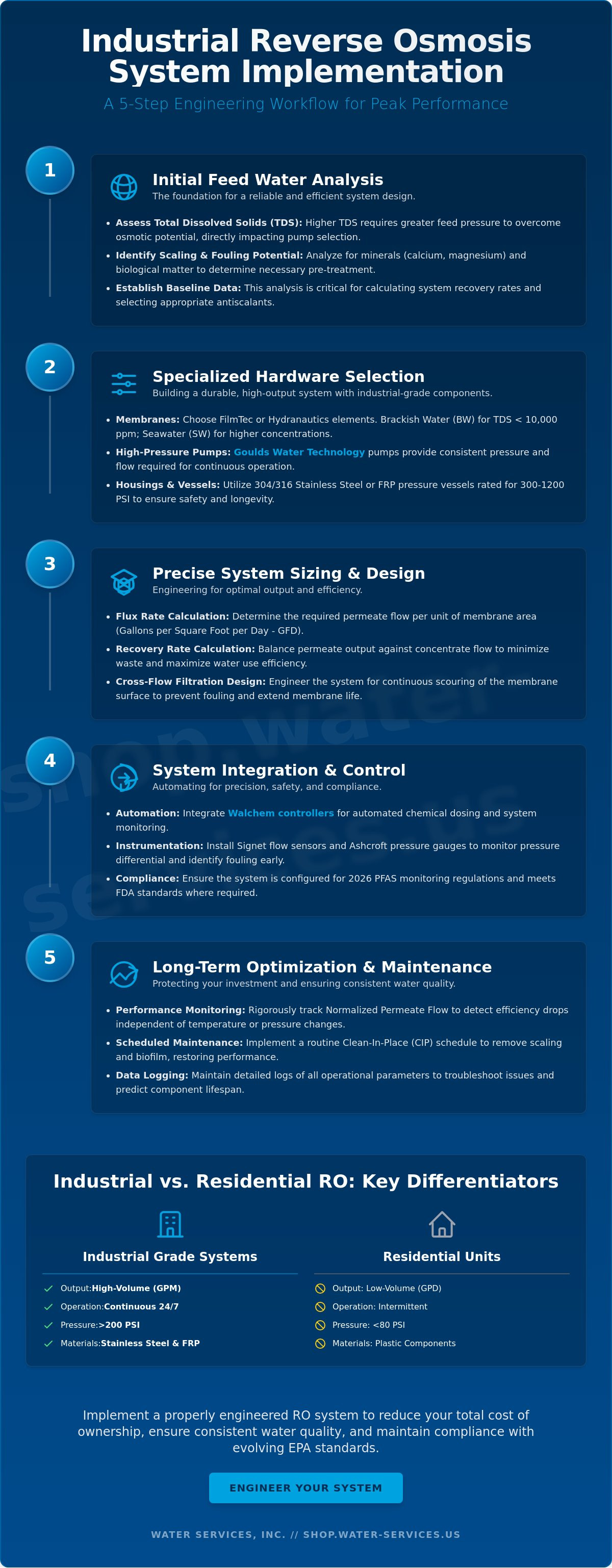
How to Implement an RO System: A 5-Step Engineering Workflow
Implementing a reverse osmosis water purification system requires a structured engineering approach. It isn't a simple assembly of parts. It's a sequence of calculated decisions. Each step ensures the final effluent meets your specific process standards while protecting your capital investment. A professional implementation moves from raw data to a fully commissioned asset with documented performance benchmarks.
Step 1 & 2: Analysis and Design
A laboratory-grade water analysis is the non-negotiable foundation of any industrial project. You must characterize the feed water for TDS, hardness, silica, and organic content. This data informs the calculation of the "Recovery Rate." This metric balances the volume of purified permeate against the waste concentrate. While EPA reverse osmosis efficiency standards provide benchmarks for point-of-use systems, industrial recovery rates typically range from 50% to 85% depending on water chemistry. Once the recovery target is set, engineers select high-pressure pumps. These must deliver the specific head pressure required to overcome osmotic resistance at the designed permeate flow rate.
Step 3 & 4: Integration and Installation
Installation focuses on mechanical integrity and automation. High-pressure plumbing lines must be secured with proper supports to prevent vibration-induced fatigue. Use Ashcroft pressure gauges at every stage: pre-filter inlet, post-filter outlet, and across the membrane array. These gauges provide the primary data for troubleshooting. Integrating electric power controls allows the system to communicate with level sensors in storage tanks. This prevents dry-run conditions or tank overflows. Safety remains paramount during chemical startup. Technicians must utilize appropriate PPE, including chemical-resistant gloves and eye protection, when calibrating antiscalant dosing rates.
Step 5: Commissioning and Monitoring
Commissioning is the final validation. Start by flushing the reverse osmosis water purification system with low-pressure water to remove air and debris. Check every pressure vessel seal for leaks. Once pressurized, record the initial permeate conductivity, temperature, and flow rates. These numbers establish your performance baseline. Any deviation from this baseline in the future indicates fouling or mechanical wear. Modern facilities use Walchem controller interfaces for this task. These units provide remote monitoring and real-time data logging, ensuring that operators can respond to water quality shifts before they impact production.
Optimizing RO Performance: Maintenance and Troubleshooting
Operational longevity depends on data, not guesswork. A reverse osmosis water purification system performs best when operators monitor Normalized Permeate Flow (NPF) daily. NPF corrects for fluctuations in feed water temperature and pressure, providing a true baseline of membrane health. Without normalization, a seasonal drop in water temperature might be mistaken for fouling. Precision monitoring prevents unnecessary downtime and ensures the system operates within its designed flux parameters.
Scale and biofouling are the primary threats in harsh industrial environments. Scale forms when mineral concentrations exceed solubility limits in the concentrate stream. Biofouling occurs when microorganisms colonize the membrane surface. Both issues increase energy consumption and decrease water quality. Utilizing high-quality antiscalants and monitoring the differential pressure across each stage allows for early intervention. If the pressure drop increases by 15 percent over the baseline, a Clean-In-Place (CIP) procedure is required to restore performance.
When to Clean vs. Replace RO Membranes
Clean your membranes when permeate flow drops by 10 to 15 percent or when the salt passage increases by 5 to 10 percent. Delaying a CIP beyond these triggers often results in irreversible compaction of the foulants. Chemical oxidation, frequently caused by accidental chlorine exposure, cannot be rectified through cleaning; it requires immediate element replacement. For a deeper understanding of permeate characteristics and water quality standards, read our guide on What is RO Water? A Technical Guide.
Remote Site Troubleshooting for Mining and Military
Remote operations in mining or military sectors face unique challenges. Feed water temperature fluctuations significantly impact flux. Cold water is more viscous and requires higher feed pressure to maintain production. Maintain a critical spare parts inventory to avoid logistical delays. This inventory should include Ashcroft pressure gauges, Pentair filter housings, and replacement sediment cartridges. If local teams cannot resolve a persistent flux decline, utilize our technical support services for remote diagnostics and engineering assistance.
Keep your facility running at peak capacity and avoid costly system failures. Order replacement FilmTec membranes and industrial filtration hardware today.
Modular and Mobile RO Solutions for Global Operations
Industrial projects in remote locations require rapid infrastructure deployment. A modular reverse osmosis water purification system solves the logistical challenges of site-specific construction. These systems are engineered within ISO-standard shipping containers, providing a "plug-and-play" asset that's ready for immediate connection to feed water and power sources. Containerized RO plants eliminate the need for extensive on-site building permits and specialized masonry. This allows facilities to achieve high-purity water production within weeks rather than months.
Standardizing water quality is a critical requirement for global mining operations and military encampments. When a fleet of mobile units is deployed, maintenance protocols and spare parts inventories become uniform across all geographic sectors. This consistency reduces the training burden on local operators. It ensures that process water meets exact technical specifications regardless of the local environment. For temporary site needs or short-term remediation projects, organizations often evaluate the logistical benefits of mobile ultrafiltration systems alongside permanent installations to determine the most cost-effective path for water security.
Containerized RO Plant Engineering
Ruggedization is the hallmark of modular engineering. Units destined for extreme climates include integrated HVAC systems to maintain optimal operating temperatures for sensitive electronics and membranes. These self-contained environments protect high-pressure pumps and Walchem controllers from dust, humidity, and corrosive salt air. For a comprehensive look at how these systems integrate into broader facility goals, see our pillar article on Industrial Water Treatment Systems: Engineering High-Purity Solutions.
Partnering with Water Services, Inc.
Water Services, Inc. has engineered custom industrial solutions since 1994. Our Provo, Utah headquarters serves as the hub for domestic reliability and global distribution. We provide direct access to top-tier hardware, including Goulds Water Technology pumps, Viqua UV systems, and Harmsco filtration products. This centralized expertise ensures that every reverse osmosis water purification system we design is backed by decades of technical integrity and logistical competence. We understand the rigors of demanding commercial environments and prioritize the durability of your water infrastructure. Consult with our engineers for a custom RO system design to ensure your facility meets its 2026 water quality and compliance targets.
Securing Your Industrial Water Infrastructure
Successful implementation of a reverse osmosis water purification system depends on precise engineering. It begins with rigorous feed water characterization and ends with the selection of high-performance membranes that match your specific TDS requirements. Maintaining a performance baseline through NPF monitoring ensures that your system continues to meet evolving regulatory standards while minimizing your total cost of ownership. Integrating durable pre-treatment stages and high-pressure pumps remains the most effective strategy for preventing premature membrane fouling and unscheduled downtime.
Water Services, Inc. has provided technical expertise and industrial-grade hardware since 1994. As an authorized distributor for industry leaders including Goulds, FilmTec, and Hydranautics, we maintain a robust inventory of components and membranes for global shipping. Our team offers remote site support and logistical competence to ensure your facility maintains its water quality targets in any environment. Shop Industrial Reverse Osmosis Components and Membranes to secure the reliability of your water treatment assets. Our engineers are ready to assist with your next custom design or maintenance cycle.
Frequently Asked Questions
How long do industrial reverse osmosis membranes typically last?
Industrial reverse osmosis membranes typically last between 2 and 5 years. This lifespan depends heavily on the consistency of pre-treatment and the chemical nature of the feed water. Implementing a rigorous Clean-In-Place (CIP) schedule when permeate flow declines by 10 percent can prevent premature replacement. Elements from manufacturers like FilmTec or Hydranautics are designed for this longevity when protected from oxidation, biofouling, and mineral scaling.
What is the typical recovery rate for a commercial RO system?
Typical recovery rates for commercial and industrial systems range from 50 to 85 percent. The specific percentage is determined during the design phase based on the feed water's Total Dissolved Solids (TDS) and silica levels. Higher recovery rates reduce waste but increase the risk of membrane scaling. Balancing these factors is essential for optimizing the total cost of ownership for your reverse osmosis water purification system.
Can a reverse osmosis system remove bacteria and viruses?
A reverse osmosis water purification system effectively removes 95 to 99 percent of bacteria and viruses due to the small pore size of the membrane. However, RO shouldn't be the sole biological barrier. Minor imperfections in membrane seals or "O" rings can allow pathogens to bypass the filtration stage. For this reason, industrial facilities often integrate Viqua UV systems as a secondary disinfection step to ensure absolute water safety.
What pre-treatment is required for a reverse osmosis water purification system?
Essential pre-treatment includes multimedia filter tanks for sediment removal and chemical dosing for scale inhibition. These stages protect the sensitive membrane surface from physical abrasion and mineral precipitation. Carbon filtration is also necessary if the feed water contains chlorine, which causes irreversible oxidation of thin-film composite membranes. Proper pre-filtration ensures the high-pressure pump operates within its designed head pressure tolerances while maintaining consistent flux.
How do I calculate the pump pressure needed for my RO system?
Calculating pump pressure requires determining the Net Driving Pressure (NDP). You must account for the feed water's osmotic pressure, the membrane's resistance, and the pressure drops across the vessels. Generally, higher TDS requires higher pressure to force water through the semi-permeable barrier. Selecting a Goulds Water Technology pump with the correct performance curve ensures the system maintains the required GPM at the calculated operating pressure.
What is the difference between brackish water and seawater RO?
The primary difference is the concentration of Total Dissolved Solids (TDS) in the source water. Brackish water (BW) systems are engineered for water with TDS levels below 10,000 ppm, such as well or municipal water. Seawater (SW) systems handle concentrations exceeding 10,000 ppm. Because seawater has much higher osmotic pressure, SW systems require specialized membranes and pumps capable of much higher operating pressures than BW arrays.
How much waste water does an industrial RO system produce?
Waste water production is the inverse of the system's recovery rate. For example, a system operating at a 75 percent recovery rate produces 25 gallons of concentrate for every 75 gallons of permeate produced. This concentrate stream carries away the rejected salts and minerals. Managing this brine is a critical part of industrial design, especially in regions with strict discharge regulations or when minimizing total water consumption.
Is a UV sterilizer necessary if I already have an RO system?
UV sterilization is highly recommended as a post-treatment step for high-purity applications. While RO membranes are physical barriers, they aren't considered absolute sterilized filters in industrial settings. Bacteria can occasionally colonize the permeate side of the membrane or downstream storage tanks. Integrating a Viqua UV water purification system provides a final, non-chemical disinfection layer that neutralizes any remaining microorganisms before the water reaches the process line.
0 comments