

Did you know that as of 2026, national monitoring requirements for specific PFAS chemicals have officially commenced for water systems? You likely recognize that securing a reliable, high-purity water supply is no longer just a baseline operational requirement. It's a complex engineering challenge where system downtime or regulatory non-compliance in wastewater discharge can halt your entire production line. High total cost of ownership often stems from poor component selection, yet many facilities continue to struggle with rising energy costs and excessive chemical consumption. Effective commercial water treatment requires a shift from simple hardware procurement to precise engineering integration.
This 2026 guide provides the technical specifications and financial frameworks necessary to select a system that ensures durability and maximum ROI. You'll learn how to align your facility with the latest EPA standards while reducing operational overhead. We'll examine the critical roles of FilmTec reverse osmosis membranes, Goulds Water Technology pumps, and Viqua UV purification systems. This overview covers everything from containerized RO plants to the precise calibration of Walchem controllers and Signet flow sensors for a stable, high-performance industrial water cycle.
Key Takeaways
- Quantify the financial impact of water quality on industrial equipment longevity to secure maximum ROI and long-term operational compliance.
- Evaluate the specific performance metrics of FilmTec RO membranes and Viqua UV systems to ensure high-purity water for specialized industrial applications.
- Compare the logistical advantages of standardized skid-mounted units against containerized reverse osmosis plants for remote mining and oil site deployments.
- Utilize a comprehensive buyer’s checklist to analyze TDS, pH, and peak flow rates before finalizing your commercial water treatment infrastructure.
- Streamline global deployment and system durability through strategic planning for on-site commissioning and international logistical support.
Defining Commercial Water Treatment ROI & Operational Compliance
The scope of commercial water treatment spans the entire industrial lifecycle. It begins with raw influent pretreatment and extends to complex wastewater recovery systems. Facilities must manage high-purity process water for cooling towers and boilers while simultaneously addressing discharge requirements. Utilizing diverse industrial water treatment technologies ensures that every gallon contributes to operational efficiency rather than becoming a liability. Selecting the right equipment is an engineering decision, not a purchasing one. Precise water chemistry management protects your infrastructure from the point of entry to the point of discharge.
Financial performance in industrial settings depends on the Total Cost of Ownership (TCO). Procurement teams often prioritize the lowest initial capex. This strategy frequently backfires in harsh environments. Cheap components fail under high pressure or corrosive chemistry. The resulting downtime and emergency repairs quickly exceed any initial savings. Investing in high-grade water treatment hardware like Goulds pumps or FilmTec membranes ensures mechanical integrity and predictable maintenance cycles. Reliability is the only path to a sustainable ROI in 2026 industrial markets.
The Cost of Poor Water Quality
Scaling and corrosion are the primary drivers of equipment degradation. Influent chemistry with high hardness or silica levels destroys industrial heat exchangers and boiler tubes. This leads to reduced thermal efficiency and eventual mechanical failure. When these systems fail, the hourly cost of treatment system failure can reach thousands of dollars in lost production. Higher Total Dissolved Solids (TDS) levels directly increase the frequency of reverse osmosis membrane replacement and cleaning cycles. Reliability requires proactive monitoring through Walchem controllers and Signet flow sensors to prevent catastrophic failures and extend the life of downstream assets.
Compliance and Environmental Stewardship
Regulatory landscapes are shifting rapidly as of May 2026. The EPA has introduced stricter monitoring for PFAS and microplastics under the draft Sixth Contaminant Candidate List. Mining operations and power plants are moving toward Zero Liquid Discharge (ZLD) to meet these standards and mitigate water scarcity risks. Modular and containerized systems simplify environmental permitting by offering pre-engineered compliance. These systems allow for faster deployment in remote sites where environmental stewardship is a legal mandate. Meeting international discharge standards avoids heavy fines and protects your social license to operate in a global market.
Evaluating Core Technologies: RO, UV, and Pumping Systems
Industrial commercial water treatment relies on the precise synchronization of filtration, disinfection, and fluid transport. High-purity water production isn't achieved through a single component but through a balanced assembly of high-performance hardware. System efficiency depends on how well the reverse osmosis membranes, ultraviolet sterilizers, and high-pressure pumps operate under load. Integrating chemical dosing systems for scale inhibition and pH adjustment is equally vital. These systems ensure that your influent chemistry remains within the narrow operational windows required by sensitive downstream equipment.
Industrial Reverse Osmosis (RO) Membranes
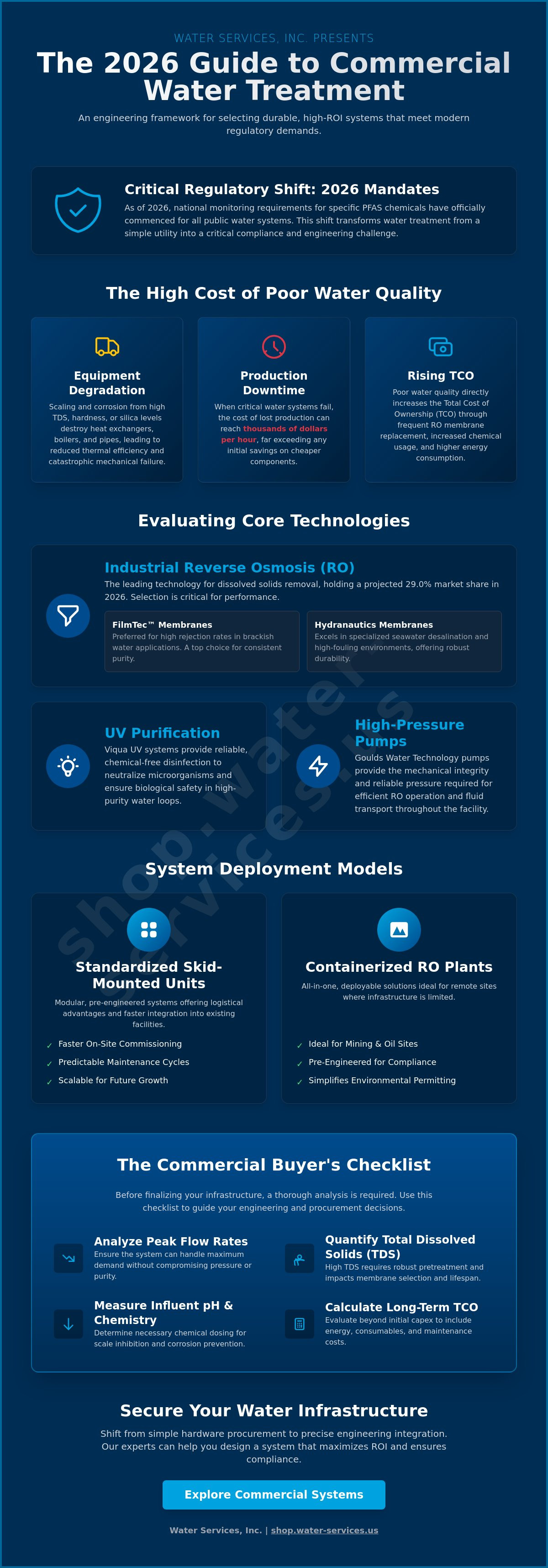
Reverse osmosis remains the leading technology for dissolved solids removal, holding a projected 29.0% market share in 2026. Selecting between FilmTec vs Hydranautics requires a technical analysis of your specific source water. FilmTec membranes are often preferred for their high rejection rates in brackish applications. Hydranautics excels in specialized seawater and high-fouling environments. You must monitor flux rates, measured in gallons per day per square foot (GFD), to prevent premature scaling. High recovery percentages are desirable, but pushing a system too hard in high-TDS environments leads to rapid membrane degradation. Regular replacement of sediment and carbon filters is a fundamental maintenance protocol to protect these expensive assets.
UV Sterilization and Pumping Dynamics
Viqua UV systems provide a critical layer of non-chemical disinfection for military, laboratory, and food production facilities. These units eliminate pathogens without adding residual chemicals that could interfere with sensitive processes. The effectiveness of UV depends on consistent flow velocity and water clarity. This is why Goulds Water Technology Pumps are the industrial standard for reliability. They provide the steady pressure required to maintain optimal hydraulic conditions. Selecting the right pump curve is essential for handling fluctuating flow demands without wasting energy. Efficient pumping reduces the total cost of ownership by minimizing electricity consumption and mechanical wear on the entire commercial water treatment system.
To maintain compliance with EPA industrial effluent guidelines, precise chemical dosing is mandatory. Pulsafeeder metering pumps paired with Walchem controllers allow for automated antiscalant injection. This prevents mineral precipitation on membrane surfaces. If you are designing a new facility or upgrading an existing skid, you can browse our industrial pump specifications to find the exact performance match for your flow requirements.
Custom Modular vs. Standardized Components: The Engineering Choice
Selecting the physical configuration of a commercial water treatment system is as critical as the filtration technology itself. Standardized skid-mounted systems offer a viable solution for facilities with predictable water chemistry and indoor installation space. These units provide shorter lead times and lower initial capital expenditures. However, standardized skids often lack the specialized material coatings or component redundancies required for aggressive industrial environments. When process water requirements deviate from standard municipal baselines, a custom modular approach becomes necessary to maintain long-term mechanical integrity.
Engineering for "Plug and Play" deployment requires a shift toward modularity that simplifies global logistics. Systems designed to meet DoD Industrial Water Treatment Standards prioritize reliability and ease of maintenance in high-stakes environments. These standards ensure that every component, from the frame to the sensors, can withstand the rigors of rapid deployment and continuous operation. This engineering philosophy minimizes on-site assembly time and reduces the risk of installation errors in remote regions.
The Case for Containerized Solutions
Containerized treatment plants are the definitive choice for remote mining, oil, and military sites. These systems house all hardware within reinforced, ISO-standard shipping containers. This configuration provides essential protection from harsh environmental conditions such as extreme heat, abrasive dust, and high humidity. It also allows for the centralization of electric power controls within a climate-controlled enclosure. Keeping sensitive electrical components away from ambient moisture and heat prevents premature circuit failure and ensures stable automation performance. For emergency response or temporary sites, these units offer the fastest path to a reliable water supply.
Integrating Precision Controls
Automation is the cornerstone of modern industrial water management. Walchem controllers serve as the primary interface for automated process management, regulating everything from antiscalant dosing to backwash cycles. Real-time monitoring depends on the accuracy of Signet flow sensors, which provide the volumetric data required to calculate membrane flux and system recovery. Diagnostic precision is further enhanced by the use of Ashcroft pressure gauges. These instruments allow operators to detect subtle pressure differentials across multimedia filter tanks or RO vessels. Identifying these trends early prevents membrane fouling and unplanned downtime. Modern commercial water treatment plants now utilize remote telemetry to transmit this data to a central hub, allowing for expert oversight of global installations from a single location.
The Commercial Buyer’s Checklist: Flow Rates, TDS, and TCO
A successful commercial water treatment project starts with data, not hardware. Procurement teams must follow a rigorous technical checklist to ensure the selected system meets site-specific requirements. Skipping these steps leads to operational bottlenecks and accelerated component failure. Use the following five steps to define your system parameters:
- Step 1: Conduct a comprehensive raw water analysis measuring Total Dissolved Solids (TDS), pH, hardness, and silica.
- Step 2: Define peak versus average flow rate requirements in Gallons Per Minute (GPM).
- Step 3: Determine required effluent purity, distinguishing between potable standards and ultra-pure process water.
- Step 4: Evaluate logistical constraints including the physical footprint, power availability, and site access for containerized units.
- Step 5: Calculate the 5-year Total Cost of Ownership (TCO) by including consumables, energy, and membrane replacement cycles.
Analyzing Influent Chemistry
Raw water quality dictates the design of the entire pretreatment train. Identifying "membrane killers" like high silica or iron is the priority during initial testing. These contaminants cause irreversible fouling in reverse osmosis systems if not addressed. Selecting the correct water treatment chemicals for pretreatment prevents mineral precipitation. Pre-filtration strategies must also be matched to the suspended solids load. Multimedia filter tanks are ideal for high-turbidity sources, while Harmsco or Pentair cartridge filtration provides the final polishing required before high-pressure membrane entry. Precise chemical dosing through Pulsafeeder pumps ensures the influent remains within safe operational limits.
Sizing for Scalability
Industrial facilities often operate on 24/7 cycles where water demand is constant. Calculating GPM requirements must account for peak instantaneous flow rather than just daily averages. Oversizing a system by 20% to 30% is often more cost-effective than a future upgrade. This extra capacity provides a buffer for seasonal fluctuations in feed water quality or unexpected production increases. A system running at 70% capacity lasts longer and requires less frequent maintenance than one pushed to its hydraulic limit. High-efficiency Goulds pumps and FilmTec membranes reduce long-term electrical costs, significantly impacting the total financial outlook.
To ensure your facility meets both technical and financial benchmarks, examine our full range of industrial water treatment systems and select the components that match your specific water profile.
Global Deployment & Maintenance: Securing Your Water Infrastructure
Shipping commercial water treatment infrastructure to regions like Africa, the Middle East, or South America presents unique logistical hurdles. These include navigating complex customs regulations, specialized crating for maritime transport, and inland haulage to landlocked mining or oil sites. Success depends on a provider capable of managing these variables without compromising hardware integrity. Engineering a system for global deployment requires more than just high-quality components. It demands a logistical framework that ensures the system arrives on-site ready for immediate integration.
On-site commissioning is a non-negotiable phase of any international project. Experienced engineers must verify hydraulic balances and calibrate Walchem controllers against the actual site influent. This process includes comprehensive operator training to ensure local personnel can manage routine backwash cycles and monitor Signet flow sensors correctly. A robust spare parts management strategy is equally critical. Maintaining an on-site inventory of replacement sediment and carbon filters, along with backup Pulsafeeder metering pumps, minimizes the risk of extended downtime in geographically isolated areas.
Remote Site Support and Maintenance
Serviceability is a core design requirement for systems deployed in remote environments. Engineering teams must prioritize easy access to FilmTec membranes and Goulds pumps within the confined footprint of containerized plants. This design philosophy allows local technicians to perform routine maintenance without specialized heavy lifting equipment. Safety protocols are paramount during these operations. Personnel must utilize appropriate personal protective equipment (PPE) during chemical handling and high-pressure system maintenance to prevent workplace injuries.
Why Technical Authority Matters
Reliability in extreme environments is built on decades of field data. Water Services, Inc. leverages over 30 years of experience in mining wastewater treatment to design systems that survive the rigors of heavy industry. We provide a curated catalog of Tier-1 brands, including Goulds, Viqua, and FilmTec, ensuring every component meets industrial specifications. This technical authority allows us to offer custom design-build-maintain contracts that secure your water infrastructure for the long term. Our approach treats commercial water treatment as a dynamic engineering integration rather than a static hardware purchase.
Consult with our engineering team for a custom commercial water solution to optimize your 2026 operational footprint and ensure long-term regulatory compliance.
Securing Your Industrial Water Future for 2026 and Beyond
Designing a high-performance commercial water treatment system requires a precise balance of chemical analysis, hydraulic engineering, and logistical planning. You've seen how selecting the right RO membranes and high-pressure pumps impacts your long-term ROI. Compliance with 2026 EPA standards isn't a secondary concern; it's a fundamental requirement for operational stability. By utilizing a technical checklist and prioritizing modular engineering, you protect your facility from unplanned downtime and excessive maintenance costs.
Water Services, Inc. has provided specialized engineering and distribution since 1994. As an authorized distributor for Goulds, Viqua, and FilmTec, we offer the technical authority required for complex global projects. Whether you need a containerized RO plant for a remote mining site or replacement filters for an existing skid, our inventory supports your specific purity requirements. We specialize in the design-build-maintain contracts that secure industrial infrastructure across six continents. Our team understands the rigors of demanding environments and the necessity of precision components.
Take the next step in optimizing your water lifecycle. Browse our Industrial Water Treatment Equipment Catalog to find the exact hardware for your 2026 project requirements. We're ready to support your engineering goals with industrial-grade reliability.
Frequently Asked Questions
What is the difference between commercial and industrial water treatment?
Commercial systems typically manage potable water and HVAC requirements for facilities like hospitals or hotels. Industrial systems are designed for high-purity process water and wastewater recovery in manufacturing, mining, or power generation. Industrial applications require more robust components, such as Goulds pumps and specialized chemical dosing, to withstand aggressive chemistry and continuous 24/7 operation cycles.
How much does a commercial reverse osmosis system cost to maintain?
Maintenance costs are determined by your feed water chemistry and total volumetric throughput. Primary expenses include periodic replacement of sediment and carbon filters, antiscalant chemicals, and electricity for high-pressure pumps. Utilizing Walchem controllers for precise dosing and Signet sensors for flow monitoring helps minimize chemical waste and extends the interval between membrane cleanings.
Can commercial water systems be customized for specific industry contaminants?
Yes, commercial water treatment systems are engineered to address specific contaminants through targeted pretreatment and membrane selection. For example, high-silica influent requires specialized antiscalants and Multimedia filter tanks to prevent scale formation. We select between FilmTec and Hydranautics membranes based on whether your facility needs to treat brackish water, seawater, or high-fouling process streams.
What flow rate (GPM) do I need for a large-scale industrial facility?
Required flow rates depend on your peak instantaneous demand rather than your daily average. Large-scale facilities often require systems capable of delivering between 50 and 500 gallons per minute (GPM) to maintain production stability. Oversizing the pump and membrane capacity by approximately 20% ensures the system isn't constantly running at its mechanical limit, which improves long-term reliability.
How often should RO membranes be replaced in a commercial setting?
Reverse osmosis membranes typically require replacement every two to five years in most commercial and industrial settings. This lifespan is heavily influenced by the quality of your pretreatment and the Total Dissolved Solids (TDS) in the raw water. Monitoring pressure differentials with Ashcroft gauges allows operators to identify fouling early and perform clean-in-place (CIP) procedures to extend membrane life.
What are the benefits of containerized water treatment plants for remote sites?
Containerized plants provide a climate-controlled, secure environment that protects sensitive filtration hardware from extreme heat, dust, and humidity. These systems are pre-assembled and tested before shipment, allowing for rapid "plug and play" deployment at remote mining or military sites. Their modular design simplifies global logistics and reduces the need for extensive on-site civil engineering or building construction.
How do I ensure my commercial water treatment system meets local compliance?
Compliance is achieved by aligning your system's discharge parameters with EPA industrial effluent guidelines and local municipal codes. Integrated Walchem controllers provide automated data logging of pH, TDS, and flow rates, which is essential for regulatory reporting. Regular raw water analysis ensures that your pretreatment train is effectively removing contaminants like PFAS or heavy metals before discharge.
Does Water Services, Inc. provide international shipping and on-site setup?
We manage the entire logistical chain, including international crating, customs documentation, and transport to remote global locations. Our engineering team provides on-site commissioning to calibrate sensors and verify hydraulic performance under site-specific conditions. We also conduct comprehensive operator training to ensure your local personnel can perform routine maintenance and filter replacements safely and efficiently.
0 comments