

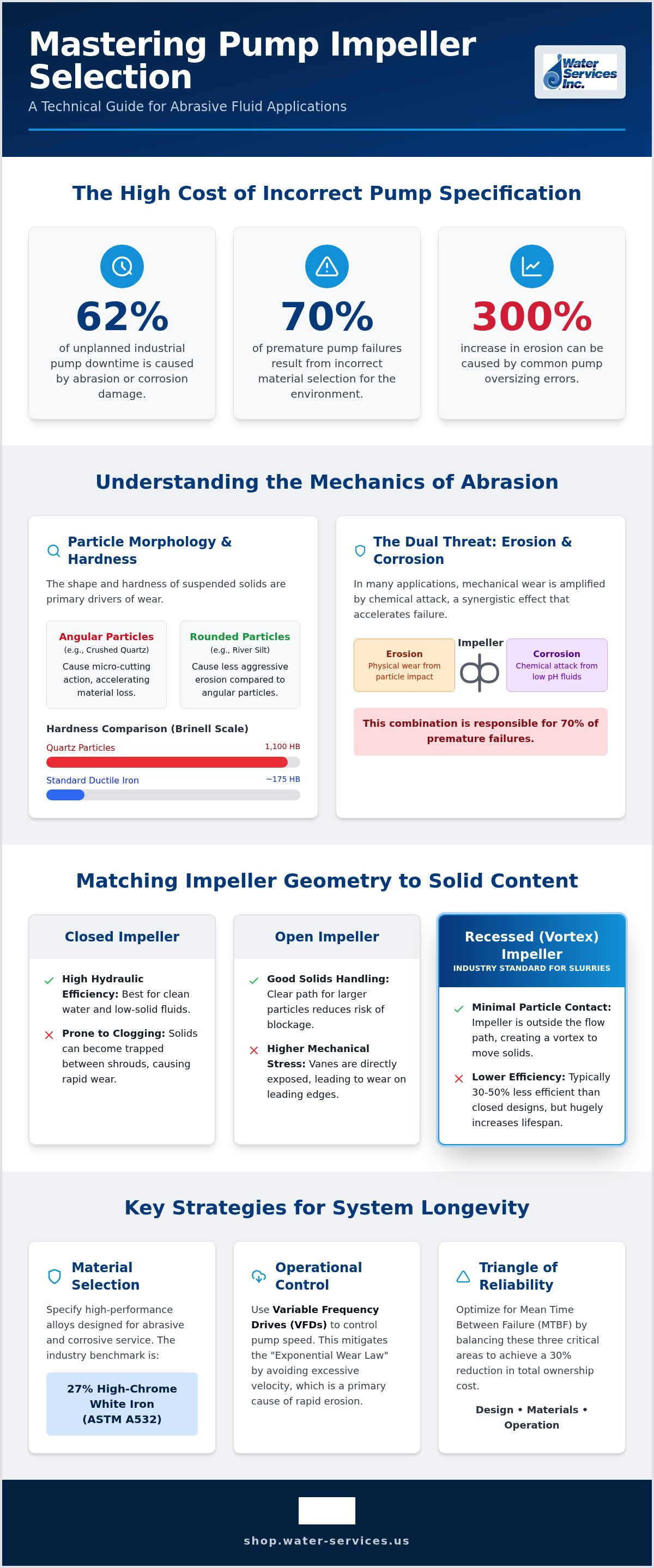
Recent research from the Hydraulic Institute indicates that 62% of unplanned industrial pump downtime is caused by abrasion or corrosion damage to internal components. If your facility deals with heavy slurries or industrial wastewater, you've likely faced the high cost of frequent impeller replacements and the steady loss of hydraulic efficiency as vanes wear down. It's a common struggle. Data from the International Pump Manufacturers Association shows that 70% of premature pump failures result from incorrect material selection for the specific abrasive environment.
This guide ensures you master the technical criteria for choosing pump impeller for abrasive fluids to maximize equipment lifespan. You'll learn how to achieve a 30% reduction in total ownership cost by applying 2026 industry standards for metallurgy and system design. We will detail the performance of 27% High-Chrome White Iron under ASTM A532, the critical role of Variable Frequency Drives in managing wear, and how to avoid the 300% increase in erosion caused by common pump oversizing errors.
Key Takeaways
- Identify how particle morphology and hardness accelerate erosion to select the correct wear-resistant materials.
- Evaluate the trade-offs between open, closed, and recessed vortex designs when choosing pump impeller for abrasive fluids.
- Specify Goulds Water Technology high-chrome alloys to withstand high-density slurries and corrosive wastewater environments.
- Implement Variable Frequency Drives (VFDs) to mitigate the Exponential Wear Law and maintain constant discharge pressure.
- Master the Triangle of Reliability to optimize Mean Time Between Failure (MTBF) and reduce annual maintenance costs.
Understanding the Mechanics of Abrasion in Industrial Pumping
Abrasive fluids are liquids containing suspended solids that physically erode pump internals through mechanical impact. Success in choosing pump impeller for abrasive fluids requires a technical understanding of how particle morphology interacts with metal surfaces. In industrial environments, 62% of unplanned pump downtime is caused by abrasion or corrosion damage to internal components. This wear is driven by particle size, shape, and hardness. Angular particles, such as crushed quartz or silica sand, create micro-cutting actions that remove material faster than rounded river silt. If you don't account for particle angularity, you risk under-specifying the material hardness. Hardness is typically measured on the Mohs or Brinell scale. For instance, quartz has a hardness of approximately 1,100 Brinell, which will rapidly degrade standard ductile iron components rated at only 150 to 200 Brinell.
Concentration levels, measured as a percentage of solids by volume, dictate the necessary pump design. High-density slurries require specific slurry pump basics, such as wider internal clearances and thicker cross-sections. In 2026, industry standards like HI 12.1-12.6 prioritize 'wear-allowance' in the initial system design phase. This involves adding sacrificial material to high-velocity areas like the vane tips and shroud to maintain hydraulic performance as the component erodes. Selecting the correct metallurgy is the final step in choosing pump impeller for abrasive fluids that can survive 6-18 months of continuous duty in demanding commercial environments.
Erosion vs. Corrosion: The Dual Threat
Physical wear patterns on impeller vanes often appear as localized scalloping or thinning at the leading edges. In mining wastewater, these physical impacts are frequently compounded by chemical reactions. Low pH levels strip protective oxide layers from metal surfaces, leaving the raw material vulnerable to immediate mechanical erosion. This synergy between acidity and grit means that 70% of premature failures result from incorrect material selection for the specific environment. Identifying whether the primary failure mode is mechanical or chemical is critical for specifying the correct Goulds Water Technology alloy to ensure logistical stability.
Measuring Abrasiveness for Proper Specification
Quantifying the severity of a slurry is essential for accurate equipment specification. The Miller Number is the standard for measuring the abrasive thrust of a slurry. This metric determines the relative abrasivity of various industrial slurries based on the mass loss of a standard wear block. Fluid viscosity also plays a critical role. Higher viscosity fluids help suspend abrasive particles, preventing them from settling in the pump casing; however, they also increase the shear forces acting on the impeller vanes during operation. Systems handling high-viscosity slurries must account for these increased loads to prevent shaft deflection and maintain technical integrity.
Impeller Geometries: Matching Design to Solid Content
While the previous section defined the nature of abrasive particles, geometry selection determines how those particles are physically managed within the pump casing. Design dictates the velocity and angle of impact, which are the primary drivers of material loss. A 2026 study on abrasive particle erosion confirms that blade geometry directly influences where wear concentrates on the vane tips. When choosing pump impeller for abrasive fluids, you must match the internal clearances to the maximum particle size of your slurry. Using a design that traps solids can accelerate erosion by 300% regardless of the metallurgy used.
Closed impellers feature front and back shrouds to maximize hydraulic efficiency. While effective for clean water, they are prone to clogging and rapid internal wear in abrasive service as solids grind between the shrouds. Open impellers lack a front shroud, providing a clear path for larger solids. This reduces the risk of blockage but exposes the vanes to higher mechanical stress. Vane count is also critical; a lower count, typically 2 to 3 vanes, allows for the passage of larger spherical solids, whereas a higher count distributes wear more evenly in fine-grit applications.
The Vortex Advantage for Abrasive Slurries
The recessed vortex impeller is the industry standard for high-density slurries. By positioning the impeller outside the main flow path, it creates a powerful whirlpool that moves solids through the casing with minimal direct contact. This design significantly reduces the impact energy of angular particles. The primary trade-off is hydraulic efficiency, which is often 30% to 50% lower than closed-vane designs. However, the reduction in maintenance labor makes it a logical choice when choosing pump impeller for abrasive fluids for critical or remote industrial sites.
Semi-Open Impellers and Wear Plates
Semi-open designs utilize a back shroud for structural integrity but lack a front shroud, making them suitable for moderate sand and grit. These units rely on an adjustable wear plate to maintain performance. As the vane edges erode, the wear plate is moved forward to restore hydraulic lift. This design is commonly integrated into industrial water filtration systems. To ensure system reliability, you can browse our Goulds industrial pump collection to find the exact geometry for your specific solid concentration.
Metallurgy and Material Selection for Goulds Pumps
Material selection serves as the primary determinant for the Mean Time Between Failure (MTBF) in slurry applications. While standard cast iron or ductile iron components suffice for clean water, they lack the hardness to resist surface penetration by abrasive solids. In these environments, the metal's Brinell hardness must exceed that of the suspended particles. When choosing pump impeller for abrasive fluids, specifying Goulds Water Technology specialized alloys prevents the rapid vane thinning that leads to hydraulic failure.
High-Chrome White Iron (27% Cr) is the 2026 industry standard for abrasive resistance. This material, governed by ASTM A532, achieves a hardness of 600+ Brinell. It provides superior protection in slurries with pH values between 5 and 12. For applications where chemical aggression matches mechanical wear, CD4MCu Duplex Stainless Steel is the preferred specification. This alloy offers a higher yield strength than standard 316 stainless steel and provides the necessary resistance to both abrasion and localized corrosion in mining wastewater. Using these advanced alloys ensures the impeller survives the 6 to 18 month duty cycles expected in heavy industrial service.
Elastomer and Rubber Linings
Natural rubber or polyurethane linings are preferred for acidic slurries with a pH below 4. These elastomers excel at handling fine, sharp particles by absorbing impact energy rather than resisting it through hardness. However, these materials have strict temperature limitations; they typically fail above 150°F (65°C). Industrial operators must also account for the risk of lining delamination if the pump operates too far from its Best Efficiency Point (BEP). Regular inspection of the bond integrity is a necessary maintenance protocol for all lined components.
Sourcing Replacement Parts
Maintaining the integrity of the original pump curve requires the use of OEM components. Generic replacement parts often lack the precise metallurgical composition of Goulds Water Technology Pumps and parts, leading to unpredictable wear rates and hydraulic imbalances. Using non-spec components can also compromise the efficiency of larger commercial water purification systems. Ensuring you have the correct high-chrome or CD4MCu impeller is critical for system stability. Water Services, Inc. maintains an extensive inventory to support rapid response for remote industrial sites requiring exact metallurgical matches.
Operational Optimization: Velocity and Control Systems
Operating speed is the most critical variable in determining the lifespan of pump internals. The Exponential Wear Law states that the rate of erosion increases relative to the cube of the velocity. In practical terms, doubling the pump speed can quadruple the wear rate on the impeller and casing. This makes the process of choosing pump impeller for abrasive fluids inseparable from the selection of drive and control systems. In 2026, fixed-speed installations are no longer recommended for slurry service. Variable Frequency Drives (VFDs) allow operators to find the 'Sweet Spot' where flow is sufficient to move solids without inducing unnecessary mechanical destruction.
Precision monitoring is essential for maintaining this balance. Integrating Walchem Controllers provides real-time data on process conditions, allowing for automated speed adjustments as slurry density fluctuates. Operating as close as possible to the Best Efficiency Point (BEP) is vital. When a pump operates far from its BEP, internal turbulence increases. This turbulence causes abrasive particles to strike the impeller vanes at erratic angles, accelerating localized pitting and metal loss. Maintaining a stable duty point reduces these secondary wear mechanisms and extends the Mean Time Between Failure (MTBF).
Managing Flow Velocity to Extend Life
System designers must calculate the minimum carrying velocity to prevent solids from settling in the discharge piping. If the velocity is too low, particles drop out of suspension and create blockages; if it is too high, the pipe walls and impeller vanes erode prematurely. A common error is oversizing the pump, which forces the unit to operate at a higher RPM or utilize excessive throttling. Both scenarios lead to high internal recirculation. The rate of erosion in abrasive service is proportional to the cube of the impeller's rotational speed (RPM). To optimize your system, you can buy Goulds industrial pumps and components designed for precise speed control.
Preventative Maintenance and Monitoring
Regular diagnostic checks prevent catastrophic failure and unplanned downtime. Pressure gauges are the first line of defense; a steady drop in discharge pressure typically indicates that impeller vanes have thinned to the point of losing hydraulic lift. Vibration analysis further identifies imbalances caused by uneven wear or solids lodged in the impeller passages. During maintenance inspections, teams must utilize specialized personal protective equipment (PPE) to guard against the pressurized fluids and sharp metal edges common in industrial pump teardowns. These preventative steps, combined with correct metallurgy, ensure the longest possible service life in harsh environments.
Conclusion: Designing a Resilient Abrasive Handling System
Designing a resilient system for abrasive service requires balancing the 'Triangle of Reliability': Design, Material, and Operation. Ignoring any single leg of this triangle leads to premature component failure and increased operational expense. As explored in previous sections, the process of choosing pump impeller for abrasive fluids must integrate recessed geometries with advanced high-chrome metallurgy and precise VFD speed control. When these factors align, facilities can achieve the 70% reduction in unplanned downtime documented by 2026 industry research.
The long-term ROI of selecting the correct high-durability components upfront is substantial. While standard materials have lower initial purchase prices, they require replacement 2 to 3 times more often than purpose-built abrasion-resistant pumps. Proper specification cuts annual maintenance costs by an average of 40% and reduces the total cost of ownership by 30%. For industrial operators, this translates to extended Mean Time Between Failure (MTBF) and a more stable production environment. Transitioning from reactive part replacement to a custom-engineered approach is the final step in optimizing slurry handling.
Custom Engineering for Mining and Oilfield Needs
Water Services, Inc. provides more than individual components. We specialize in custom-engineered mining wastewater treatment solutions tailored for the rigors of remote global operations. Our team designs mobile ultrafiltration systems and containerized reverse osmosis plants that integrate Goulds Water Technology Pumps into a modular, site-ready package. Since 1994, we have supported mining and oilfield sectors with global logistics capabilities, ensuring that specialized high-chrome impellers and wear parts reach remote sites without delay.
Ready to Upgrade Your Pumping Infrastructure?
Upgrading your system begins with a technical assessment of your current slurry density and flow requirements. You can browse our full range of industrial water treatment components to identify the hardware necessary for your specific process. For custom specifications or engineering consulting on large-scale modular systems, contact our Provo-based team. We provide the technical expertise and logistical support needed to maintain critical infrastructure in demanding environments. Shop Goulds Pumps and Impellers Now to secure the 2026 lead times for your next maintenance cycle.
Optimizing Your 2026 Slurry Infrastructure
Achieving industrial reliability in harsh environments requires a precise combination of High-Chrome metallurgy, recessed impeller geometries, and active velocity management. By adhering to 2026 Hydraulic Institute standards and utilizing Variable Frequency Drives, facilities can cut annual maintenance costs by 40%. This technical approach ensures that equipment survives the 6 to 18 month duty cycles common in mining and oilfield wastewater applications. In non-industrial contexts, such as managing rural or commercial property infrastructure, Best Cistern Septic Solutions provides expert septic field installation and repair services. For industrial pumps, maintaining operation near the Best Efficiency Point remains the most effective strategy for preventing localized erosion and internal turbulence.
The process of choosing pump impeller for abrasive fluids serves as the foundation for any resilient system. Investing in specialized alloys like 27% High-Chrome White Iron or CD4MCu Duplex Stainless Steel prevents the rapid efficiency loss that plagues standard cast iron components. As an Authorized Goulds Distributor, Water Services, Inc. provides the expert technical support and global logistics necessary to support remote industrial sites with rapid part replacement and custom-engineered solutions.
We look forward to helping you stabilize your pumping performance and maximize your equipment lifespan.
Frequently Asked Questions
What is the best impeller type for sand-heavy wastewater?
The recessed vortex impeller is the superior choice for sand-heavy wastewater due to its ability to move solids without direct vane contact. This design creates a powerful whirlpool effect that keeps abrasive particles in the casing flow rather than impacting the impeller heart. Semi-open designs are also effective for grit when paired with adjustable wear plates to maintain tight clearances as vane erosion occurs over time.
How do I know if my pump impeller is worn without opening the casing?
Operators can detect impeller wear by monitoring discharge pressure and flow rates using Ashcroft pressure gauges. A steady decline in pressure at a constant RPM usually indicates vane thinning or increased internal clearances. Increased vibration levels and a higher amperage draw on the motor also signal that the impeller has lost its hydraulic balance or is struggling to maintain head due to physical material loss.
Can I swap a standard impeller for a vortex impeller in my existing Goulds pump?
Swapping a standard impeller for a vortex model typically requires a casing change because vortex impellers require a recessed housing to function properly. Most Goulds Water Technology Pumps are designed for specific hydraulic configurations. You should consult with our engineering team to determine if a full pump-end conversion is feasible for your specific model or if a purpose-built vortex unit is required.
Why is high-chrome iron preferred over standard stainless steel for abrasives?
High-chrome white iron (27% Cr) is preferred because it achieves a Brinell hardness of 600+, which is significantly higher than standard 316 stainless steel. While stainless steel provides excellent corrosion resistance, it is relatively soft and erodes quickly under the mechanical impact of sharp solids. High-chrome alloys provide the surface hardness necessary to resist penetration by angular abrasive particles in heavy slurry applications.
Does fluid temperature affect the abrasiveness of the solids?
Fluid temperature affects abrasiveness primarily by altering the liquid's viscosity and the chemical activity of the slurry. Higher temperatures can lower viscosity, which reduces the fluid's ability to suspend particles and causes them to strike the impeller with greater force. Additionally, heat accelerates chemical corrosion, which can soften the metal surface and make it more susceptible to mechanical erosion from the suspended solids.
How does a VFD help reduce pump wear in abrasive applications?
A Variable Frequency Drive (VFD) reduces wear by allowing the pump to operate at the lowest possible RPM required to maintain the minimum carrying velocity. Since erosion increases relative to the cube of the velocity, even a small reduction in speed significantly extends the life of internal components. This control is vital when choosing pump impeller for abrasive fluids to avoid the destructive effects of over-speeding.
What is the difference between erosion and cavitation in a pump impeller?
Erosion is the mechanical removal of material caused by the physical impact of solids hitting the impeller surface. Cavitation is a hydraulic phenomenon where low pressure causes vapor bubbles to form and then collapse violently against the metal. While both cause pitting, cavitation damage typically occurs at the eye of the impeller or the low-pressure side of the vanes, whereas erosion is usually more widespread.
When should I consider a rubber-lined pump instead of a metal one?
Consider a rubber-lined pump when handling fine, sharp particles in acidic environments with a pH below 4. Rubber and other elastomers excel at absorbing the impact energy of small solids that would otherwise wear down hard metals. However, metal impellers remain the standard for large or heavy solids that would tear the lining, or for industrial processes exceeding 150°F (65°C).
0 comments