

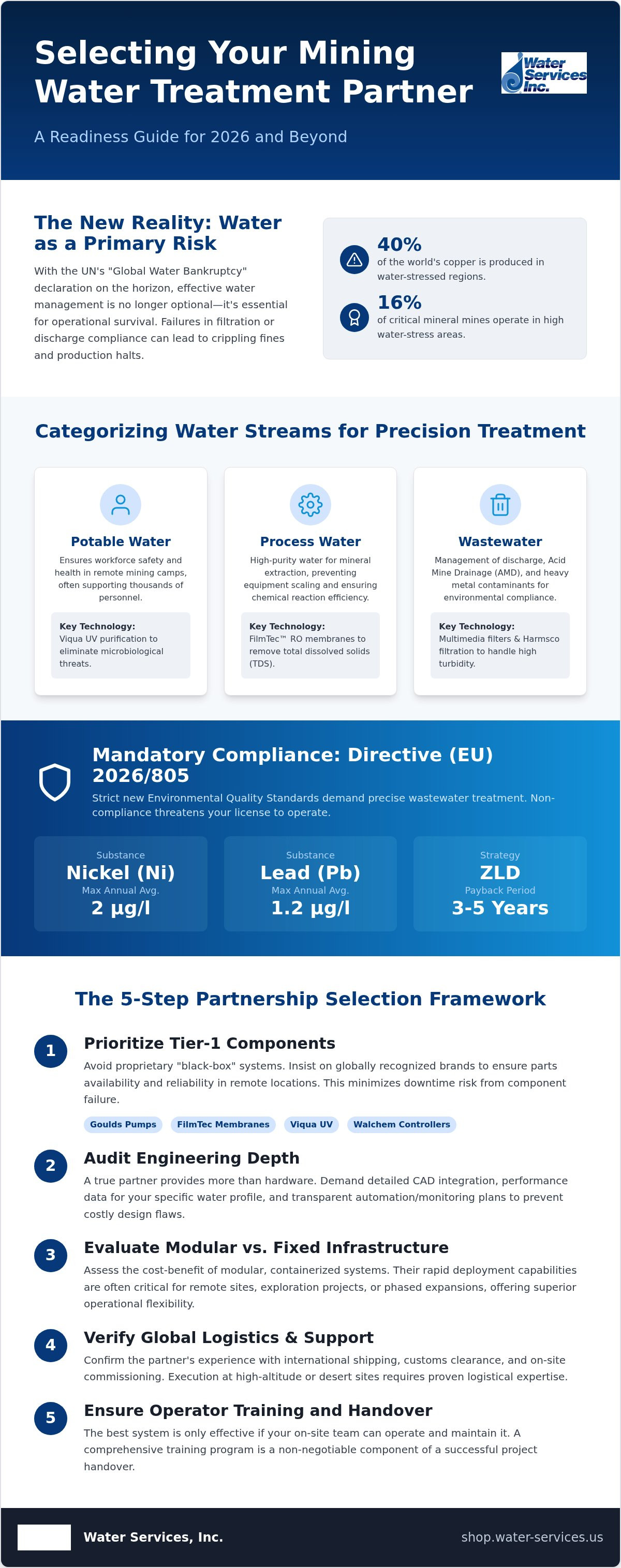
With the United Nations declaring a state of "Global Water Bankruptcy" in January 2026, the margin for error in mine water management has effectively vanished. For operators in water-stressed regions, which now produce 40% of the world's copper, water is no longer just a utility; it's a primary operational risk. You know that a single filtration failure or a non-compliant discharge of substances like nickel or lead can trigger massive regulatory fines and halt production for weeks.
Choosing the right collaborator is the only way to mitigate these risks. This guide details exactly how to select a water treatment partner for mining projects that prioritizes technical integrity and logistical resilience. We will master the criteria for vetting modular, containerized systems and Tier-1 components such as Goulds pumps and FilmTec RO membranes. You'll learn how to ensure your partner can provide seamless logistics for remote global sites, maintain compliance with Directive (EU) 2026/805 standards, and deliver a reliable process water supply that supports long-term operational continuity.
Key Takeaways
- Categorize water streams into potable, process, and wastewater to align with 2026 discharge standards and resource recovery mandates.
- Master a 5-step framework on how to select a water treatment partner for mining projects that prioritizes Tier-1 components like Goulds pumps and FilmTec RO membranes.
- Evaluate the cost-benefit of modular containerized RO plants versus fixed infrastructure to improve rapid deployment capabilities in remote regions.
- Identify critical logistical requirements for international shipping, customs, and on-site operator training to ensure operational continuity at high-altitude or desert sites.
- Audit engineering depth by reviewing CAD integration and technical performance data for specific raw water profiles to minimize operational downtime.
Defining the Scope: Mining Water Challenges in 2026
The 2026 mining environment requires a granular understanding of water chemistry and volume management. Operators must categorize site water into three distinct streams: potable water for workforce safety, process water for mineral extraction, and wastewater for environmental compliance. Understanding these specific requirements is the foundational step in how to select a water treatment partner for mining projects. Failure to differentiate these streams often leads to over-engineered systems that inflate CAPEX or under-performing units that risk regulatory breach.
Regulatory pressure has intensified with Directive (EU) 2026/805, which established strict Annual Average Environmental Quality Standards for substances like Nickel (2 µg/l) and Lead (1.2 µg/l). These standards mean that non-compliance is no longer just a fine; it's a threat to your social license to operate. A partner must demonstrate competence in achieving Zero Liquid Discharge (ZLD) to ensure operational continuity in water-stressed regions. Currently, 16% of critical mineral mines operate in high water-stress areas. Effective ZLD systems eliminate liquid effluent entirely, often providing a 3 to 5 year payback period through reduced discharge fees and lower water purchasing costs.
Potable and Process Water Requirements
Remote mining camps often support thousands of personnel. This requires dependable potable water systems that utilize Viqua UV purification to eliminate microbiological threats. Beyond human consumption, mineral processing demands high-purity process water to avoid equipment scale and ensure chemical reaction efficiency. Selecting a commercial reverse osmosis water filtration system is a critical technical decision. Using FilmTec RO membranes ensures the removal of total dissolved solids (TDS) to meet specific metallurgical specifications for ore enrichment. Technical integrity in this stream prevents pump failure and maintains steady production cycles.
Wastewater and Tailings Management
Managing discharge is often the most complex logistical challenge on a remote site. Acid mine drainage (AMD) and heavy metal contaminants require specialized mining wastewater treatment solutions that can handle fluctuating flow rates and high turbidity. Various industrial wastewater treatment methods, such as chemical precipitation and membrane filtration, are used to recover dissolved constituents from sludge. Your partner should provide hardware like multimedia filter tanks and Harmsco filtration products that adapt to your site's unique raw water profile. This level of engineering oversight prevents the "black-box" technology failures that frequently cause operational downtime.
Technical Competence: Assessing Equipment Standards and Engineering
Reliability in mining operations depends on the quality of individual hardware components. When determining how to select a water treatment partner for mining projects, you must evaluate their commitment to Tier-1 equipment standards. Proprietary, "black-box" technologies often lead to long-term operational risks. If a custom part fails at a remote site in Central Africa or high in the Andes, the resulting downtime can cost thousands per hour. Choosing a partner that integrates globally recognized brands like Goulds, FilmTec, and Viqua ensures that replacement parts are available through established distribution networks.
Engineering depth is another critical metric. A professional partner should offer more than just hardware; they must provide detailed CAD integration and preliminary design data that fits your specific site footprint. This technical transparency extends to automation and monitoring. The integration of Walchem controllers and Signet flow sensors allows for precise chemical dosing and real-time flow tracking. This level of control is necessary to maintain compliance with EPA's mining wastewater regulations, ensuring that effluent discharge remains within legal limits.
Pumping and Fluid Movement Reliability
Centrifugal pumps in mining environments must withstand abrasive particulates and high-pressure demands. Durability is a priority when moving raw mine water or chemical reagents. Goulds Water Technology Pumps are the industry standard for these applications because they offer high-head performance and robust mechanical seals. Sizing these units correctly requires an analysis of total dynamic head (TDH) and net positive suction head (NPSH) to prevent cavitation and ensure consistent fluid movement across the mineral processing circuit. You can browse industrial-grade pumps and controllers to see how these components integrate into a larger system.
Filtration and Membrane Performance
Membrane selection is driven by raw water chemistry and the required purity of the output. FilmTec reverse osmosis membranes are often preferred for brackish water desalination due to their high salt rejection rates and energy efficiency. However, Hydranautics membranes may be selected if the water profile shows specific organic fouling tendencies. Multimedia filter tanks serve as the primary mechanical barrier, removing suspended solids before they reach the RO membranes. Engineers should consult an industrial water filtration systems technical roundup to compare sediment removal technologies and ensure the pre-treatment stage is sufficient for the downstream membrane life.
Operational Flexibility: Modular vs. Fixed Infrastructure
The choice between fixed civil infrastructure and modular hardware represents a primary financial pivot point for any mining operation. Fixed-asset plants demand substantial capital expenditure (CAPEX) and multi-year planning cycles that can delay production. Conversely, modular systems operate on an operational expenditure (OPEX) model. This provides immediate technical capabilities without the long-term balance sheet commitment. When determining how to select a water treatment partner for mining projects, you must assess whether your site requires the permanence of a traditional facility or the agility of mobile, pre-integrated units. Modular systems are uniquely suited for exploration phases and early-stage mining where water chemistry profiles are still being established. They allow for rapid scaling as the project moves from pilot to full production.
The Case for Containerized Systems
Containerized reverse osmosis plants eliminate the need for extensive on-site construction and specialized labor. These units arrive as integrated hardware solutions, which is a critical advantage for projects in remote regions such as Africa and South America. The steel enclosure serves a dual purpose. It simplifies international shipping logistics and provides a climate-controlled environment for sensitive electronics. This protection is vital for electric power controls and Walchem automation panels that would otherwise be exposed to dust and extreme temperatures. Using pre-fabricated units ensures that the engineering standards established in the factory are maintained during site execution. It's a reliable way to ensure that your water treatment capacity is operational within weeks rather than months.
Rental and Leasing Models for Mining
Leasing and rental models offer a strategic solution for managing temporary site needs or emergency water response scenarios. These arrangements allow operators to manage seasonal production peaks without a permanent increase in asset base. Mobile ultrafiltration systems can be deployed rapidly to handle high-turbidity events or sudden increases in processing volume. Most rental contracts include comprehensive maintenance and technical support. This shifts the burden of equipment reliability to the partner, ensuring that your local staff can focus on core mineral processing. It's an efficient way to access high-performance hardware while maintaining financial flexibility and optimizing tax implications. This model also allows you to test specific technical configurations before committing to a full purchase.
Logistics and Global Support: Remote Site Execution
Remote execution is where theoretical engineering meets physical reality. When evaluating how to select a water treatment partner for mining projects, you must scrutinize their logistical track record as closely as their technical specifications. High-performance hardware is useless if it cannot survive transit to a landlocked site or if your local team lacks the training to operate it. A partner's ability to navigate complex customs requirements and international shipping routes is a prerequisite for maintaining your production schedule. This includes a robust spare parts strategy that ensures replacement sediment and carbon filters or Pulsafeeder metering pumps are available before a critical failure occurs.
Modern mining water management also relies on digital oversight. Evaluating remote monitoring capabilities via Walchem IoT controllers allows for real-time troubleshooting from thousands of miles away. This connectivity reduces the need for expensive emergency site visits and allows for precise adjustments to chemical dosing. It's a technical safeguard that ensures your system remains compliant with environmental standards even when on-site expertise is limited. Effective partnership means having a vendor that remains engaged through commissioning and provides ongoing operator training for your local staff.
Navigating International Distribution
Shipping containerized RO plants to landlocked mining regions in Africa or South America presents unique challenges. Equipment must be crated and protected to withstand harsh transit conditions, including high humidity and extreme mechanical vibration. Partnering with a provider based in a logistical hub like Provo, Utah, provides a strategic advantage for global distribution. This location allows for the efficient consolidation of Tier-1 components from various manufacturers before they are shipped as a single, integrated solution. It ensures that every Ashcroft pressure gauge and Signet flow sensor arrives calibrated and ready for immediate installation.
On-Site Support and Maintenance
System longevity depends on regular calibration and the correct application of water treatment chemicals. Antiscalants and specialized reagents are necessary to prevent membrane fouling and extend the life of your FilmTec or Hydranautics RO elements. Your partner should establish a clear frequency for on-site technical visits to audit system performance and refine operator protocols. Remote troubleshooting through digital water services acts as a first line of defense, but physical inspections ensure that mechanical components like Goulds pump seals are maintained according to manufacturer specifications. You can procure replacement components and chemicals directly from our distribution center to maintain your site's operational integrity.
The Selection Matrix: A 5-Step Partnership Framework
A systematic vetting process reduces the risk of operational failure. When finalizing how to select a water treatment partner for mining projects, you must move beyond surface-level quotes and execute a rigorous selection matrix. This framework prioritizes technical performance and logistical reliability over the lowest initial bid. It ensures that the selected partner can meet the rigorous demands of a 24/7 industrial environment. Use the following five steps to audit potential collaborators:
- Step 1: Technical Validation. Request performance data for raw water profiles that match your site's specific chemistry, such as high sulfate or heavy metal concentrations.
- Step 2: Logistical Audit. Review the partner’s documented history of successful deliveries to remote, high-altitude, or desert environments.
- Step 3: Financial Modeling. Calculate the Total Cost of Ownership (TCO) for a 5 to 10 year period, including energy consumption, antiscalant costs, and membrane replacement cycles.
- Step 4: Compliance Assurance. Verify that the partner provides written performance guarantees for discharge limits, particularly regarding the 2026 standards for heavy metals.
- Step 5: Support Evaluation. Test the partner’s response time for emergency spare parts and technical troubleshooting before signing a long-term contract.
Drafting the Water Treatment RFP
Your Request for Proposal (RFP) should demand complete transparency in component sourcing. Specify that all high-wear components, such as centrifugal pumps and RO membranes, must be Tier-1 brands like Goulds or FilmTec. Generic alternatives often lack the durability required for mining duty and complicate the spare parts supply chain. Demand detailed Operations and Maintenance (O&M) cost projections. This allows your procurement team to accurately budget for the system’s entire lifecycle rather than just the initial installation.
Finalizing the Partnership
The final agreement must include Service Level Agreements (SLAs) that define expected system uptime and technical response times. Establish a direct procurement line for essential consumables and personal protective equipment (PPE) to maintain site safety during chemical handling. A reliable partner functions as an extension of your engineering team, providing technical integrity and logistical stability. Contact Water Services, Inc. for a custom mining water treatment consultation to validate your site’s technical requirements and ensure long-term operational continuity.
Securing Operational Continuity through Technical Integrity
Operational success in 2026 depends on a partner's ability to balance technical precision with logistical resilience. You've seen that Tier-1 components like Goulds pumps and FilmTec membranes are essential to avoid the downtime risks associated with generic hardware. Modular, containerized plants provide the necessary flexibility for remote sites; they ensure that your water treatment capacity scales with production demands without the delays of fixed infrastructure. Mastering how to select a water treatment partner for mining projects requires a rigorous audit of these engineering standards and global support capabilities.
Water Services, Inc. has provided engineered modular solutions since 1994, with successful global installations across Africa and the Middle East. As an authorized distributor for Goulds and FilmTec, we ensure that your site receives high-performance equipment backed by reliable spare parts distribution. Our expertise in remote site execution helps you maintain regulatory compliance and protect your social license to operate. Request a Mining Project Consultation from Water Services, Inc. to optimize your water management strategy. We look forward to supporting your next project with dependable industrial solutions.
Frequently Asked Questions
What are the most common contaminants in mining wastewater?
Common contaminants in mining wastewater include heavy metals such as Nickel, Lead, and Cadmium, alongside suspended solids and sulfates. Directive (EU) 2026/805 establishes strict environmental quality standards for these substances, including an annual average of 2 µg/l for Nickel and 1.2 µg/l for Lead. Effective treatment requires specialized mining wastewater solutions that utilize chemical precipitation and membrane filtration to meet these rigorous discharge mandates.
How do I choose between purchasing a fixed plant and renting a mobile unit?
Choosing between fixed and mobile units depends on your project's lifespan and logistical constraints. Fixed plants are ideal for multi-decade operations with high-volume processing needs. Mobile units offer rapid deployment and lower initial costs for exploration or remote sites. Evaluating these operational models is a critical step in how to select a water treatment partner for mining projects, as it impacts both your balance sheet and site agility.
Which pump brands are best for remote mining sites?
Goulds Water Technology Pumps are the preferred choice for remote mining sites due to their mechanical durability and high-head performance. These pumps are engineered to handle abrasive fluids and particulates common in mineral processing circuits. Using standardized Tier-1 pumping hardware ensures that replacement parts are available through global distribution networks, which significantly reduces the risk of extended operational downtime in isolated regions.
Can containerized RO plants handle brackish or high-salinity mine water?
Containerized RO plants are fully capable of treating brackish or high-salinity mine water when equipped with FilmTec or Hydranautics membranes. These systems achieve high salt rejection rates and are often integrated with multimedia filter tanks to protect the membranes from sediment fouling. The climate-controlled container protects the RO elements and high-pressure pumps from the extreme temperatures and dust typically found at remote mining operations.
What is the typical lead time for a custom-designed mining water treatment system?
Lead times for custom water treatment systems vary based on technical complexity and infrastructure type. Modular containerized plants typically require 12 to 20 weeks from engineering approval to site delivery. In contrast, large-scale fixed plants involving civil works and extensive on-site integration can take 12 to 18 months. Procurement teams should prioritize partners with established component inventories to mitigate global supply chain delays.
How does Zero Liquid Discharge (ZLD) impact mining operation costs?
Zero Liquid Discharge (ZLD) increases initial CAPEX but provides substantial long-term savings by eliminating liquid effluent discharge fees and environmental fines. Most mining operations see a 3 to 5 year payback period through the recovery of process water and the elimination of freshwater purchasing costs. ZLD is increasingly becoming a regulatory expectation for maintaining a social license to operate in water-stressed regions.
What certifications should I look for in a mining water treatment partner?
A qualified partner should hold ISO 9001 quality management certifications and demonstrate adherence to ASME standards for pressure vessels. Verifying these credentials is a key part of how to select a water treatment partner for mining projects. It's also vital to verify their experience with specific regional regulations, such as the EPA's mining wastewater guidelines or the EU Water Framework Directive.
How do Walchem controllers improve mining water system efficiency?
Walchem controllers enhance system efficiency by providing automated chemical dosing based on real-time water chemistry data. These controllers utilize Signet flow sensors to adjust antiscalant and reagent injection, which reduces chemical waste and protects RO membranes from scaling. Integrated IoT capabilities allow for remote monitoring and troubleshooting, ensuring the system operates at peak performance without requiring constant on-site technical supervision.
0 comments