

The hose that fits a connection may still be the wrong choice for the fluid inside it. Selecting chemical metering pump tubing means matching the material to the chemical and operating conditions, then confirming the tubing dimensions and pump connection. Air hose serves a different purpose and should not be used for chemical dosing.
Fit is an important starting point, especially when replacing tubing to keep a dosing system operating. Material compatibility matters just as much: chemical identity, concentration, temperature, and pressure can affect tubing performance. Compatibility charts are useful screening tools, not a substitute for application-specific assessment.
This guide explains what to gather before choosing a replacement, including material, inside diameter, and connection details. It also distinguishes chemical-feed tubing from pneumatic air hose and outlines which specifications matter for compressed-air service. Use these steps to compare products for the right application without mistaking an air hose for chemical metering pump tubing.
Key Takeaways
- Match the pump’s model-specific requirements and connections to the liquid service.
- Check chemical compatibility against the exact fluid, concentration, and operating conditions.
- Keep chemical-feed lines separate from pneumatic service: air hose is for compressed air, not chemical dosing.
- Before ordering a replacement, record the pump details, tube dimensions, connections, and process conditions.
- For pneumatic service, compare air hose by its stated material, inside diameter, length, and working pressure.
What Chemical Metering Pump Tubing Does, and What It Does Not Do
Definition: Chemical metering pump tubing carries process fluid from its supply, through the pump, and onward to the injection point. It must suit the pump design and liquid-service conditions. Compressed-air hose carries air for pneumatic equipment; it is not automatically suitable for chemicals.
A tube can appear to fit while failing to meet a dosing system’s material or operating requirements. A pressure rating alone does not establish chemical resistance, pump suitability, or correct connection fit. Select each line for its actual role, not its appearance.
Where tubing fits in a chemical dosing system
The flow path generally begins at a chemical container or supply tank. Suction tubing connects the supply to the pump inlet. The pump moves a measured volume of liquid, and discharge tubing carries it from the pump outlet to the injection point. Depending on the equipment, tubing may also sit inside the pump head and contact moving components.
These sections can face different conditions. The suction side draws liquid toward the pump, while the discharge side delivers it against downstream conditions. Pump-head tubing may have requirements tied to the pump’s operating mechanism. One installation can therefore require different specifications for different tube locations. For background on how tubing functions in a peristaltic pump, see Peristaltic Pump Tubing Considerations.
Do not assume that a tube suitable for one part of the system will work everywhere. Identify each tube’s location and use the pump-specific requirements for that position.
Chemical-feed tubing versus compressed-air hose
Chemical-feed tubing conveys liquid as part of a dosing process. Compressed-air hose carries pressurized air to pneumatic equipment, such as air-compressor systems. Because the services differ, so do the selection criteria. Chemical-feed tubing must suit the process fluid and pump connection; pneumatic hose must meet the requirements of its air application.
A working-pressure figure describes a pressure limit under specified conditions. On its own, it does not show how a hose material will respond to a chemical, its concentration, or the operating environment. Do not treat an air-hose pressure rating as evidence of chemical compatibility. Air hose belongs in pneumatic service, not in a metering-pump liquid line.
Before replacing tubing, identify whether the line is in the pump head, suction, or discharge. Then match it to the relevant pump and process requirements. This prevents a category mistake before you compare dimensions or materials.
Matching Chemical Metering Tubing to Chemical and Pump
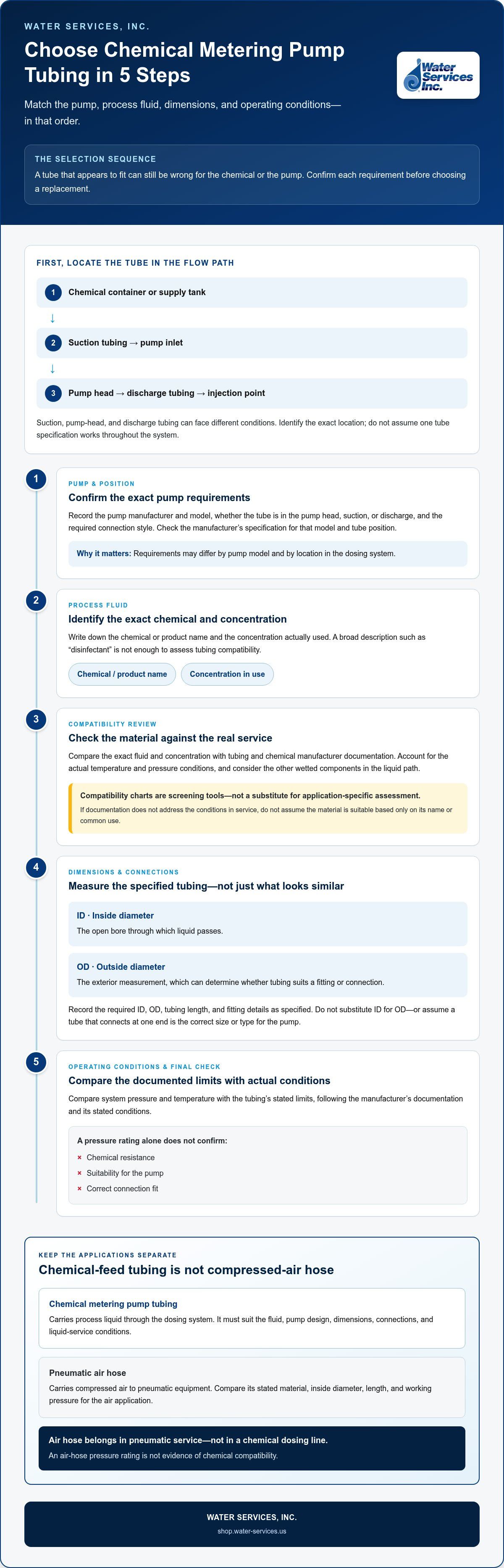
Choose chemical metering pump tubing in a deliberate order: confirm the pump and connection requirements, establish chemical compatibility, then verify dimensions and operating limits. Starting with a generic material name or a tube that looks similar can result in a mismatch, even when it appears to fit.
Selection checklist: Match the exact chemical and concentration, pump model and connections, tubing dimensions and length, and the system’s pressure and temperature conditions.
Check chemical compatibility before material selection
Identify the process fluid precisely. A broad label such as “disinfectant” is not enough to assess compatibility because both chemical identity and concentration matter. Record the chemical or product name and the concentration used, then compare them with compatibility documentation for the tubing material.
Consult relevant documentation from the tubing and chemical manufacturers, and account for actual operating conditions rather than relying on a general material chart alone. Compatibility references help with screening, but they do not establish suitability for every concentration, temperature, or application. If the documentation does not address the conditions in service, do not assume a material is suitable based only on its name or common use.
No single tubing material should be treated as compatible with every treatment chemical. The pump’s other wetted components matter too. Tubing selection is one part of evaluating the liquid path, not a substitute for checking the system as a whole.
Match dimensions and pump connections
Find the pump manufacturer’s specification for the exact model and tubing position. Pump-head, suction, and discharge requirements may differ. Use the equipment documentation to identify the required tubing size, connection style, and any model-specific limits. A tube that connects at one end may still be the wrong size or type for the pump.
Read dimensions carefully. Inside diameter (ID) is the open bore through which liquid passes. Outside diameter (OD) measures the tubing across its exterior and can determine whether it suits a fitting or connection. Do not substitute one measurement for the other. Record both when specified, along with the required length and fitting details.
Compare the system’s operating pressure and temperature with the tubing’s stated limits. Ratings apply under stated conditions, so account for what the tubing will actually experience and follow the manufacturer’s documentation. A pressure rating alone does not confirm chemical resistance or pump fit.
- Chemistry: Identify the exact chemical and concentration.
- Pump fit: Confirm model, tubing position, and connection requirements.
- Dimensions: Record ID, OD, length, and fitting details as specified.
- Operating conditions: Compare pressure and temperature with documented limits.
Keep pneumatic service separate from liquid dosing. If you are selecting hose for compressed air rather than chemical feed, compare the stated air-hose specifications in the Air Hose collection.
Chemical Metering Tubing vs. Air Hose: Which Product Fits Each Job?
Choose by the medium the line carries, not by whether it looks like a tube or fits a connection. Chemical metering pump tubing is part of a liquid dosing path. Air hose serves pneumatic equipment. Similar dimensions or a pressure rating do not make the two interchangeable.
| Comparison point | Chemical metering tubing | Compressed-air hose |
|---|---|---|
| Conveyed medium | Liquid treatment chemical or process fluid | Compressed air |
| Intended service | Metering-pump liquid path, including pump-head, suction, or discharge lines | Pneumatic tools, actuators, machinery, or air-compressor connections as specified |
| Critical specification | Chemical compatibility, pump fit, connection, dimensions, and operating conditions | Application, hose material, inside diameter, length, working pressure, and environment |
| Selection reference | Pump documentation and relevant chemical and tubing compatibility information | Equipment requirements and the hose’s stated specifications |
The distinction is practical: a hose rated for air service is not thereby validated for chemical dosing. Pressure capacity addresses only one part of selection. It does not establish that the hose material is compatible with a particular process fluid or that the tube fits the metering pump as required.
When chemical metering tubing is the correct category
Choose this category when a line carries treatment chemicals through a metering pump. Start with the pump model’s documentation, then match the tubing position and connection. Check compatibility against the exact chemical, concentration, and operating conditions. A general-purpose hose with a matching diameter is not a substitute for documented material suitability and pump fit.
For water-treatment applications, the dosing line is one part of a larger process involving selected water treatment chemicals. The product’s identity and concentration help define what the wetted tubing must tolerate. Do not generalize from a broad label or assume one material suits every treatment chemical.
When compressed-air hose is the correct category
Use air hose for pneumatic service, including tools, actuators, machinery, and air-compressor connections when the hose is specified for that application. Compare the stated material, inside diameter, length, and working-pressure rating with the equipment requirements. Also consider the installation environment and the hose’s intended use.
Water Services, Inc. offers an Air Hose collection for pneumatic applications. Compare the information provided for each product with the requirements of the air system. Those details do not establish chemical compatibility. For compressed-air service, review the Air Hose collection, and keep air products separate from chemical-feed or metering-pump liquid lines.
Use the category that matches the job: documented chemical suitability and pump requirements for liquid dosing, or stated hose specifications for pneumatic service. This distinction prevents a pressure rating or convenient fit from being mistaken for proof of suitability.
A Practical Replacement Checklist for Metering Pump Tubing
Replacing a line without recording its role and specifications can create a mismatch that affects fit or dosing-system operation. Use a deliberate workflow before ordering chemical metering pump tubing. Follow site safety procedures and equipment documentation. Treat the existing tube as a reference to inspect, not proof that its material or size is correct.
Record the existing line and operating conditions
First identify which section needs replacement: pump-head, suction, or discharge. Record the pump make and model, the line’s position, fitting type, and tube dimensions. Note the chemical identity and concentration, along with operating temperature and expected pressure. These details create a replacement specification to compare with manufacturer documentation.
- Isolate the system. Follow site procedures and equipment instructions before handling the dosing line. Do not begin removal until the system has been made safe according to those procedures.
- Identify the pump. Record its make, model, and the tubing location. Consult model-specific documentation for required tubing and connection details. Water Services, Inc.’s pump equipment range provides context on the equipment category; replacement requirements should follow the documentation for the pump installed in your system.
- Document dimensions and connections. Measure the existing tube and note inside and outside diameter where relevant, line length, fitting type, and how it connects at each end. A visual estimate can miss a dimensional difference that affects fit.
- Record process conditions. Write down the exact chemical and concentration, operating temperature, and expected pressure for the line’s position. Avoid broad descriptions that leave the fluid or operating conditions ambiguous.
- Compare before ordering. Check the recorded details against the pump manufacturer’s specification and tubing documentation, including compatibility information. Resolve discrepancies using equipment requirements rather than automatically copying the old tube’s material or dimensions.
Inspect and replace without introducing a mismatch
Before removal, inspect the line and connections for visible wear, deformation, leakage, or damage. These signs can indicate a need for replacement, but appearance alone does not establish the correct material or specification. Follow site safety procedures and pump documentation during isolation, removal, installation, and return-to-service steps.
There is no single replacement schedule for every pump or application. Follow the equipment and tubing manufacturers’ guidance, and account for actual service conditions and inspection findings. Do not extend a line’s use based only on its age or replace it on an assumed interval unsupported by the applicable documentation.
Keep the service category clear when purchasing. For pneumatic equipment, use hose specified for compressed-air applications, not as a substitute for a chemical-feed line. To compare air-service products, browse the Air Hose collection.
Choose Air Hose for Pneumatic Service from Water Services, Inc.
Water Services, Inc.’s Air Hose collection serves pneumatic applications, including compressed-air service. It is a separate product category from chemical metering pump tubing. Do not select air hose for a dosing line based on a matching diameter or pressure figure. Use product details to compare options for air service, but do not treat them as proof of chemical compatibility or metering-pump suitability.
Examples from the Air Hose collection
Consider two common pneumatic requirements. A short connection near a piece of equipment may call for a different hose length than a longer route across a work area. In either case, match the product’s stated material, dimensions, and pressure rating to the air-system requirements. Do not use a product’s physical fit as a substitute for checking its intended service.
For a fixed installation, consider the hose route, connection points, and the amount of reach required. For a connection that needs to move with equipment, consider how the hose will be used and whether its listed specifications match that application. In every case, keep the comparison focused on pneumatic service. An air-hose specification does not establish suitability for conveying chemicals.
Browse by dimensions and pneumatic requirements
Before choosing an air hose, identify the equipment connection and the route the hose must follow. Then compare the product’s stated material, inside diameter, length, and working-pressure rating with the pneumatic service requirements. Dimensions help assess fit and reach, while the pressure rating provides a stated operating limit. Material and product description help distinguish among hose types and assemblies.
Use equipment documentation to define the application requirements. A hose that matches the inside diameter may still be the wrong length or pressure specification. Likewise, an air-service product description should not be read as a chemical-resistance statement. Keep compressed-air lines and chemical-feed lines separate during selection and installation.
For liquid dosing, follow the metering pump’s tubing specification and use compatibility information for the process chemical and conditions. Air-hose products are intended for pneumatic service, and their specifications do not make them suitable for conveying treatment chemicals. This distinction is essential when choosing products for an industrial water-treatment environment.
- For pneumatic service: Compare the stated hose material, ID, length, and working pressure with the air-system requirements.
- For chemical dosing: Select tubing using pump documentation, connection requirements, and chemical compatibility information.
- For replacement work: Confirm the service first, then compare product details relevant to that application.
For compressed-air applications, browse Air Hose products and compare the stated specifications with the requirements of the pneumatic service.
Keep Your Next Hose Selection on Specification
Make the next purchase by service, not appearance. For a dosing-system replacement, keep the pump documentation and process requirements with the order details for chemical metering pump tubing. For compressed-air work, use the equipment requirements to narrow the appropriate air-hose options. This separation helps keep pneumatic products out of liquid chemical lines.
Water Services, Inc. offers air hose for pneumatic applications. Review the product information against your air-system requirements, and do not use it as evidence of chemical compatibility. For liquid dosing, use the pump and tubing documentation alongside compatibility information for the process fluid and operating conditions.
For water-treatment equipment and process products, explore Water Services, Inc.’s pump equipment and water treatment products to find options for your system.
Frequently Asked Questions
Can I use air hose for chemical metering pump tubing?
No. Air hose is selected for pneumatic service, and its air-pressure rating does not show that its material can convey a process chemical. Chemical exposure may affect hose material even if the dimensions appear to fit. Use tubing specified for the metering pump and documented as suitable for the exact chemical and operating conditions. Keep compressed-air hose out of liquid dosing lines unless its manufacturer explicitly documents that specific use.
How do I choose the right chemical metering pump tubing?
Start with the pump model’s documentation and identify the required tube type for its specific position in the system. Then compare the exact chemical and concentration with material compatibility information. Check the connection, inside and outside diameters, length, temperature, and pressure against installation requirements. A suction line and a pump-head tube may have different needs, so do not assume one replacement part suits both.
What tubing material is best for chemical dosing?
There is no single best material for every dosing application. The right choice depends on chemical identity, concentration, temperature, pressure, and pump design. Materials such as PTFE and PVDF are used in chemical service, but neither is universally suitable. Treat compatibility charts as screening tools, then rely on documentation that applies to the actual fluid and operating conditions.
How do I measure metering pump tubing?
Use the pump documentation to determine which dimensions matter, then measure the tube section being replaced with suitable measuring tools. Record inside diameter, outside diameter, and required length separately because they describe different dimensions. Also note fitting style and tubing position, such as pump head, suction, or discharge. Do not rely on a visual estimate or assume a nominal size printed on an old tube is accurate.
What happens if metering pump tubing is the wrong size?
Incorrect dimensions can prevent a secure connection or interfere with how the pump moves liquid. A poor fit may contribute to leaks, unstable dosing, or premature wear, depending on pump design and installation. A tube that is too short can also strain connections. Compare the replacement with the pump’s specified dimensions and fittings rather than forcing a near-match into place.
How often should chemical metering pump tubing be replaced?
There is no single replacement interval for every chemical, pump, and operating condition. Follow the pump and tubing manufacturers’ maintenance guidance for the installation. Inspect tubing at the intervals required by site procedures, and respond to visible damage, deformation, leakage, or other signs of deterioration. Keep a record of inspection findings and replacements so maintenance decisions reflect actual service history, not an assumed universal schedule.
Is the Water Services, Inc. Air Hose collection suitable for chemical dosing?
No. The Water Services, Inc. Air Hose collection is for pneumatic applications, not chemical-feed or metering-pump liquid lines. Use its product information to compare air-service options, not to establish compatibility with treatment chemicals. Select chemical dosing tubing according to the pump requirements and fluid compatibility information.
0 comments