

The pump with the highest rated flow may be the wrong choice for your process. Effective chemical metering pump selection starts with the actual dosing duty, then checks whether the pump can maintain the required rate at operating pressure and across the needed adjustment range. A mismatch can affect dosing accuracy and reliability.
Capacity is a useful starting point, but flow rate alone doesn’t settle the decision. Chemical identity, concentration, temperature, and wetted-material compatibility matter just as much. So do site conditions, control requirements, and the maintenance your team can support.
This guide explains what operating data to gather before requesting a selection and how to compare pump capacity, materials, controls, and maintenance needs. It also outlines trade-offs between common pump technologies and the specifications to confirm with a supplier or application engineer. Water Services, Inc. supplies Pulsafeeder metering pumps and Walchem controllers for industrial water-treatment applications, equipment categories to consider as you define your requirements.
Key Takeaways
- Start with the dosing objective, injection point, schedule, and process outcome to define the pump’s job.
- For chemical metering pump selection, compare the documented operating range and pressure requirements rather than relying on a single maximum value.
- Assess diaphragm and peristaltic pump categories against the fluid, adjustment needs, control method, and maintenance demands.
- Prepare a buyer checklist covering chemical concentration and temperature, wetted materials, controls, and site conditions before requesting a quotation.
- Use the completed specification to identify assumptions that still need confirmation with a supplier or application specialist.
Start Chemical Metering Pump Selection with the Dosing Duty
A chemical metering pump delivers a controlled liquid dose into a process. It may feed treatment chemical into a flowing line or add reagent to a vessel, but its job is defined by the process outcome, not by a model name or maximum capacity. A Metering pump provides a useful overview of the equipment’s basic principles and types.
Begin chemical metering pump selection by describing what the dose must achieve, where it enters the process, and when dosing must occur. For example, a water-treatment duty might call for continuous feed proportional to process flow, while a batch process may require a set dose during a defined operating cycle. These are different duties, even when they use the same chemical.
What information defines the dosing duty?
Record the target dose and the basis it uses. A dose may be specified as chemical mass per volume of process fluid, while pump capacity is typically stated as liquid volume per unit of time. The required chemical feed rate depends on the target dose, process flow, and concentration of the supplied solution. Keep these values distinct so a supplier can review the calculation and its assumptions.
Document whether dosing is continuous, intermittent, or controlled by process demand. Identify the injection point and describe the line or vessel, flow conditions, and any known mixing or backpressure requirements. State the intended result, such as maintaining a treatment condition or meeting a process target. Don’t assume the feed rate available from a chemical supply system is the rate the process requires.
Which process conditions should be established first?
Capture normal, minimum, and maximum process conditions where available. Record pressure at the injection point, along with process-flow changes that may affect the required dose. The normal operating point matters because the pump must suit routine operation, not just an occasional peak demand.
Describe the operating schedule and how the duty changes during startup, shutdown, batch transitions, or process upsets. Explain what dosing should do if process flow stops or a control signal is lost. Those responses may affect the control arrangement, so identify them before specifying equipment.
Minimum inputs before pump sizing: target dose and basis, process flow range, chemical feed concentration, injection location and pressure, operating schedule, and the required response to process interruptions. These details give a supplier or application engineer a defined duty to evaluate instead of an isolated capacity estimate.
Match Pump Capacity, Pressure, and Chemical Compatibility
With the duty defined, translate it into a pump operating point and a verifiable materials specification. In chemical metering pump selection, rated capacity alone isn’t enough. Confirm that the required feed rate falls within the documented operating range under the actual discharge conditions.
How do you translate required dose into pump capacity?
Keep the target dose, process flow, solution concentration, and pump-flow units consistent. If the process requirement is expressed as chemical mass per volume of treated fluid, account for the active chemical content and solution concentration when determining the required liquid feed rate. Confirm the calculation basis with the supplier, especially if the chemical is supplied as a diluted solution or the dose uses a different basis.
Distinguish the pump’s nominal or maximum capacity from its expected operating point. A pump may have sufficient maximum output but still be unsuitable if the normal feed rate falls outside its documented adjustment range. Record missing data for confirmation rather than substituting assumed values. For broader context on system design and liquid characteristics, see Designing Liquid Dosing Systems.
How should you assess pressure and chemical compatibility?
Record pressure at the injection point and ask a qualified supplier to evaluate the required discharge pressure and pressure differential. The pump must overcome process pressure and relevant system resistance. Don’t treat vessel or line pressure alone as a complete pressure specification. Provide available piping and injection details for review.
Document the chemical identity, concentration, operating temperature, viscosity, and relevant contaminants. Then check every wetted component against current manufacturer compatibility guidance. Review the complete fluid-contact path, including the pump head, diaphragm or tubing where applicable, seals, valves, and connections. Compatibility can depend on concentration and temperature, so one compatible material doesn’t confirm the suitability of the whole assembly.
| Specification item | Record or verify | Evidence still needed |
|---|---|---|
| Duty | Target dose and calculation basis | Confirm units and active-chemical basis |
| Flow | Required minimum, normal, and maximum feed | Compare with documented operating range |
| Pressure | Injection-point pressure and system details | Supplier confirmation of required discharge pressure |
| Chemical | Identity, concentration, temperature, viscosity, contaminants | Current compatibility guidance for each wetted part |
| Materials | Head, seals, valves, tubing, and connections | Confirmation of the complete fluid-contact path |
For projects that also require fastening hardware, review the fasteners collection separately. Fasteners don’t determine pump capacity, pressure, or chemical compatibility.
Compare Metering Pump Types, Controls, and Operating Conditions
Once duty, flow, pressure, and chemical properties are documented, compare technologies against the conditions the pump must handle. Diaphragm and peristaltic pumps are useful categories to evaluate, not automatic recommendations. For a broader overview of operating principles and selection factors, see Metering Pumps 101.
Diaphragm pumps are commonly evaluated for clean-liquid duties and higher-pressure applications. Peristaltic pumps may suit some abrasive, viscous, shear-sensitive, or off-gassing fluids, but generally operate at lower pressures and require periodic tubing replacement. These are starting points for comparison, not guarantees of suitability. Chemical compatibility, documented operating limits, and performance at the intended operating point still need confirmation.
Which pump characteristics affect the comparison?
Compare the adjustment range, turndown, repeatability, and method of setting the feed rate. Check whether the required normal operating point falls within the manufacturer’s documented range, and ask the supplier to confirm performance under the specified pressure and chemical conditions. Review maintenance tasks too: identify routine inspections, expected replacement components, and whether parts can be accessed and sourced for the application.
Use the same duty data for each candidate. A comparison is useful only when pumps are assessed against consistent flow, pressure, chemical, and operating requirements. The industrial pump range includes Pulsafeeder metering pumps, but check model-specific limits and materials against current manufacturer documentation.
When should controls or instrumentation be part of selection?
Decide whether operators will adjust the feed manually, the pump must respond to an external signal, or dosing should follow measured process conditions. Define the required signals, alarms, interlocks, and response to events such as low process flow or loss of an instrument signal. Then verify that pump inputs, controller outputs, and instrumentation are compatible, including signal type and control logic.
A metering pump delivers the chemical dose; a controller monitors inputs or directs the dosing response according to the configured process logic. A controller doesn’t establish that the pump is correctly sized or chemically compatible. Water Services, Inc. supplies Walchem controllers as part of its water-treatment equipment offering. Confirm the specific controller’s capabilities against the application requirements before specifying an integrated arrangement.
For chemical metering pump selection, compare the complete operating arrangement: pump adjustment, control signals, sensor feedback, and maintenance needs. Ask the supplier to document which requirements are met and which still need verification.
Avoid Common Chemical Metering Pump Selection Errors
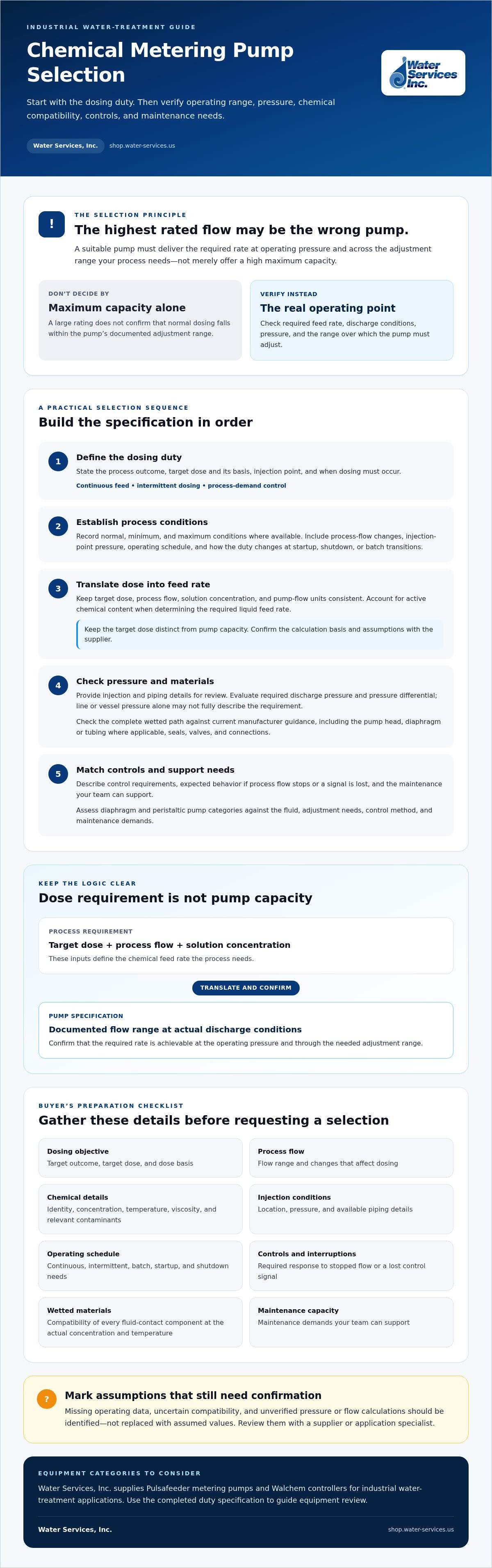
An incomplete inquiry can produce a proposal that appears suitable on paper but leaves important assumptions unresolved. Use this checklist to identify gaps before requesting a quotation. In chemical metering pump selection, the normal operating point matters as much as the maximum requirement.
What details are often missing from a pump inquiry?
Label every flow value as a target, maximum, or measured rate, and include its units and basis. Process flow is not the same as chemical feed rate. Missing chemical concentration, temperature, injection-point pressure, or required feed range can also prevent a meaningful comparison. Include expected process changes and control signals that could alter dosing.
Buyer checklist before requesting a quotation
- Define the duty: Record the target dose, chemical feed rate, units, and calculation basis. Include minimum, normal, and maximum operating points where known.
- Describe site conditions: Note injection location, pressure, operating schedule, process changes, and the required response to shutdowns or interruptions.
- Identify the chemical: Specify its identity, concentration, operating temperature, viscosity, and relevant contaminants.
- Separate equipment requirements: List pump capacity and pressure needs apart from controller functions, sensor inputs, installation interfaces, and maintenance expectations.
- Document controls: State required signals, alarms, interlocks, feedback, and process-response logic. Flag any details that still need confirmation.
Don’t size from a single maximum flow value. Maximum capacity doesn’t establish whether a pump can deliver the normal dose accurately within its documented operating range. Ask the supplier to review the expected operating point alongside the full duty range.
A broad material label doesn’t prove chemical compatibility either. A material may behave differently depending on chemical concentration, temperature, and other fluid conditions. Verify the pump head, seals, valves, tubing, and other wetted components as one fluid-contact path using current manufacturer compatibility documentation. Safety and compliance checks should reflect the chemical, process, and site requirements, not assumptions applied universally.
How can buyers verify a proposed selection before ordering?
Compare the proposal line by line with the documented process duty and operating conditions. Request evidence for the quoted model’s operating limits and wetted materials, and confirm that the stated flow refers to the intended operating point. Record assumptions, exclusions, and unanswered technical questions for review before final approval.
Keep separate hardware needs distinct from pump specifications. For fastening hardware, view the fasteners collection. It isn’t a substitute for confirming pump, control, or chemical-compatibility requirements.
Finalize the Specification and Choose the Right Next Step
A useful pump specification turns process needs into items a supplier can verify. For chemical metering pump selection, bring the duty, operating range, and site interfaces together in one handoff. Separate confirmed data from estimates so open questions are visible before equipment is finalized.
What should a complete pump-selection request include?
Summarize the process objective and injection point, then provide the required dosing range and units, chemical identity and properties, operating pressure, schedule, and control requirements. Include normal, minimum, and maximum conditions where known. Attach available process diagrams, piping details, or instrumentation information if they clarify the installation or signals.
Organize the request so each item can be reviewed:
- Pump duty: Target dose, liquid feed range, operating point, and pressure conditions.
- Chemical and materials: Chemical details and the wetted-material compatibility evidence required.
- Controls: Required inputs, outputs, feedback, alarms, and process response.
- Service conditions: Operating schedule, process changes, and maintenance considerations.
- Open items: Label every estimate, assumption, exclusion, and question requiring supplier confirmation.
Water Services, Inc. supplies industrial pump equipment, including Pulsafeeder metering pumps, and water-treatment chemicals. Confirm product specifications and application suitability against current manufacturer documentation and process requirements. If you’re also reviewing chemical supply for a treatment application, keep that evaluation distinct from pump sizing. A chemical’s availability doesn’t establish the required feed rate or confirm material compatibility.
When is installation hardware a separate purchasing decision?
Fasteners and mounting hardware support assembly or installation; they don’t determine hydraulic capacity, pressure capability, or chemical compatibility. Treat them as a separate purchasing decision. Confirm mounting requirements against the pump documentation and installation design, including site-specific requirements identified by the project team. Don’t assume a fastener listing includes metering pumps or selection information.
Before approving a proposal, compare it with the documented duty and operating conditions. Ask the supplier or application specialist to review unresolved assumptions, confirm the quoted configuration’s limits, and identify any exclusions. That review helps distinguish a complete, verifiable specification from a selection based on incomplete inputs.
Turn Your Pump Requirements into a Verifiable Specification
Strong chemical metering pump selection starts with a defined dosing duty, then checks flow, pressure, chemical compatibility, controls, and service conditions against documented equipment limits. Keep the normal operating point in view, and mark assumptions that still need supplier confirmation before finalizing a pump.
Water Services, Inc. offers Pulsafeeder metering pumps and Walchem controllers for water-treatment applications. Confirm each model’s specifications and application fit against current manufacturer documentation. Keep installation hardware as a separate decision: fasteners don’t determine pump capacity or chemical compatibility.
If your project also requires mounting or assembly hardware, browse the store’s fastener selection. With a clear process duty and the right details verified, you can move forward with greater confidence in your equipment decision.
Frequently Asked Questions
How do I size a chemical metering pump?
Size the pump from the required chemical feed rate and the pressure it must discharge against. Use the target dose, process flow, and chemical solution concentration to establish the required liquid feed rate, keeping units and calculation basis consistent. Then compare that rate with the pump’s documented operating range at the expected pressure. Check minimum, normal, and maximum demand rather than choosing from maximum capacity alone.
What information is needed to select a chemical dosing pump?
Provide the process objective, injection point, target dose, chemical feed range, and whether dosing is continuous, intermittent, or demand-controlled. Include chemical identity, concentration, temperature, and viscosity, plus line or vessel pressure at the injection point. Note operating schedules, process changes, required signals, alarms, and what dosing should do if flow or an instrument signal is interrupted. Mark estimates and assumptions so they can be confirmed.
Which pump materials are compatible with my chemical?
Compatibility depends on the exact chemical, its concentration, temperature, and relevant contaminants, so a broad material label isn’t enough to confirm suitability. Check the pump manufacturer’s current chemical-resistance guidance for every wetted component, including the head, diaphragm or tubing, seals, valves, and connections. Treat the fluid-contact path as a complete assembly. Ask the supplier to confirm unresolved compatibility questions before ordering.
What is the difference between a metering pump and a dosing pump?
The terms “metering pump” and “dosing pump” are often used for pumps that deliver a controlled quantity of liquid into a process. In practice, the label alone doesn’t define the equipment’s accuracy, capacity, pressure capability, or controls. Check the manufacturer’s documented performance and suitability for the specified duty. Evaluate a pump’s ability to meter a fluid against the required operating conditions, not just its product name.
Do I need a controller with a chemical metering pump?
Not always. A controller may be needed if dosing must respond to process measurements, external signals, alarms, or interlocks. For a duty with a fixed feed rate and manual adjustment, a separate controller may not be required, but the process design determines the appropriate arrangement. Confirm that pump inputs, controller outputs, and sensors are compatible. Water Services, Inc. offers Walchem controllers for water-treatment applications. Verify specific functions against current product documentation.
Can one metering pump handle different chemicals?
Sometimes, but don’t assume a pump can switch chemicals safely or maintain suitable performance without review. Each fluid may have different compatibility, concentration, viscosity, and operating requirements. Confirm all wetted materials against manufacturer guidance for every chemical. Also consider residual fluid, cleaning or flushing procedures, and whether cross-contamination is acceptable for the process. If duties differ in pressure or feed rate, verify that the pump’s documented limits cover each one.
What should I check before ordering a chemical metering pump?
Before ordering, compare the proposed pump’s documented operating range and pressure limits with your normal and maximum duty. Confirm the chemical details and compatibility of every wetted component, along with adjustment method, control interfaces, maintenance requirements, and installation connections. Review assumptions, exclusions, and unanswered questions with the supplier or an application specialist. For model-specific details, request current manufacturer documentation rather than relying on a general product description.
0 comments