

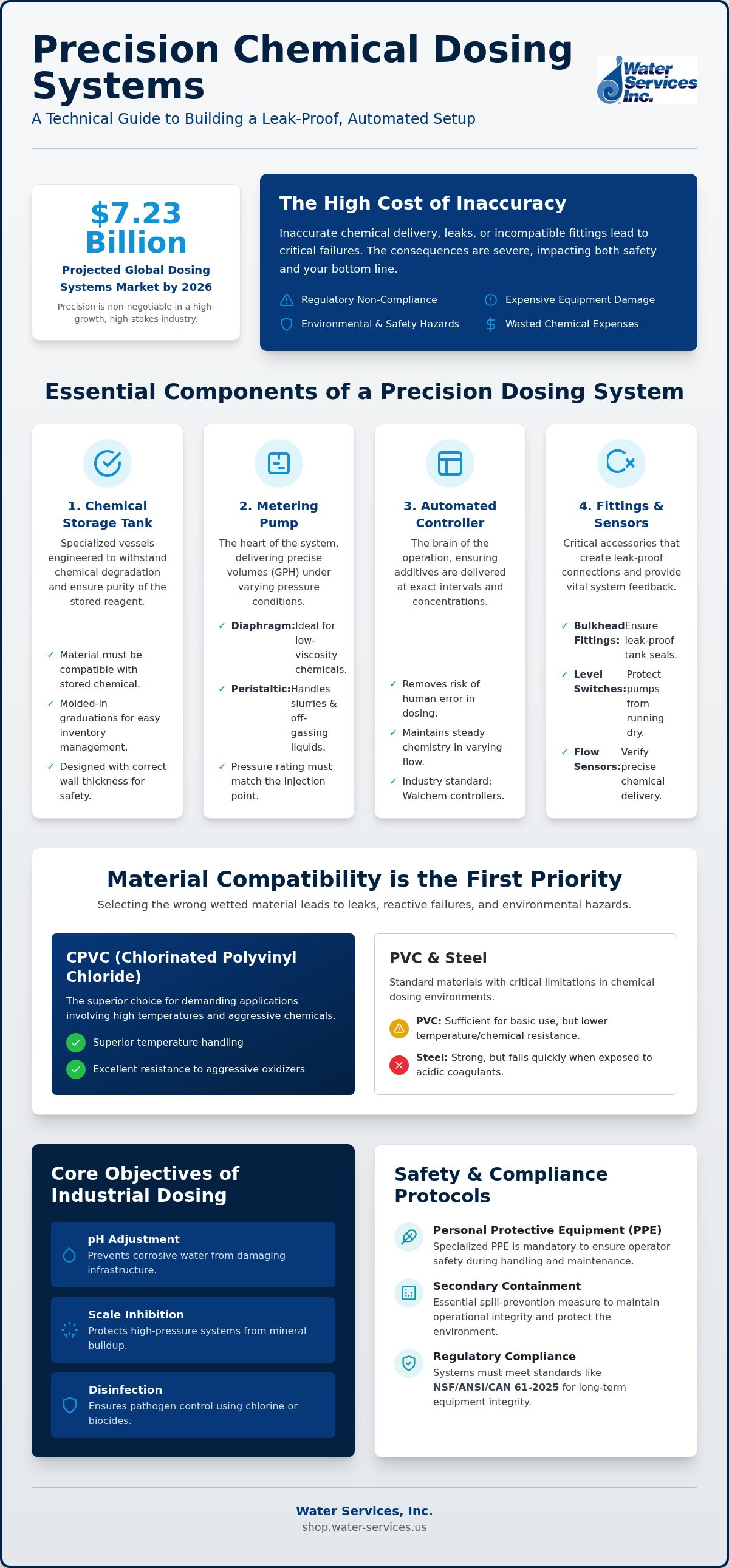
The global dosing systems market is projected to reach $7.23 billion in 2026, yet a single corroded fitting can still shut down an entire industrial facility. You likely understand that maintaining a reliable chemical dosing system for water treatment is a high-stakes balancing act where precision is non-negotiable. It's frustrating when inaccurate delivery, chemical leaks, or incompatible fittings lead to regulatory non-compliance and expensive equipment damage.
This guide provides the technical roadmap to build a leak-proof, automated setup using industrial-grade components like Pulsafeeder metering pumps and Walchem controllers. You'll learn how to select high-performance storage tanks, integrate precise Signet flow sensors, and ensure your system meets the updated NSF/ANSI/CAN 61-2025 standards. We focus on durability in harsh environments, moving from basic tank selection to advanced automated controls. By the end, you'll have the specifications needed to secure long-term equipment integrity and precise chemical delivery for your facility.
Key Takeaways
- Configure an automated chemical dosing system for water treatment to achieve precise injection rates and meet 2026 regulatory compliance standards.
- Specify high-performance components such as Pulsafeeder metering pumps and Walchem controllers to ensure consistent chemical delivery and process automation.
- Evaluate chemical storage tank requirements by focusing on material compatibility and the thermal advantages of CPVC over standard PVC for aggressive liquids.
- Integrate liquid level switches and bulkhead fittings to establish leak-proof connections and protect pumps from damage caused by low-level conditions.
- Implement mandatory safety protocols, including secondary containment and the use of specialized PPE, to maintain operational integrity and operator safety.
What is a Chemical Dosing System for Water Treatment?
A chemical dosing system for water treatment is an automated assembly engineered to inject precise volumes of liquid chemicals into a process stream. These systems ensure that additives like coagulants, disinfectants, or antiscalants reach the water at exact intervals and concentrations. Understanding what dosing means in an industrial environment is critical for maintaining water quality and operational safety. Automation removes the risk of human error. It provides a steady baseline for complex water chemistry management across varying flow conditions.
Reliability is the primary metric for these systems. In industries like mining, municipal water treatment, and industrial process water, precise delivery is mandatory for regulatory compliance. Inaccurate dosing doesn't just waste expensive chemicals. It leads to catastrophic equipment failure. For example, failing to maintain correct antiscalant levels can permanently foul expensive FilmTec or Hydranautics reverse osmosis membranes. A robust chemical dosing system for water treatment preserves downstream assets and prevents the internal corrosion of distribution piping.
The Core Objectives of Industrial Dosing
Industrial dosing serves three primary functions. First, pH adjustment prevents corrosive water from leaching metals or damaging infrastructure. Second, scale inhibition is vital for high-pressure reverse osmosis systems where mineral buildup can choke flow. Third, disinfection using chlorine or specialized biocides ensures pathogen control. Each objective requires a specific metering pump configuration to handle different viscosities and flow rates. These systems must operate continuously in demanding commercial environments without losing calibration. High precision prevents chemical waste, which reduces annual operating expenses and environmental impact.
Why Material Compatibility is the First Priority
System longevity depends on the chemical resistance of every wetted part. Standard PVC is often sufficient for basic applications, but CPVC provides superior temperature handling and resistance to aggressive oxidizers. Steel might offer structural strength but fails quickly when exposed to acidic coagulants. Selecting the wrong material leads to reactive failures, leaks, and environmental hazards. In the context of industrial storage tanks, chemical compatibility is defined as the ability of a material to remain physically and chemically unchanged while in direct contact with a specific substance over a defined temperature range. Proper selection ensures the tank wall and fittings don't degrade or contaminate the stored chemical. This evaluation must extend to seals, gaskets, and bulkhead fittings to prevent point-of-failure leaks.
Essential Components of a Precision Dosing Setup
Building a high-performance chemical dosing system for water treatment requires a modular approach where every component is selected for chemical compatibility and mechanical endurance. The system relies on four primary pillars: metering pumps, storage tanks, controllers, and safety interlocks. These elements must work in synchronization to maintain consistent water chemistry and protect downstream infrastructure. If one component fails, the entire process loses its precision, leading to chemical waste or equipment damage.
Selecting Metering Pumps for Accuracy
The metering pump is the heart of the dosing cycle. Pulsafeeder technology is the industry standard for delivering precise gallons per hour (GPH) under varying pressure conditions. Diaphragm pumps are ideal for clean, low-viscosity chemicals, while peristaltic pumps handle abrasive slurries or off-gassing liquids like sodium hypochlorite without vapor locking. For large-scale industrial movement, integrating these with Goulds Water Technology Pumps ensures efficient fluid transfer across the facility. You must match the pump's pressure rating to the injection point to prevent backflow and ensure accurate delivery.
Chemical storage tanks serve as the reservoir for aggressive additives. These aren't standard water containers. They're specialized vessels engineered to withstand chemical degradation. When designing your layout, consulting a recognized design standard for chemical dosing systems helps determine the correct wall thickness and material for your specific reagent. You can browse specialized industrial tanks to find configurations that include molded-in graduations for easy inventory management.
Automation with Industrial Controllers
Precision is impossible without automation. Walchem Controllers act as the brain of the system, processing inputs from pH, ORP, and conductivity sensors in real time. These units create a closed-loop system that adjusts pump speeds based on actual water quality metrics rather than static timers. This level of control is essential for mining operations or remote military sites where site visits are infrequent. Modern controllers offer remote monitoring capabilities, allowing operators to track performance and receive alerts on mobile devices. This connectivity ensures that any deviation from the setpoint is corrected before it impacts the process.
Safety interlocks provide the final layer of protection. High-pressure level switches and flow sensors prevent the metering pump from running dry, which can cause mechanical failure in minutes. Conversely, high-level alarms prevent tank overfills that lead to hazardous spills and environmental non-compliance. These interlocks are mandatory for any professional chemical dosing system for water treatment designed for long-term reliability.
Buying Guide: Choosing the Right Chemical Dosing Tank
Selecting the correct vessel for a chemical dosing system for water treatment involves more than just calculating volume requirements. You must evaluate the chemical's reactivity, temperature, and the physical installation site. Tanks range from compact 5-gallon units for specialized field use to large-scale industrial reservoirs designed for continuous process integration. Structural design also plays a role. Flat-bottom tanks provide a stable base for easy floor mounting; conversely, curved or conical-bottom tanks are superior for managing sediment and ensuring complete drainage of expensive reagents.
Standard vs. Specialized Tank Applications
Specific operational environments dictate tank features. For wildland firefighting, the 5-Gallon Tank Fire Pump (approx. $190.99) serves as a complete mobile solution, equipped with a rubber hose and heavy-duty shoulder straps for portability. In contrast, heavy-duty industrial process tanks are essential for storing antiscalants and coagulants within larger Industrial Water Treatment Systems. These setups often require integration with containerized RO plants or mobile ultrafiltration systems where space is limited and vibration resistance is mandatory. Choosing a tank with molded-in graduations allows for quick visual inventory checks without opening the vessel, which maintains the integrity of the chemical environment.
Tank Material Matrix
Material selection determines the long-term durability of the dosing setup. PVC bulkhead flanges are the standard choice for most water treatment chemicals, providing reliable resistance in both flat and curved tank configurations. If your process involves higher temperatures or more aggressive oxidizers, CPVC is the necessary upgrade. Utilizing a specific Bulkhead Tank Fitting (2 inch, Socket x FPT) in CPVC ensures that your connection points don't become the weakest link in the system. For specialized industrial cleaning or rinse applications, an 11-gallon powder-coated steel tank offers the structural integrity required for high-pressure environments; you can find out more about the specialized hygiene solutions offered by Serenity Chemicals Limited for such demanding setups. Always cross-reference your chemical's safety data sheet (SDS) with the manufacturer’s compatibility chart before finalizing your selection. This precision prevents reactive failures and protects the integrity of your dosing pumps and controllers.
Tank Accessories: Fittings, Switches, and Level Control
Accessories are the mechanical interface between the chemical reservoir and the distribution network. Without secure fittings and accurate sensors, even the most advanced chemical dosing system for water treatment remains vulnerable to environmental leaks and pump burnout. These components ensure that the chemical remains contained while providing the process controller with the data required for safe operation. Every penetration in the tank wall represents a potential point of failure if not engineered correctly.
Level Switching and Pump Protection
Active level management is the primary defense against dry-run conditions. For standard applications, "Close on Rise" switches provide simple high-level alerts. However, complex industrial setups often require selectable switch functions to manage both refill cycles and emergency shut-offs. In high-pressure environments, such as those found in mining or boiler feed systems, selecting an SPDT Tank Liquid Level Switch rated for 300 psi is mandatory. These switches utilize Double Pole Single Throw (DPST) or Single Pole Double Throw (SPDT) configurations to trigger alarms or cut power to the metering pump. Top-mounted switches are preferred for ease of maintenance, whereas side-mounted switches allow for precise level detection in low-profile tanks.
Fittings and Flanges for Secure Integration
Bulkhead fittings create the leak-proof penetrations necessary for suction, return, and vent lines. For standard water treatment chemicals, 1-inch PVC Bulkhead Tank Flanges equipped with EPDM gaskets provide a reliable seal. When handling aggressive oxidizers or high-temperature fluids, you must switch to CPVC fittings paired with FKM (Viton) gaskets to prevent material degradation. The fitting size must match the metering pump suction line exactly to prevent cavitation or flow restriction. Properly installed flanges eliminate the stress points that lead to tank wall cracking over time. A secure connection at the tank wall preserves the integrity of the entire suction assembly.
System health monitoring extends beyond level control. Integrating Ashcroft pressure gauges at the pump discharge allows operators to identify line blockages or diaphragm failures instantly. For auxiliary systems, maintaining a stock of tank-to-bowl gaskets and replacement levers ensures that secondary components don't cause unexpected downtime. These small components represent a minor fraction of the system cost but are the leading cause of operational failure when overlooked. You can source industrial tank accessories and fittings to complete your dosing assembly and ensure long-term durability in harsh environments.
Safety and Compliance in Chemical Dosing
Safety protocols and regulatory alignment ensure the operational longevity of a chemical dosing system for water treatment. Compliance isn't a suggestion; it's a requirement to avoid environmental fines and workplace injuries. Secondary containment represents the primary line of defense against primary tank failure. Utilizing double-wall tanks or containment basins ensures that leaks are captured before they reach facility drains or soil. This is particularly critical under the updated Clean Water Act Section 401 requirements, where water quality certification standards have become more stringent for industrial discharge.
Managing Chemical Hazards
Dosing areas require clear labeling and accessible Safety Data Sheets (SDS) for every reagent. Off-gassing chemicals like sodium hypochlorite require dedicated ventilation systems to prevent the buildup of hazardous vapors in confined spaces. Operators must utilize mandatory Personal Protective Equipment (PPE), including chemical-resistant gloves, face shields, and aprons, during every refill or maintenance cycle. For best practices in reagent management and industrial selection, see our guide on Water Treatment Chemicals Distributor procedures. These steps ensure that your facility remains in compliance with the latest EPA initiatives regarding PFAS regulation and hazardous material reporting.
Immediate response capabilities are essential for managing spills. Keeping Drum Putty (1 lb) on hand allows for the immediate sealing of fuel or chemical tank punctures. This specialized putty provides a temporary seal that buys time for a controlled transfer of the remaining liquid to a backup vessel. It's a low-cost, high-value addition to any industrial emergency response kit.
System Commissioning and Maintenance
System commissioning involves more than turning on the power. You must perform routine calibration of metering pumps to verify that the GPH output matches the controller setpoint. Over-dosing leads to chemical waste; under-dosing risks process failure and membrane fouling. Inspect all bulkhead fittings and gaskets quarterly for signs of embrittlement or stress cracking. This is especially important for systems handling aggressive oxidizers that can degrade standard elastomers. All components must meet the NSF/ANSI/CAN 61-2025 standard for drinking water system components to ensure no harmful substances leach into the process stream. Proper maintenance preserves the accuracy of your chemical dosing system for water treatment and prevents expensive environmental remediation costs.
Final Step: Browse our complete collection of Industrial Chemical Tanks to find the right fit for your facility.
Optimizing Your Industrial Water Treatment Infrastructure
Achieving a reliable chemical dosing system for water treatment requires a focus on component synchronization and material integrity. Selecting authorized Pulsafeeder pumps and Walchem controllers ensures long-term calibration accuracy and process automation. You must prioritize heavy-duty PVC or CPVC fittings to maintain leak-proof connections in demanding environments. Integrating these components with specialized storage tanks and secondary containment systems is the only way to ensure both operational efficiency and regulatory compliance.
Water Services, Inc. leverages global industrial engineering expertise to provide these specialized water treatment solutions. As an authorized distributor for Pulsafeeder and Walchem, we supply the precision hardware required for complex dosing applications in mining, military, and municipal sectors. To meet the rigorous demands of these environments, sourcing through OEM Materials & Supplies ensures access to critical industrial and mil-spec materials. Utilizing the correct bulkhead fittings and level sensors protects your downstream equipment from damage and prevents hazardous spills. We provide the technical support and inventory depth needed to build a durable, automated assembly.
Shop Industrial Chemical Tanks and Dosing Components to secure your system's reliability today. With the right hardware and automation in place, you can maintain a safe and efficient water treatment process for years to come.
Frequently Asked Questions
What is the best material for a chemical dosing tank?
The best material is determined by chemical compatibility and operating temperature. Linear Low-Density Polyethylene (LLDPE) is a standard choice for general reagents, but aggressive oxidizers or high-temperature liquids require CPVC or cross-linked polyethylene. Refer to a compatibility chart to ensure the tank material won't degrade. This prevents reactive failures and maintains the integrity of your stored chemicals over long-term industrial use.
How do I calculate the capacity needed for my dosing tank?
Calculate capacity by multiplying your injection rate in gallons per hour (GPH) by the target refill frequency in hours. If your process requires 0.25 GPH and you want a 72-hour refill window, you need an 18-gallon minimum capacity. Incorporate a 20% buffer to ensure the metering pump never runs dry before the next scheduled refill. This calculation keeps your process running continuously without frequent manual intervention.
Can I use a standard water tank for chemical dosing?
Standard water tanks are unsuitable because they aren't engineered for the specific gravity and corrosive nature of industrial reagents. A professional chemical dosing system for water treatment requires heavy-duty vessels with reinforced walls and chemically resistant resins. Using a standard tank leads to structural failure, environmental leaks, and potential regulatory fines. Industrial tanks are specifically rated for the aggressive properties of coagulants, acids, and disinfectants.
What is the difference between a DPST and SPDT level switch?
A Double Pole Single Throw (DPST) switch opens or closes two circuits at once with a single action. Conversely, a Single Pole Double Throw (SPDT) switch features three terminals and can toggle power between two different outputs. This allows you to activate a high-level alarm light while simultaneously deactivating the supply pump. SPDT switches offer superior control for automated safety interlocks in complex industrial environments.
How often should I calibrate my chemical metering pump?
Perform calibration every three to six months to account for mechanical wear and changes in liquid viscosity. You should also recalibrate immediately after changing chemical batches or performing pump maintenance. Consistent calibration maintains the accuracy of your chemical dosing system for water treatment, ensuring you don't over-dose or under-dose your process. This practice protects downstream membranes and reduces the total cost of chemical consumption.
Are bulkhead fittings universal for all chemical tanks?
Bulkhead fittings are not universal and must be selected based on tank geometry and chemical compatibility. Fittings for flat-wall tanks differ from those designed for curved surfaces, which require specific radius gaskets for a leak-proof seal. Additionally, the gasket material must match the chemical's reactivity. Using an EPDM gasket with petroleum-based chemicals, for example, will cause the seal to swell and fail rapidly.
What safety features are required for industrial chemical dosing systems?
Mandatory safety features include secondary containment to capture primary tank leaks and pressure relief valves to prevent line bursts. High-level switches and flow sensors are essential for automated pump protection. Every installation must also provide appropriate PPE and meet local discharge standards. Adhering to the NSF/ANSI/CAN 61-2025 standard ensures that all system components are safe for use in drinking water applications.
0 comments