

Did you know that centrifugal pumps in copper and gold processing circuits often consume up to 28% of a plant's total power? This energy intensity, combined with the relentless abrasive wear from mineral slurries, makes centrifugal pump selection for mining operations one of the most critical decisions for any site manager. You already know that choosing the wrong equipment leads to skyrocketing maintenance costs and unplanned production halts. It's a constant battle to keep circuits running while managing high-head dewatering demands and strict environmental discharge regulations.
This 2026 guide provides the technical framework you need to master pump selection and optimize your mineral processing efficiency. We'll show you how to leverage advanced metallurgy like 27% chrome steel to triple your wear life and reduce your Total Cost of Ownership (TCO). We will analyze the latest ISO 2858 standards, MSHA safety compliance for hazardous environments under the updated 2026 framework, and why Goulds Water Technology Pumps remain the industry benchmark for reliability. By the end of this article, you'll have a clear path to extending your Mean Time Between Failure (MTBF) and ensuring your infrastructure survives the world's harshest industrial environments.
Key Takeaways
- Master the technical criteria for centrifugal pump selection for mining operations to reduce your Total Cost of Ownership and prevent unplanned downtime.
- Learn to calculate Total Dynamic Head and Net Positive Suction Head accurately to avoid cavitation in deep sump applications.
- Identify specific high-chrome alloys and metallurgy required to withstand abrasive mineral slurries and extend equipment lifespan.
- Apply a five-step framework to define fluid characteristics and hydraulic targets for complex mining circuits.
- Understand the integration of Goulds Water Technology pumps within modular water treatment systems for remote site deployment.
Why Centrifugal Pumps are Mission-Critical in Modern Mining
Mine-duty centrifugal pumps are specialized, heavy-duty units engineered to transport abrasive solids and manage high-head dewatering requirements. Unlike standard industrial equipment, these pumps feature reinforced casings and wear-resistant impellers designed for 24/7 operation in harsh environments. Centrifugal pumps function by converting rotational energy into hydrodynamic energy, a process that serves as the heartbeat of both open-pit and underground mines. Proper centrifugal pump selection for mining operations is no longer just about moving volume; it's about maintaining site viability and safety.
In 2026, the industry has transitioned toward higher-efficiency hydraulic designs. This shift is driven by data showing that pumping systems can account for up to 28% of a mineral processing plant's total energy consumption. A single pump failure often results in immediate production circuit halts, leading to significant financial losses and potential safety hazards. High-durability hardware from manufacturers like Goulds Water Technology provides the reliability needed to mitigate these risks.
Mine Dewatering and Groundwater Management
Deep-pit operations rely on high-head capabilities to prevent catastrophic flooding. These pumps must handle massive groundwater influxes that frequently contain suspended solids and abrasive grit. Efficient dewatering maintains the water table at safe levels and ensures that tunnels remain accessible. Selection for these applications focuses on the pump's ability to maintain performance under high pressure while resisting the wear caused by raw, untreated groundwater discharge.
Process Water and Slurry Transport
Processing circuits require the movement of mineral-laden fluids through flotation and separation stages. These high-density mixtures present a unique challenge due to their abrasive nature. Maintaining consistent flow rates is essential for accurate chemical dosing and overall recovery rates. Engineers must select pumps that balance hydraulic efficiency with the structural integrity required to handle high-density slurry without constant maintenance interventions. To sustain this throughput, many facilities also rely on an industrial conveyor belting distributor to ensure the reliable delivery of raw ore into the crushing and mixing stages before it enters the pumping circuit.
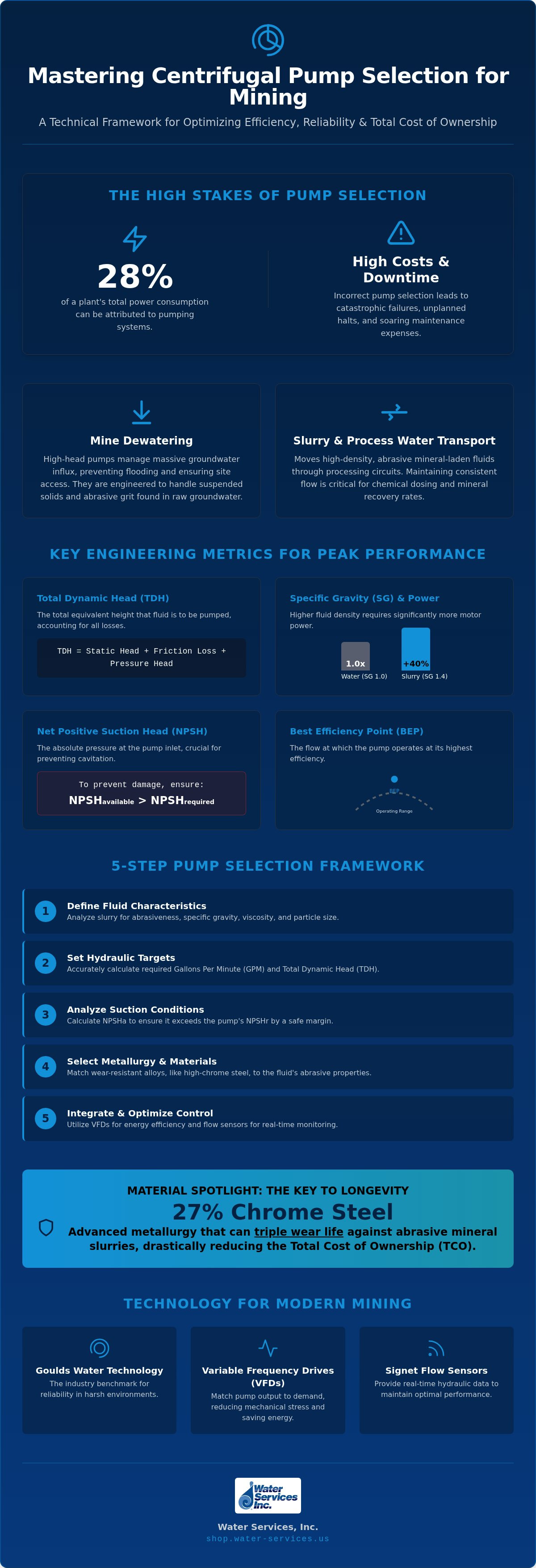
Precision in engineering metrics is the foundation of successful centrifugal pump selection for mining operations. Calculating Total Dynamic Head (TDH) requires summing the static elevation, friction losses, and pressure head across the entire pipe network. In complex mining circuits, friction losses often escalate due to the high viscosity of mineral slurries. Engineers must also account for Specific Gravity (SG), as motor horsepower requirements scale linearly with the density of the fluid. A pump moving a slurry with an SG of 1.4 requires 40% more power than one moving clear water at the same flow rate.
Preventing cavitation is a primary technical objective during the selection process. This requires a detailed analysis of Net Positive Suction Head (NPSH) to ensure the available head (NPSHa) exceeds the pump's required head (NPSHr) by a safe margin. Cavitation causes rapid impeller erosion and catastrophic mechanical seal failure, particularly in deep sump applications. For more technical insights on managing these variables, consult industry resources on Pumping Systems for Mining Site Water Management. Operating at the Best Efficiency Point (BEP) is equally vital; running a pump too far to the left or right of its curve increases radial loads and shortens the lifespan of bearings and shafts.
Hydraulic Performance and Flow Dynamics
Determining the required Gallons Per Minute (GPM) depends on whether the application is for high-volume dewatering or specific process requirements. Pipe friction and elevation changes significantly impact centrifugal performance, especially as mineral deposits grow within the lines. Utilizing Signet flow sensors allows operators to monitor real-time hydraulic output and identify when performance deviates from the design curve. This data is essential for maintaining the velocity needed to keep solids in suspension during slurry transport.
Digital Integration and Process Control
Modern mining operations utilize Variable Frequency Drives (VFDs) to manage fluctuating demand without wasting energy. These drives allow the pump to match the exact requirements of the circuit, reducing mechanical stress. In chemical-heavy circuits, Walchem controllers automate pump cycles based on pH or conductivity triggers, ensuring precise dosing and compliance with environmental regulations. Integrating these digital tools with predictive maintenance sensors for vibration and temperature can reduce downtime by up to 65%. To optimize your specific circuit, you can explore our technical range of Goulds centrifugal pumps designed for industrial integration.
Material Selection: Matching Metallurgy to Mineralogy
Material selection is a critical pivot point in centrifugal pump selection for mining operations. The primary engineering challenge involves balancing mechanical abrasion resistance with chemical corrosion protection. While standard cast iron suffices for clear water transport, mining environments demand specialized metallurgy to survive constant bombardment from mineral solids. High-chrome alloys, specifically those with chrome levels exceeding 25%, provide the hardness required for severe slurry duties. Understanding Fundamental Engineering Metrics for Pump Selection allows engineers to predict wear patterns based on fluid velocity and particle impingement angles.
Effective mining wastewater treatment solutions often require pumps that can handle both abrasive silt and corrosive reagents. In these circuits, the selection of internal components directly dictates the Mean Time Between Failure (MTBF). Using high-durability materials ensures that the pump casing and impeller don't degrade prematurely under the combined stress of physical wear and chemical attack. Precise material matching is mandatory for long-term operational stability.
Hard Metal vs. Soft Liner Applications
Hard metal pumps utilizing 27% chrome iron are the preferred choice for mill discharge applications where large, sharp particles are present. These components resist the gouging and high-stress grinding common in primary grinding circuits. Conversely, natural rubber or polyurethane liners offer superior performance for fine, abrasive tailings by absorbing the impact energy of the particles. Metal components are typically selected for slurries containing particles with a Mohs hardness greater than 5, while elastomer liners are reserved for softer or finer solids. Natural rubber provides excellent resilience against sharp-edged fine particles but fails quickly when exposed to oils or high temperatures.
Chemical Resistance in Process Circuits
Acidic mine drainage (AMD) environments necessitate materials that resist low pH levels, such as duplex stainless steels or specialized fluoroplastic linings. Low pH environments act as a catalyst for galvanic corrosion, which can destroy a standard pump in weeks. Corrosion can thin pump walls and pit impellers, leading to a rapid loss of hydraulic efficiency. It's essential to select materials compatible with the specific water treatment chemicals used in the circuit to prevent premature seal degradation. Proper material matching prevents the chemical reagents from compromising the structural integrity of the pump's wetted parts. This stage of centrifugal pump selection for mining operations ensures reliability in remote, chemical-heavy processing circuits.
A 5-Step Framework for Mining Pump Selection
Successful centrifugal pump selection for mining operations follows a logical, data-driven workflow. Skipping any step in this engineering framework increases the risk of premature component failure and costly production halts. Operators must prioritize technical specifications over initial purchase price to ensure long-term circuit stability.
Step 1: Define the fluid characteristics. You must document the percentage of solids by volume, specific gravity (SG), pH levels, and operating temperature. These variables dictate the base material requirements and seal selection. Step 2: Determine hydraulic requirements. Establish your flow targets in Gallons Per Minute (GPM) and calculate the Total Dynamic Head (TDH). This includes accounting for elevation changes and friction losses in high-viscosity slurry lines. Step 3: Select the pump configuration. Orientation is determined by the physical constraints of the installation site, such as sump depth or floor space in a processing plant. Step 4: Match the metallurgy to the ore type. Use the mineral hardness and acidity data to select between high-chrome alloys or elastomer liners to resist abrasive wear. Step 5: Evaluate the Total Cost of Ownership (TCO). Focus on energy efficiency and wear life. Since pumps can account for up to 28% of a plant's power consumption, a more efficient hydraulic design pays for itself through reduced utility costs and extended Mean Time Between Failure (MTBF).
Evaluating Pump Configuration and Orientation
Horizontal end-suction pumps are the standard for processing plants due to their ease of maintenance and robust bearing frames. These units allow for quick inspections and parts replacement without disturbing the piping. Vertical turbine pumps are better suited for high-head dewatering from deep shafts where floor space is limited. For sumps where priming is a consistent issue or where the water level fluctuates rapidly, submersible units provide a reliable solution by eliminating suction lift challenges and the risk of running dry.
Remote Site Logistics and Serviceability
In remote mining environments, the availability of spare parts is as important as the pump's initial performance. Selecting Goulds Water Technology Pumps ensures access to a global distribution network, which is critical for minimizing downtime. Engineers should prioritize designs with "back pull-out" capabilities. This feature allows the removal of the rotating element for seal or impeller changes without disconnecting the motor or the suction and discharge piping. Maintenance teams must also be equipped with appropriate PPE when servicing equipment in hazardous mine zones or handling pumps used in chemical dosing circuits. You can view our full inventory of mine-ready pumping hardware to find the right configuration for your specific site logistics.
Optimizing Mining Water Circuits with Goulds Technology
Goulds Water Technology has established itself as the gold standard for industrial water treatment systems within the global mining sector. High-durability centrifugal hardware is essential when integrating treatment stages directly into active mineral processing circuits. Effective centrifugal pump selection for mining operations ensures that secondary water loops, such as those used for gland seal water or reagent mixing, operate with the same reliability as the primary slurry lines. Goulds pumps provide the hydraulic precision required to maintain these sensitive balances while resisting the ambient dust and vibration typical of mine sites.
Water Services, Inc. bridges the gap between simple hardware procurement and complex technical design. As an authorized distributor of Goulds Water Technology Pumps, we provide the engineering expertise needed to deploy containerized reverse osmosis (RO) and ultrafiltration (UF) plants in remote environments. These modular units require pumps that can handle high-pressure feed requirements while maintaining a compact footprint. Our technical team evaluates the entire circuit to ensure that the pump's metallurgy and seal configuration match the specific chemical profile of the mine's wastewater, preventing premature failure in resource recovery stages.
Pumps in Modular Treatment Systems
Booster pumps play a critical role in containerized RO systems by providing the necessary osmotic pressure to overcome high TDS (Total Dissolved Solids) levels in mine drainage. Managing feed water pressure is vital for the longevity of downstream industrial water filtration systems. If pressure fluctuates, it can cause membrane fouling or bypass. We utilize compact centrifugal designs for space-constrained mobile units, ensuring that every square inch of a containerized plant is optimized for performance. These systems are engineered for rapid deployment, allowing mines to scale their water treatment capacity as pit depths or processing volumes increase.
The Water Services Advantage
Our global reach extends from our headquarters in Provo, Utah, to remote mining operations across Africa and South America. Since 1994, we've provided over 30 years of infrastructure experience to the industrial sector, specializing in the logistical challenges of remote site deployment. We don't just sell hardware; we offer technical consulting for complex mining wastewater compliance and resource recovery projects. Operators gain direct access to our complete pump collection for rapid replacement, ensuring that critical spares are always available to minimize downtime. This combination of Goulds' engineering excellence and our logistical competence provides a stable foundation for any mining water circuit.
Securing Long-Term Performance in Mining Circuits
Strategic centrifugal pump selection for mining operations requires a rigorous focus on hydraulic precision and material compatibility. By prioritizing high-chrome alloys and digital process controls, operators can mitigate the high energy costs and maintenance downtime typical of abrasive processing circuits. Success in 2026 depends on shifting from initial purchase price to a Total Cost of Ownership model that accounts for every kilowatt and hour of uptime.
Water Services, Inc. provides the engineering expertise to bridge the gap between hardware procurement and site-specific performance. As an authorized Goulds distributor, we specialize in high-purity industrial solutions and custom engineering for global mining sites. Our logistical capabilities ensure that your infrastructure remains resilient, whether you're managing deep-pit dewatering or complex mineral recovery loops. We're ready to support your next project with technical precision and industrial-grade reliability.
Browse our Goulds Water Technology Pump collection for your mining operation.
Frequently Asked Questions
How do I choose between a horizontal and vertical centrifugal pump for mine dewatering?
Horizontal centrifugal pumps are the preferred choice for surface processing plants because they offer easier maintenance access and a simpler installation process. Vertical turbine pumps are more effective for dewatering deep shafts where floor space is limited or where the pump must be submerged in a sump. The decision depends on the available installation footprint and the required suction lift. Horizontal units utilize a back pull-out design to minimize downtime during service.
What is the best impeller material for handling highly abrasive gold mine tailings?
High-chrome white iron, specifically alloys with 25% to 27% chromium, is the most durable material for handling abrasive gold mine tailings. This metallurgy provides the necessary hardness to resist the gouging wear caused by angular mineral particles. While rubber liners are effective for fine solids, hard-metal impellers are required for the higher impact velocities found in primary mill discharge and tailings transport circuits. This material choice significantly extends the component lifespan.
Can centrifugal pumps handle air entrainment in mining sumps?
Standard centrifugal pumps do not handle air entrainment well and can suffer from air binding or a complete loss of prime. In mining sumps where froth or air is common, specialized recessed impellers or inducer-type designs are necessary to move the fluid. Proper centrifugal pump selection for mining operations must account for the presence of air to prevent erratic flow and mechanical damage to the seal and bearings caused by dry running.
How does slurry density affect the motor size needed for a centrifugal pump?
Slurry density has a direct, linear impact on the motor horsepower required for a centrifugal pump. As the specific gravity of the fluid increases, the weight of the material being moved also increases; this requires more torque from the motor. A slurry with a specific gravity of 1.5 requires 50% more power than clear water at the same flow rate. Failure to size the motor for the maximum expected density leads to frequent electrical tripping.
What are the benefits of using Goulds Water Technology pumps in remote mining locations?
Goulds Water Technology pumps offer a global distribution network that ensures spare parts are available in remote mining regions like Africa and South America. This accessibility is critical for minimizing downtime in isolated operations. Water Services, Inc. provides authorized technical support and engineering design to ensure these pumps are correctly integrated into modular treatment plants. Their reputation for industrial reliability makes them the benchmark for remote site infrastructure and high-purity water management.
How often should mining pump seals be inspected to prevent unplanned downtime?
Mining pump seals should undergo visual inspections weekly, with a more detailed technical assessment performed every month. In abrasive slurry duties, seal life is significantly shorter than in clear water applications. Utilizing vibration and temperature sensors can help transition to a predictive maintenance schedule. Early detection of seal leakage prevents the fluid from reaching the bearing frame; this avoids catastrophic failure and the high costs associated with complete pump overhauls.
What role does a VFD play in improving the efficiency of a mining pump?
A Variable Frequency Drive allows a mining pump to adjust its rotational speed to match real-time demand rather than running at a fixed maximum. This optimization improves centrifugal pump selection for mining operations by reducing energy consumption and mechanical wear. By operating closer to the Best Efficiency Point during fluctuating dewatering cycles, the VFD extends the lifespan of the impeller and mechanical seals. This leads to a lower total cost of ownership.
Is it better to repair or replace a worn centrifugal pump casing in a mining environment?
Replacing a worn centrifugal pump casing is usually more cost-effective than attempting a repair in a high-pressure mining environment. While some surface pitting can be patched with ceramic epoxies, structural thinning compromises the pressure rating of the unit. A failure in a thinned casing can cause hazardous spray or flooding in the plant. Standard practice in modern mines is to maintain a stock of replacement casings to ensure an immediate return to service.
0 comments