

In 2026, relying on passive wetlands for high-flow discharge is no longer just a technical risk; it's a regulatory liability that invites escalating fines under EPA 40 CFR Part 434. While passive systems have historically managed legacy sites, modern mining demands more precision. Deciding between active vs passive acid mine drainage treatment requires a cold analysis of flow rates, metal loading, and the total cost of ownership. You're likely struggling with managing sludge volume and disposal costs while trying to prevent system failure in remote, high-flow environments where logistics are difficult and discharge standards are non-negotiable.
We understand that achieving guaranteed discharge compliance shouldn't mean sacrificing your operational footprint. This engineering guide provides a technical comparison of active and passive AMD treatment strategies to help your operation achieve regulatory compliance and long-term cost-efficiency. We'll examine the scalability of modular HDS systems, the role of durable Goulds pumps in low-pH environments, and how to reduce your treatment infrastructure footprint. By evaluating these technical metrics, you can transition from viewing AMD as a liability to a streamlined component of your production cycle that scales effectively with your mine production.
Key Takeaways
- Align your treatment strategy with 2026 EPA effluent guidelines (40 CFR Part 440) to guarantee discharge compliance and avoid escalating regulatory fines.
- Compare the operational limits of active vs passive acid mine drainage treatment, identifying why active HDS systems are required for high-flow environments exceeding 1,000 GPM.
- Specify durable hardware like Goulds pumps and Walchem controllers to maintain system integrity in low-pH, corrosive mining environments.
- Utilize modular, containerized reverse osmosis and mobile ultrafiltration plants to reduce footprint and simplify logistics at remote mine locations.
- Implement precise de-carbonation and mechanical aeration steps to optimize reagent consumption and minimize total sludge disposal costs.
The Chemistry and Regulatory Pressure of Acid Mine Drainage
Acid Mine Drainage (AMD) is the acidic, metal-rich outflow generated from disturbed sulfide-bearing minerals. The primary driver of this phenomenon is the oxidation of pyrite (FeS2). When mine operations expose these minerals to air and water, a chemical reaction occurs that produces sulfuric acid and dissolved iron. This process lowers the pH of the water, which then leaches other contaminants from the surrounding rock. Understanding The Chemistry and Regulatory Pressure of Acid Mine Drainage is the first step in evaluating the efficiency of active vs passive acid mine drainage treatment for modern site management.
The resulting discharge typically contains high concentrations of iron, aluminum, and manganese, along with toxic trace metals like arsenic and cadmium. By 2026, regulatory enforcement has moved closer to Zero Liquid Discharge (ZLD) goals for industrial sites. Current EPA guidelines under 40 CFR Part 440 mandate strict effluent limits that are difficult to reach without precise chemical intervention. Passive systems often lack the capacity to handle these high metal loads during peak flow events, making active treatment a necessity for many commercial operations.
The Role of Bio-Leaching in Acid Formation
Bio-leaching is the process where specific microorganisms, such as Acidithiobacillus ferrooxidans, catalyze and accelerate the oxidation of sulfide minerals. These bacteria thrive in low-pH environments and can increase acid production rates by several orders of magnitude compared to abiotic oxidation alone. This biological acceleration makes passive-only treatment difficult for high-load sites because the natural neutralization capacity of wetlands is quickly overwhelmed. Active systems use mechanical aeration and chemical dosing to counteract this rapid acid generation at the source.
Regulatory Drivers for Active Treatment
Modern compliance requires a shift toward more reliable Mining Wastewater Treatment Solutions that guarantee specific effluent quality. In 2026, effluent limits for iron and manganese have become more stringent, requiring treatment systems that can adapt to fluctuating water chemistry. The financial risk of non-compliance is substantial. Regulatory fines and potential site closures often cost significantly more than the capital investment required for an active High-Density Sludge (HDS) plant. When comparing active vs passive acid mine drainage treatment, the ability of active systems to provide real-time telemetry and automated dosing ensures a level of reliability that passive systems cannot match in high-risk environments.
Active Treatment: The High-Density Sludge (HDS) Process
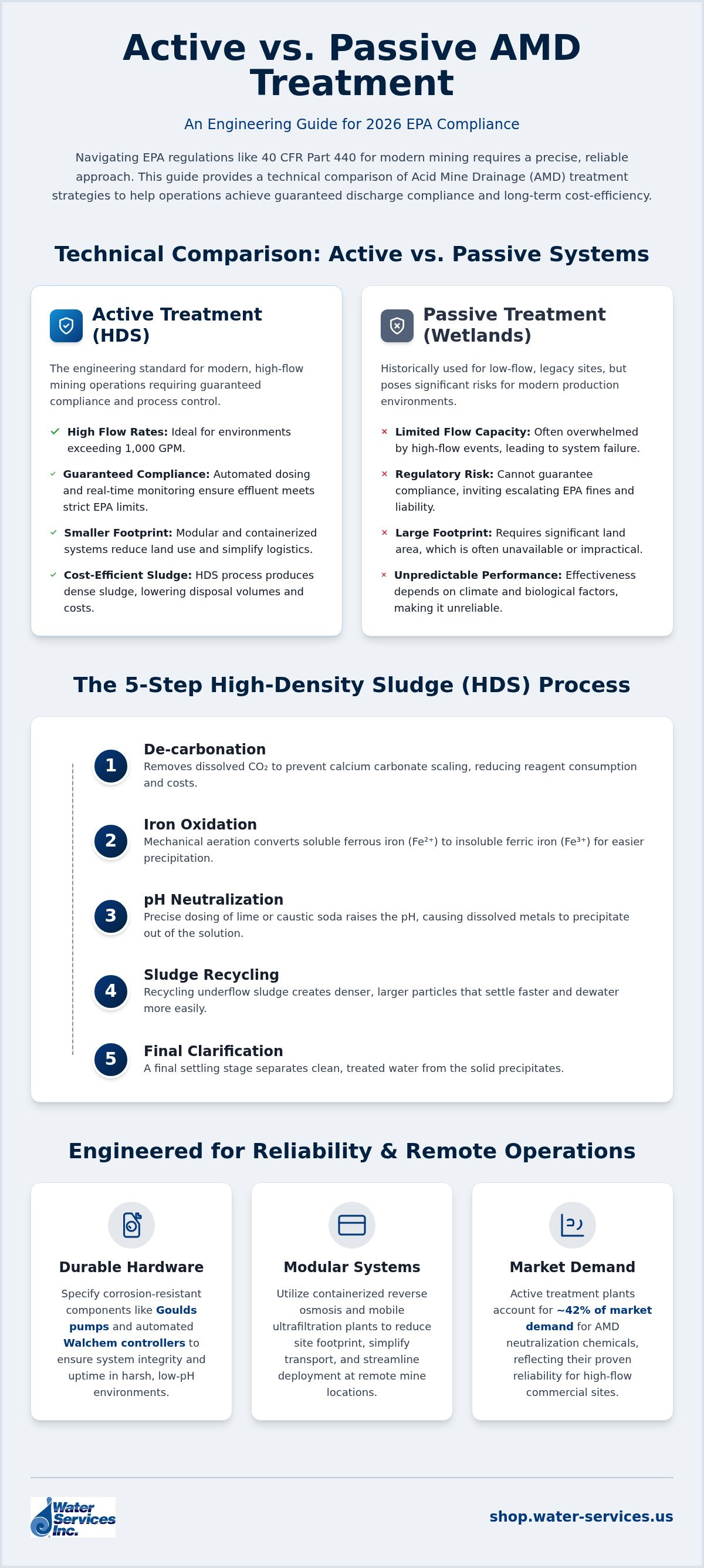
Active treatment systems, specifically the High-Density Sludge (HDS) process, provide the technical precision required to meet 2026 discharge standards. In 2026, active treatment plants account for approximately 42.0% of the market demand for AMD neutralization chemicals, reflecting their reliability for high-flow sites. While some operators evaluate the Passive Treatment of Acid-Mine Drainage for low-flow legacy environments, active HDS is the engineering standard for modern production. This multi-stage process converts dissolved metals into stable, solid precipitates through controlled chemical reactions.
The HDS flowsheet follows five critical steps to ensure effluent quality:
- De-carbonation: Removing dissolved CO2 prevents the formation of calcium carbonate, which otherwise consumes excess lime reagents and increases costs.
- Iron Oxidation: Mechanical aeration or diffused air systems convert ferrous iron (Fe2+) to ferric iron (Fe3+), allowing it to precipitate at lower pH levels.
- pH Neutralization: Precise dosing of lime or caustic soda raises the water pH to the target setpoint for specific metal precipitation.
- Sludge Recycling: This is the core of the HDS process. Recycling a portion of the underflow sludge back into the lime-mix tank creates larger, denser particles.
- Final Clarification: A settling stage separates treated water from the solids, followed by polishing filters if required for ZLD goals.
When comparing active vs passive acid mine drainage treatment, the primary advantage of the HDS process is its ability to handle fluctuating influent chemistry and high flow rates that would overwhelm a natural wetland.
Maximizing Reagent Efficiency in Active Systems
Precision in chemical application is mandatory for operational cost-efficiency. Stoichiometric dosing ensures you only use the exact amount of reagent required by the current acidity load, preventing waste. Using automated Walchem controllers and Pulsafeeder metering pumps allows for real-time adjustments based on sensor feedback. High-quality flocculants are then added to accelerate the settling of heavy metals in the final clarifier. Sludge recycling reduces waste volume by up to 90% compared to conventional low-density sludge systems, which significantly lowers long-term disposal costs.
Oxidation Strategies for Difficult Metals
Removing manganese presents a technical hurdle because it often requires a pH level of 9.0 or higher for effective precipitation. Engineers must decide between mechanical aeration and chemical oxidation using permanganate or hydrogen peroxide. Integrating high-performance Goulds water technology pumps ensures the system can handle the abrasive, corrosive nature of metal-rich sludge without frequent mechanical failure. Proper hardware selection prevents the system downtime that often leads to discharge non-compliance. For sites with complex chemistry, choosing the right industrial pumping hardware is critical for maintaining consistent process flow.
Active vs. Passive Treatment: Technical Comparison
Selecting the right remediation strategy requires a rigorous assessment of site-specific data. When evaluating active vs passive acid mine drainage treatment, flow rate capacity is often the primary deciding factor. Active systems are engineered to handle high-volume discharges exceeding 1,000 GPM with consistent efficiency. In contrast, passive systems are typically restricted to lower hydraulic loads and can fail under sudden surges. While passive systems offer lower OPEX because they don't require daily chemical reagents, they demand a massive land footprint. Active systems are compact and modular; this makes them ideal for sites where topography or property boundaries limit construction. Reliability also differs significantly. Active plants provide guaranteed effluent quality regardless of weather, while passive systems are sensitive to temperature drops and heavy rainfall events that can flush untreated metals into the environment.
The financial comparison involves balancing CAPEX and OPEX over the life of the mine. Passive systems often have higher initial construction costs due to the earthmoving and land acquisition required for large-scale wetlands. Active systems have lower initial build costs when using modular designs but require ongoing investment in reagents and electricity. For operations focused on long-term stability, the ability to scale an active system as mine production grows provides a distinct logistical advantage.
When to Choose Passive Remediation
Passive remediation remains a viable choice for abandoned mine lands or low-flow seeps where long-term management is necessary without daily active oversight. Technologies like anoxic limestone drains (ALDs) and constructed wetlands work well for legacy sites with consistent, low-volume chemistry. However, these systems face significant challenges in 2026. The most common failure mode is "plugging," where metal hydroxides precipitate within the stone beds, reducing permeability and causing system bypass. Operators must account for the eventual cost of excavating and replacing these media beds, which often occurs every 15 to 25 years depending on the metal loading.
The Rise of Hybrid AMD Treatment Models
A significant trend in 2026 is the adoption of hybrid models that leverage the strengths of both approaches. This strategy uses active treatment for primary neutralization and heavy metal removal, followed by a passive polishing stage for final TDS reduction and ecosystem integration. This dual approach ensures compliance during high-flow periods while reducing overall reagent consumption during periods of stability. Site-specific factors like available topography and net acidity determine the exact balance of the flowsheet. For operations requiring precise chemical dosing within these hybrid frameworks, integrating modular water treatment components allows the system to scale alongside production. Maintaining mechanical uptime in these systems requires industrial-grade Goulds water technology pumps, which are built to withstand the abrasive nature of metal-rich mine water.
Engineering the System: Hardware and Process Control
The technical reliability of active vs passive acid mine drainage treatment is ultimately determined by the hardware ecosystem. While passive systems rely on geological media and gravity, active treatment requires industrial-grade mechanical components to withstand corrosive environments. Pumping AMD with a pH as low as 2.5 requires specific metallurgy, such as CD4MCu or duplex stainless steel, to prevent premature casing failure. Process control is equally critical. In 2026, 40 CFR Part 440 compliance requires precise discharge reporting, which is only possible through integrated flow monitoring and real-time telemetry. Automated systems eliminate the human error associated with manual dosing, ensuring that effluent remains within permit limits even during sudden flow surges or chemistry shifts.
Industrial Pumping with Goulds Water Technology
For mining wastewater applications, Goulds Water Technology Pumps are the industry standard due to their durability in abrasive, low-pH conditions. Selecting the correct pump configuration depends on the site's hydraulic profile. Vertical turbine pumps are typically utilized for deep sumps or pit dewatering where high head pressure is required. Submersible sewage and solids-handling pumps are preferred for transferring high-density sludge (HDS) within the treatment plant. Maintenance protocols must prioritize seal integrity and impeller wear. Handling high-solids sludge requires regular inspections to prevent clogging, as the dense precipitates generated in active systems can be highly abrasive to standard cast iron components.
Precision Dosing with Walchem and Pulsafeeder
Active treatment efficiency relies on the stoichiometric accuracy of chemical delivery. Integrating Walchem Controllers allows for pH-driven dosing that adjusts reagent input in real-time based on influent acidity. These controllers work in tandem with Pulsafeeder metering pumps to ensure that lime or caustic soda is not wasted during periods of lower acid loading. This precision prevents reagent over-consumption, which is a major driver of operational costs. Modern controllers also provide essential data logging capabilities. This digital paper trail is vital for environmental compliance audits, providing proof of consistent treatment performance that passive systems cannot document with the same level of granularity.
Safety remains a priority when managing bulk chemicals in remote mining locations. Operators must utilize specialized personal protective equipment (PPE) and secondary containment systems to prevent accidental exposure or spills. Accurate flow monitoring using Signet sensors and Ashcroft pressure gauges ensures that the entire system operates within its design parameters. If you are looking to upgrade your current infrastructure, browse our full range of industrial water treatment equipment to secure your site's compliance.
Modular and Mobile Solutions for Remote Mine Sites
Deploying permanent water infrastructure at remote mine sites often involves prohibitive civil engineering costs and extended timelines. Modular systems solve this by housing the entire treatment flowsheet within standard shipping containers. When comparing active vs passive acid mine drainage treatment for short-term projects or remote locations, the ability to mobilize equipment quickly is paramount. While passive systems require extensive land preparation and earthworks, containerized active systems can be commissioned within weeks of arrival. This flexibility is vital for operations in regions with extreme climates or limited local labor where traditional construction is unfeasible.
Containerized Reverse Osmosis and Metal Recovery
Mining operations increasingly utilize membrane technology to achieve the stringent discharge limits required in 2026. These Commercial Reverse Osmosis Systems act as a final polishing stage for AMD effluent, removing dissolved solids that chemical precipitation might miss. By integrating FilmTec or Hydranautics membranes, these plants can handle high-mineral water while maintaining high recovery rates. Engineering a 40ft containerized unit requires specialized climate control and insulation to protect sensitive electronics and membrane housings from extreme heat or sub-zero temperatures. This modular approach also facilitates metal recovery, turning a waste stream into a potential revenue source by concentrating valuable minerals for extraction.
Custom Engineering for Global Mining
Water Services, Inc. leverages decades of engineering expertise to design modular mining plants tailored to specific site chemistries. Since our founding in 1994, we've successfully deployed systems in challenging environments across Africa and the Middle East. These global installations demonstrate the reliability of containerized RO and mobile ultrafiltration in remote regions where technical support is sparse. Mobile ultrafiltration systems often serve as essential pre-treatment, protecting downstream membranes from fouling by removing suspended solids and colloidal matter. These units are designed for rapid deployment, ensuring that mine production isn't delayed by water management bottlenecks.
For many operators, the choice between rental and purchase provides essential financial flexibility. Short-term mining projects or sites with fluctuating water volumes benefit from rental units that don't require a long-term capital commitment. You can explore a wider range of hardware options in our Industrial Water Filtration Systems Roundup. This technical oversight ensures that whether you're purchasing a permanent containerized RO plant or renting a mobile unit, the system is engineered for maximum uptime and regulatory compliance. Global support teams provide commissioning and training, ensuring your local staff can maintain the system's performance in any environment.
Optimizing Your 2026 Mine Water Management Strategy
The decision between active vs passive acid mine drainage treatment isn't just a cost comparison; it's a strategic choice for long-term regulatory compliance. While passive systems provide low-energy solutions for legacy seeps, the technical precision of High-Density Sludge (HDS) and containerized reverse osmosis plants is necessary for modern high-flow environments. Managing heavy metal loading and sludge volume requires industrial-grade hardware that can withstand corrosive, low-pH conditions. Reliability is non-negotiable for 2026 discharge standards.
Water Services, Inc. has provided custom modular engineering for global mining operations since 1994. As an authorized Goulds and Pulsafeeder distributor, we specialize in commissioning reliable treatment systems for remote regions where logistics are difficult. Our expertise ensures your site meets 40 CFR Part 440 guidelines while maintaining a compact, scalable operational footprint that grows with your production. We understand the rigors of industrial environments and prioritize technical integrity in every system we design.
Request a Technical Consultation for Mining Wastewater Treatment today to evaluate your specific site chemistry and flow requirements. We're committed to helping you transition your AMD management into a streamlined, compliant industrial process.
Frequently Asked Questions
What is the primary difference between active and passive AMD treatment?
Active treatment requires continuous energy and chemical inputs to drive neutralization, whereas passive treatment relies on natural biological and chemical processes within constructed environments. When comparing active vs passive acid mine drainage treatment, the former provides higher precision and scalability for industrial sites. Passive systems are generally better suited for legacy management where flow rates are low and consistent, as they lack the mechanical controls found in active HDS plants.
Which chemicals are most effective for neutralizing acid mine drainage?
Hydrated lime and quicklime are the most common neutralizing agents, expected to constitute 37.2% of the market demand in 2026. These reagents effectively raise pH levels to precipitate dissolved metals. Other options include caustic soda for specific metal removal or magnesium oxide nanoparticles for advanced resource recovery. Active systems utilize Pulsafeeder metering pumps to ensure stoichiometric accuracy, preventing the over-consumption of these chemicals during fluctuating influent conditions.
How does the High-Density Sludge (HDS) process reduce waste volume?
The High-Density Sludge (HDS) process reduces waste volume by recycling a portion of the settled solids back into the neutralization tank. This recycling encourages the precipitation of new metal hydroxides onto existing particles, creating larger and denser solids. This method can reduce sludge volume by up to 90% compared to conventional low-density processes. Lower sludge volume translates directly to reduced disposal costs and a smaller footprint for the necessary storage infrastructure.
Can passive treatment systems meet 2026 EPA discharge limits?
Passive systems struggle to meet the stringent 2026 EPA discharge limits, particularly 40 CFR Part 440, when handling high metal loads or variable flow rates. While they work for low-flow legacy sites, their performance is weather-dependent and prone to media plugging. Active systems are often the only reliable path to guaranteed compliance for modern mining operations. They provide the real-time telemetry and chemical precision required to consistently hit heavy metal discharge targets.
What type of pumps are best for handling corrosive mine water?
Goulds Water Technology Pumps are preferred for handling corrosive mine water due to their durable metallurgy and specialized impeller designs. Selecting between vertical turbine and submersible configurations depends on the site's hydraulic head and solids content. For abrasive, low-pH sludge, pumps must utilize materials like duplex stainless steel to prevent casing failure. Proper pump selection ensures maximum uptime in active vs passive acid mine drainage treatment systems, where mechanical reliability is critical.
Is reverse osmosis effective for treating acid mine drainage?
Reverse osmosis is highly effective as a final polishing stage for acid mine drainage effluent, especially when Zero Liquid Discharge (ZLD) is the goal. Using FilmTec or Hydranautics membranes allows for the removal of dissolved solids that chemical precipitation cannot capture. These systems are often housed in containerized plants to facilitate rapid deployment. Pre-treatment with mobile ultrafiltration is essential to prevent membrane fouling from suspended solids, ensuring the longevity of the RO components.
What are the typical maintenance requirements for an active AMD plant?
Typical maintenance for an active AMD plant includes regular calibration of Walchem controllers and inspection of Pulsafeeder metering pumps. Operators must monitor pump seal integrity and impeller wear caused by abrasive sludge. Sensors for pH and flow require routine cleaning and standardization to ensure discharge reporting accuracy. Unlike passive systems that may only need periodic excavation, active plants require a consistent schedule of mechanical checks and chemical inventory management to prevent unplanned downtime.
How quickly can a modular AMD treatment system be deployed?
Modular AMD treatment systems, such as containerized RO plants, can be deployed and commissioned in weeks rather than months. These units are pre-engineered and tested before shipping, which bypasses the lengthy timelines associated with on-site civil construction. This rapid mobilization is ideal for remote regions or projects with immediate compliance deadlines. Water Services, Inc. specializes in these mobile solutions, providing global support for industrial clients who require fast, reliable water management infrastructure.
0 comments